
Mint pitch deck (2007)
Mint's 2007 Series A deck raised $4.7M by pitching free personal finance software when Quicken still owned the category. Aaron Patzer opened with a full product mockup, not a problem slide, then walked investors through referral economics, partner acquisition costs, and a prescient Intuit exit path. Intuit acquired Mint for $170M in 2009. This teardown covers all 16 slides, including Q&A backup and financial appendix.
What founders can steal from Mint's deck
- Lead with the product when UX is the wedge. Mint's second slide is a dashboard mockup with goals, spending charts, and savings tips, not a problem statement.
- Show both sides of a two-sided model, referral fees save partners $50–$375 per acquisition versus industry CAC, proving monetization without charging users.
- Name the acquirer before you need one. Intuit appears on the exit slide two years before the $170M deal closed.
- Pair ambition with appendix depth, the main deck stays visual through slide 11; risks, competitive response, and exit math live in backup slides investors can drill into.
- Align revenue with user value. "Mint makes money when users make money" frames affiliate referrals as savings, not surveillance.
Historical round profile
- Stage
- Series A
- Year
- 2007
- Outcome / Raise
- $4.7M Series A (2007)
- Business model
- Personal finance aggregation with affiliate revenue
- HQ
- Mountain View, California
Slide-by-slide breakdown (16 slides)
Every slide in Mint's 2007 presentation, what job it performs in the room, and how to adapt the sequence for your own deck.
Cover
Mint logo with the tagline "Take Back Your Wallet", dated April 20, 2007.
Why it works
Consumer-facing tagline on a B2B deck signals Mint knew the brand story had to feel personal, not enterprise. Investors see the consumer promise before any financials.
Mint: Save Time & Money
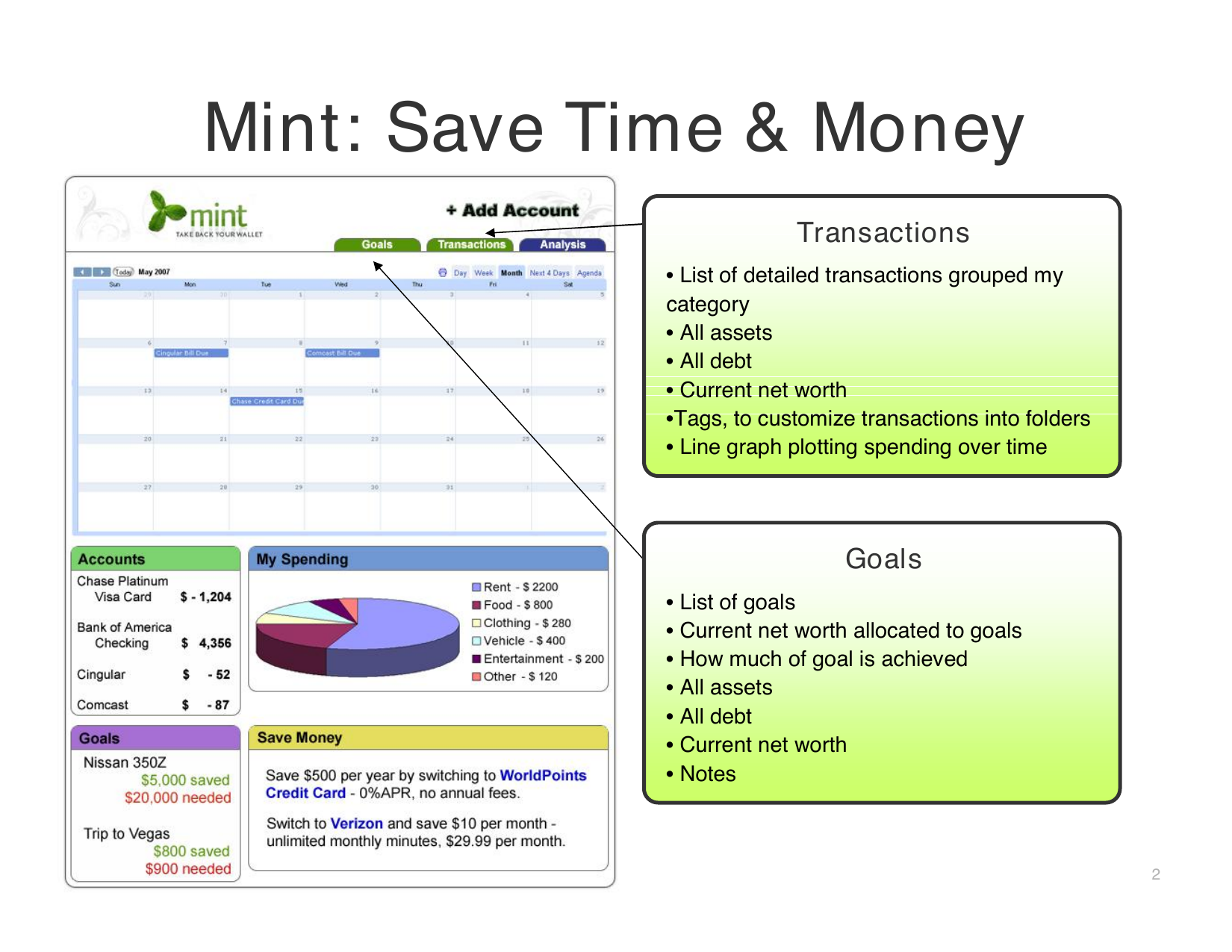
Full dashboard mockup, calendar bill reminders, account balances, spending pie chart, savings goals, and personalized switch recommendations for credit cards and cell plans.
Why it works
Product before team or market, the deck proves the experience exists. Feature callouts for Transactions and Goals map directly to time saved and money saved, the two outcomes on the title.
Team & Advisors
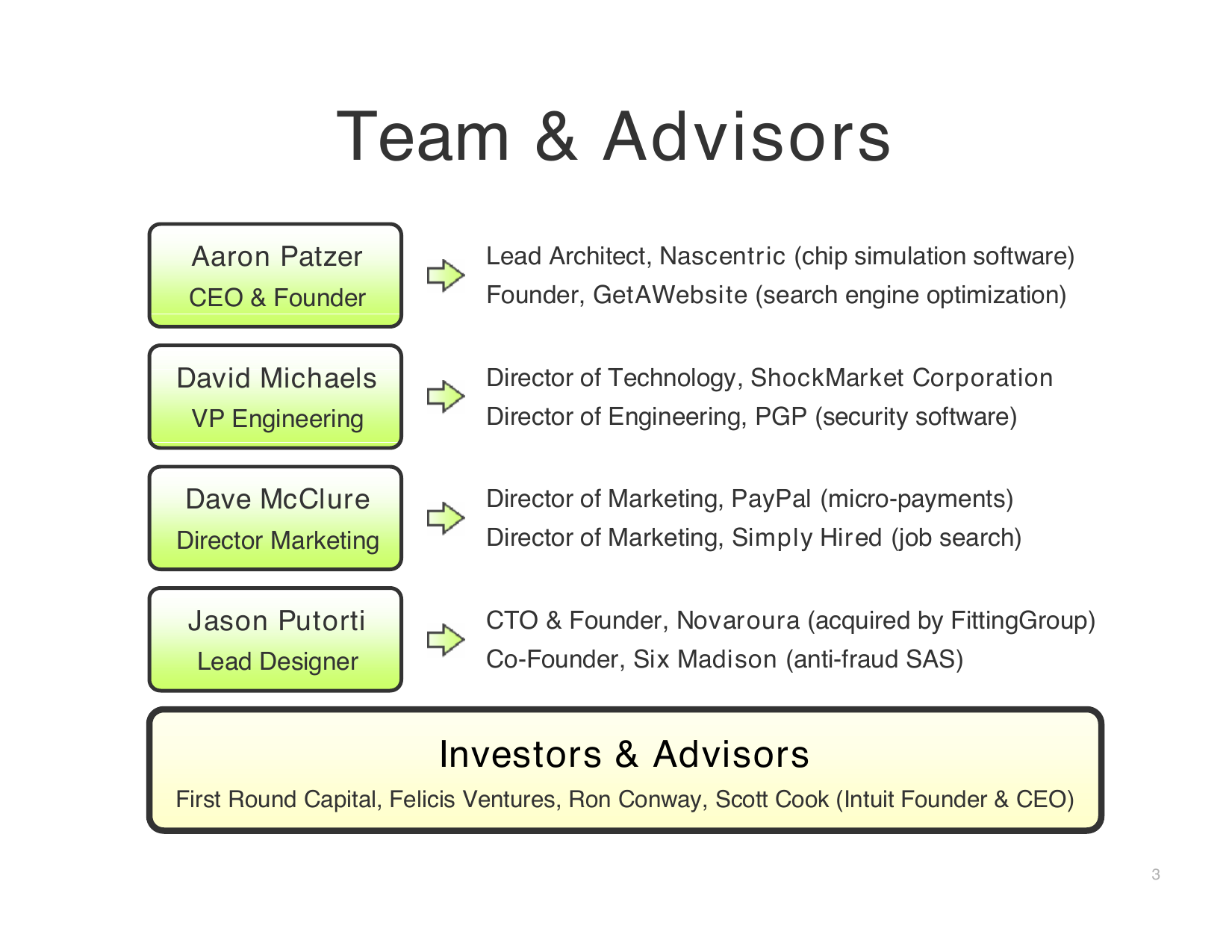
Aaron Patzer (CEO), David Michaels (VP Engineering), Dave McClure (Marketing), Jason Putorti (Lead Designer), backed by First Round Capital, Felicis Ventures, Ron Conway, and Scott Cook of Intuit.
Why it works
Scott Cook on the cap table is strategic foreshadowing. Intuit's founder validating a Quicken challenger. PayPal and PGP alumni on the team de-risk aggregation security and payments.
Market Size. US
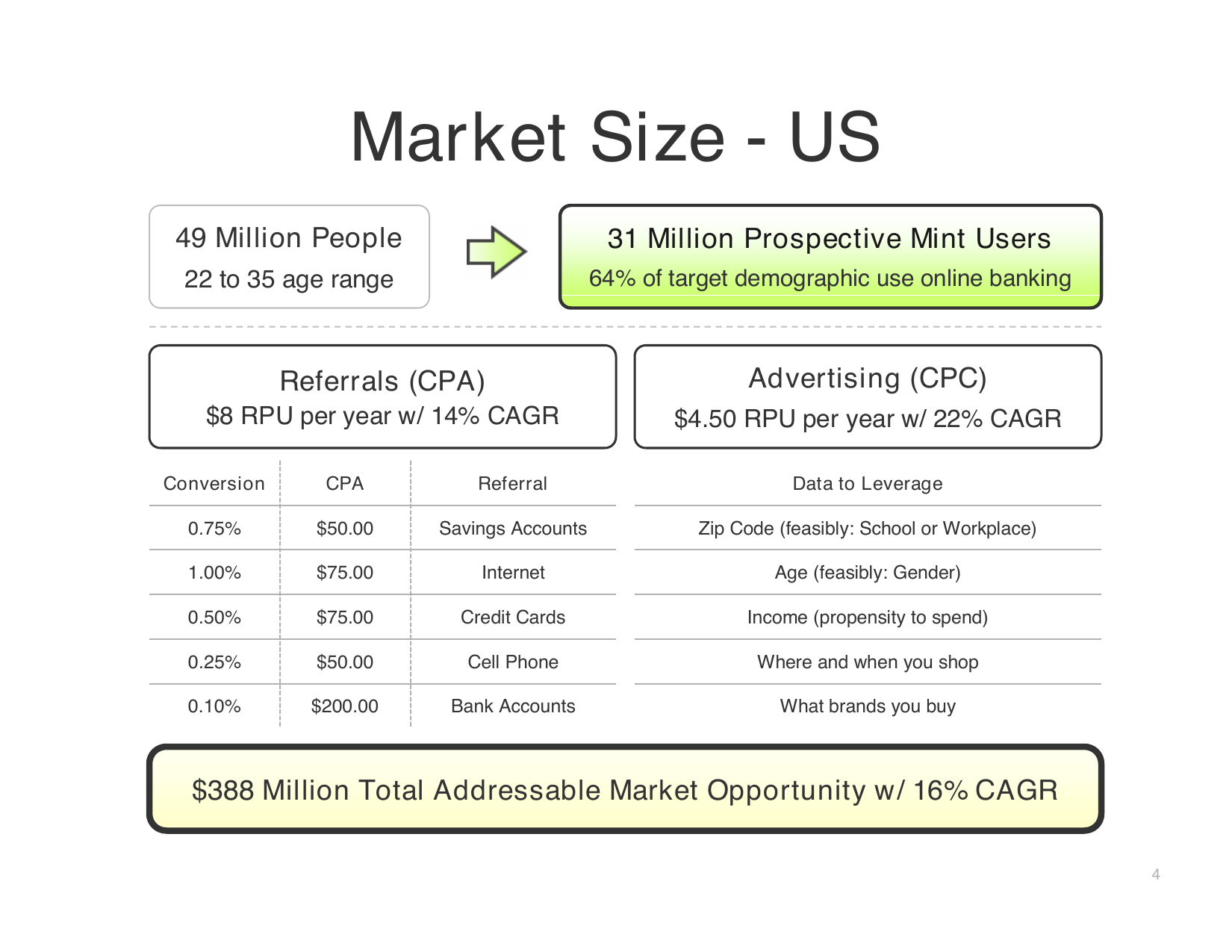
31M prospective users (64% of 49M people aged 22–35 use online banking) × $12.50 blended RPU from referrals ($8) and advertising ($4.50) = $388M TAM at 16% CAGR.
Why it works
Bottom-up math beats a billion-dollar TAM slide, demographic filter, online-banking adoption rate, and two revenue lines investors can stress-test. CPA tables by product category show the model is built, not guessed.
Competitors
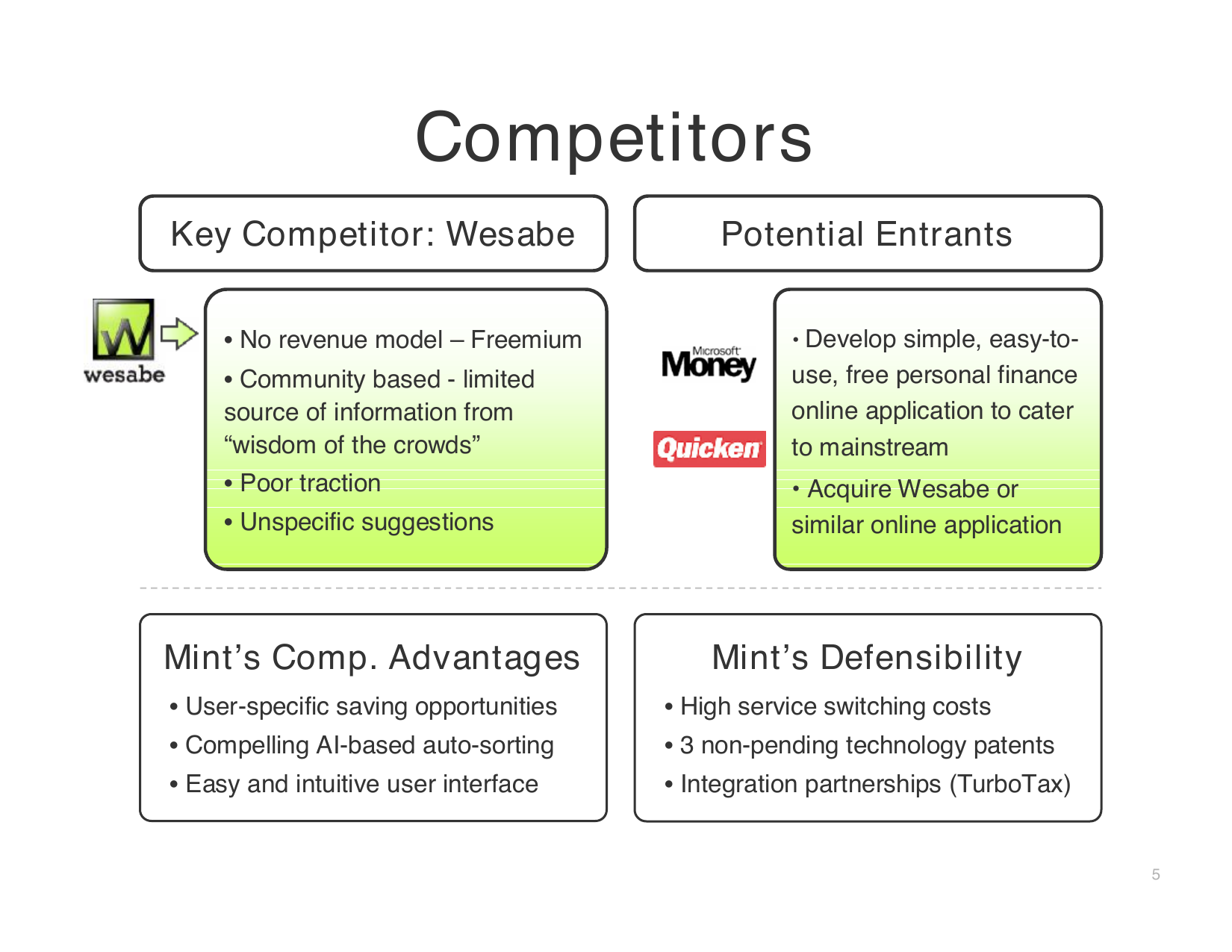
Wesabe named as the key competitor (no revenue model, poor traction); Microsoft Money and Quicken as potential entrants. Mint counters with user-specific savings, AI auto-sorting, patents, and TurboTax integration.
Why it works
Competitive slide does double duty: dismiss the startup rival and pre-empt the incumbent threat. Switching costs and three pending patents are the moat story, not feature checklists.
Value to User
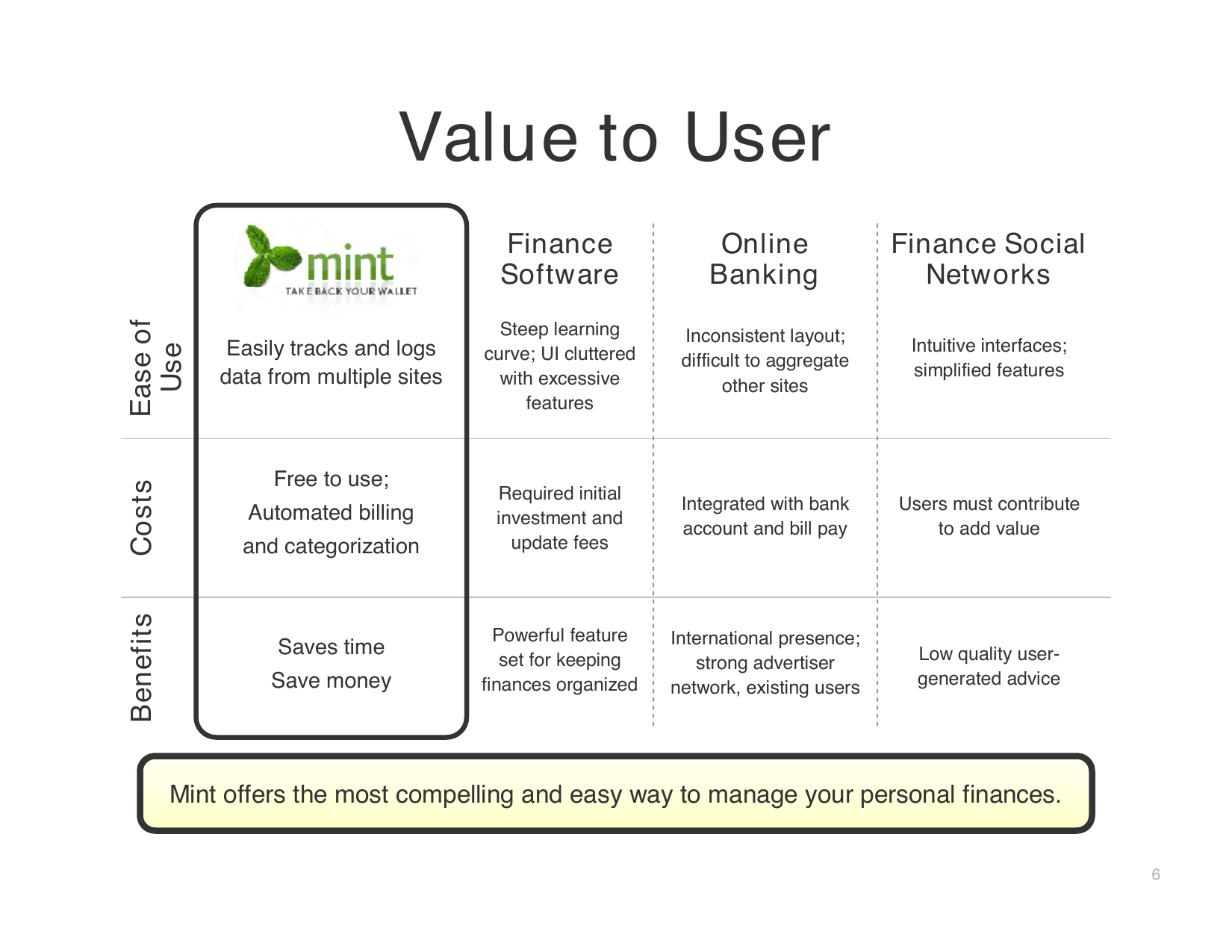
Comparison grid vs finance software, online banking, and finance social networks. Mint wins on ease of use, free cost, and saving time and money.
Why it works
Four-column matrix positions Mint in the only quadrant that's free, automated, and personalized. The summary line. "most compelling and easy way", is bold but backed by row-by-row contrasts, not adjectives alone.
Value to Partners
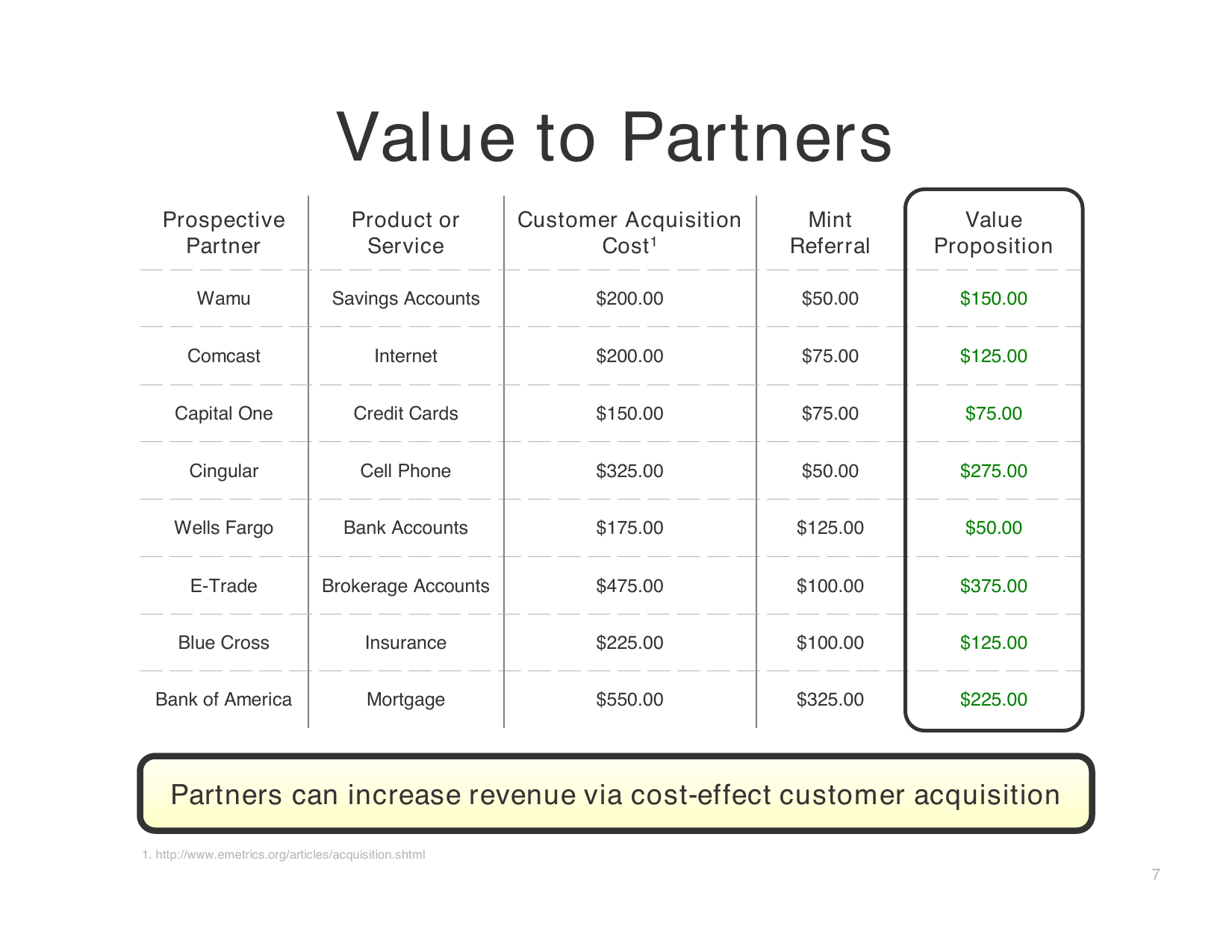
Eight named partners (WaMu, Comcast, Capital One, Cingular, Wells Fargo, E-Trade, Blue Cross, BofA). Mint referral fees run $50–$325 versus industry CAC of $150–$550, saving partners $50–$375 per customer.
Why it works
This is the slide that makes the business model credible, real company names, sourced CAC benchmarks, and a green-highlighted savings column. FinTech founders should steal this format for any affiliate or marketplace pitch.
User Acquisition
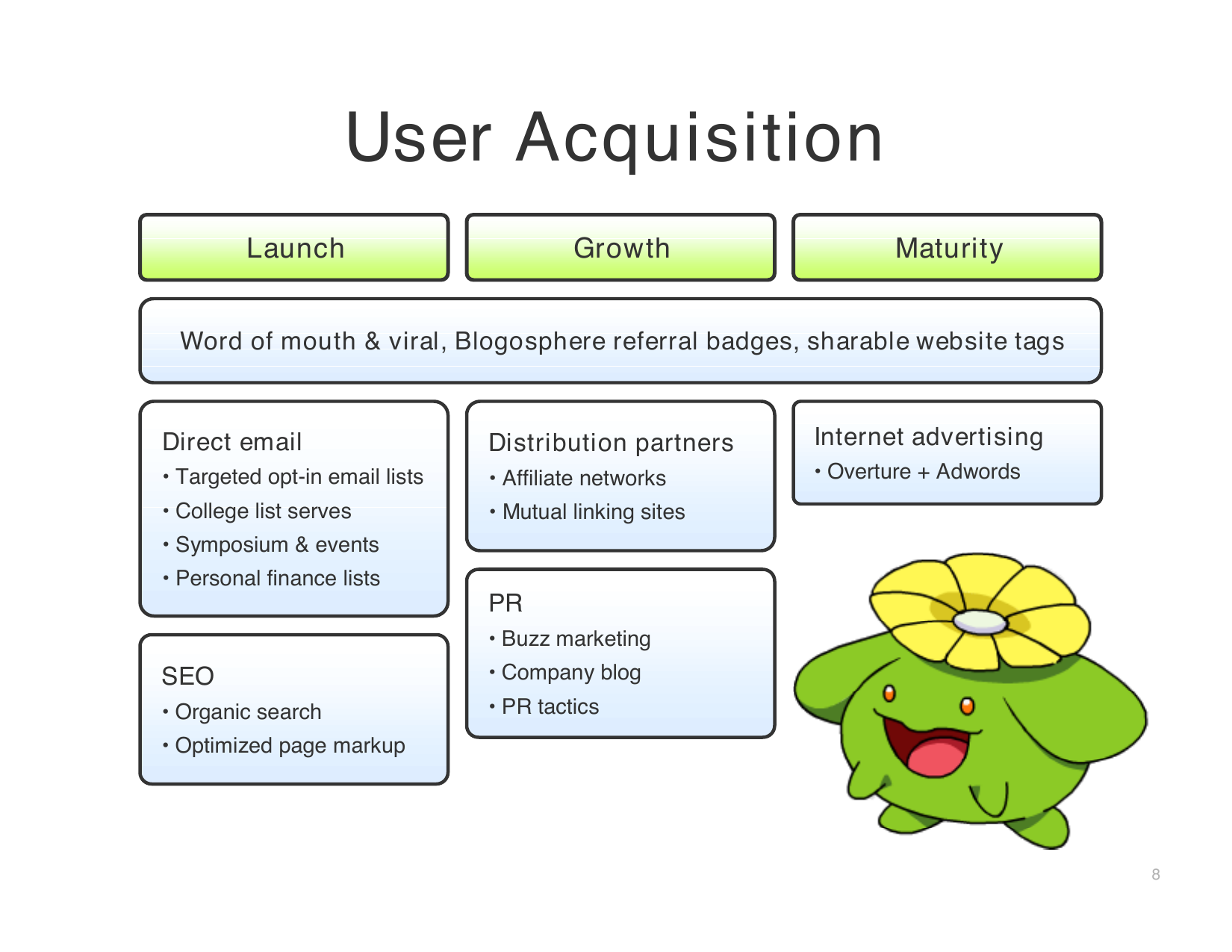
Launch → Growth → Maturity timeline, viral badges and blogosphere tags at every stage, plus email lists, SEO, affiliate networks, PR, and Overture/AdWords.
Why it works
GTM spans paid and organic without overcommitting to one channel. Viral mechanics sit above the timeline. Mint planned word-of-mouth as a permanent layer, not a launch stunt.
Business Model
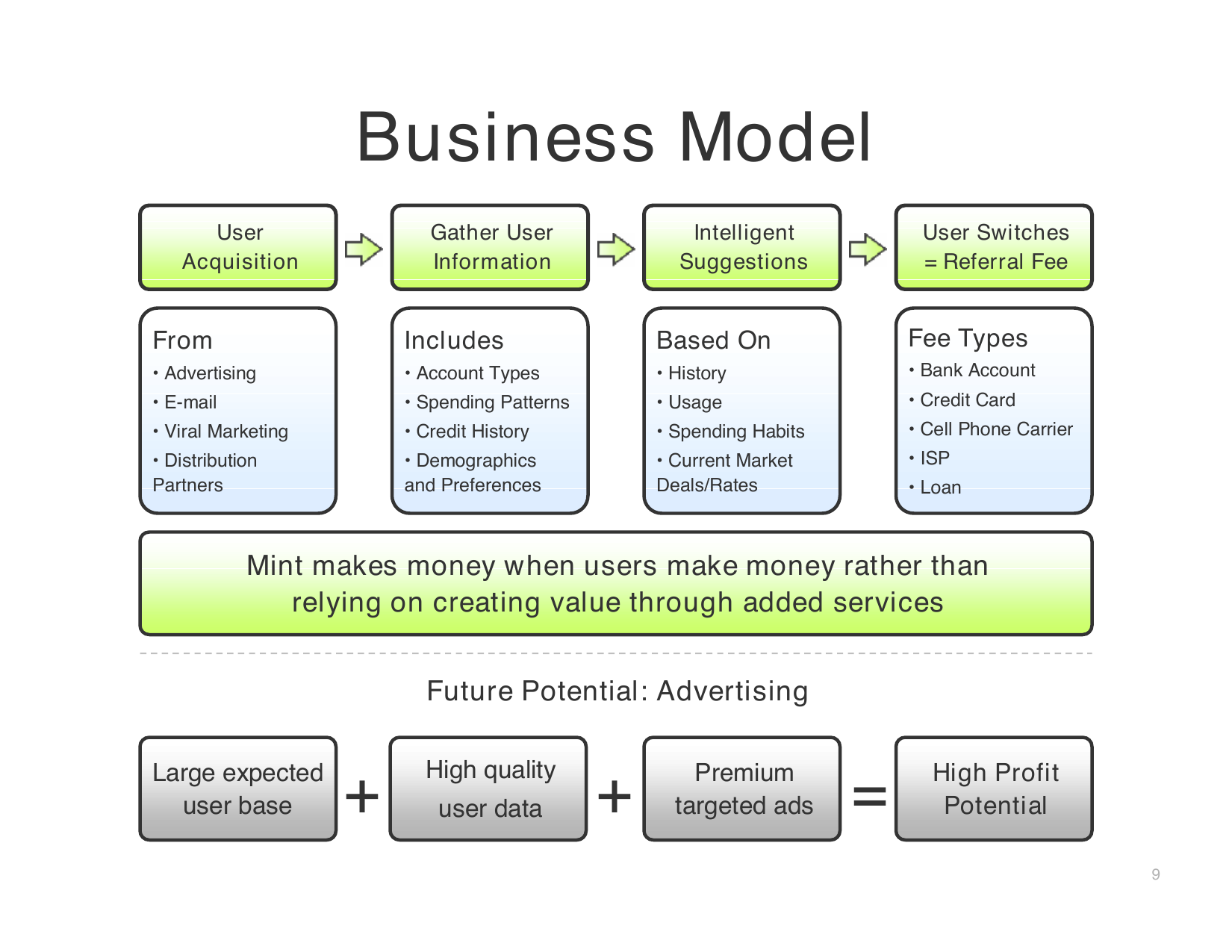
Acquire users → gather account and spending data → deliver intelligent switch suggestions → earn referral fees on bank, credit, cell, ISP, and loan conversions; future upside from targeted ads on high-quality user data.
Why it works
The flow diagram makes freemium logic obvious, data powers suggestions, suggestions drive switches, switches pay Mint. The banner line aligns incentives so investors don't worry about bait-and-switch monetization.
Financials
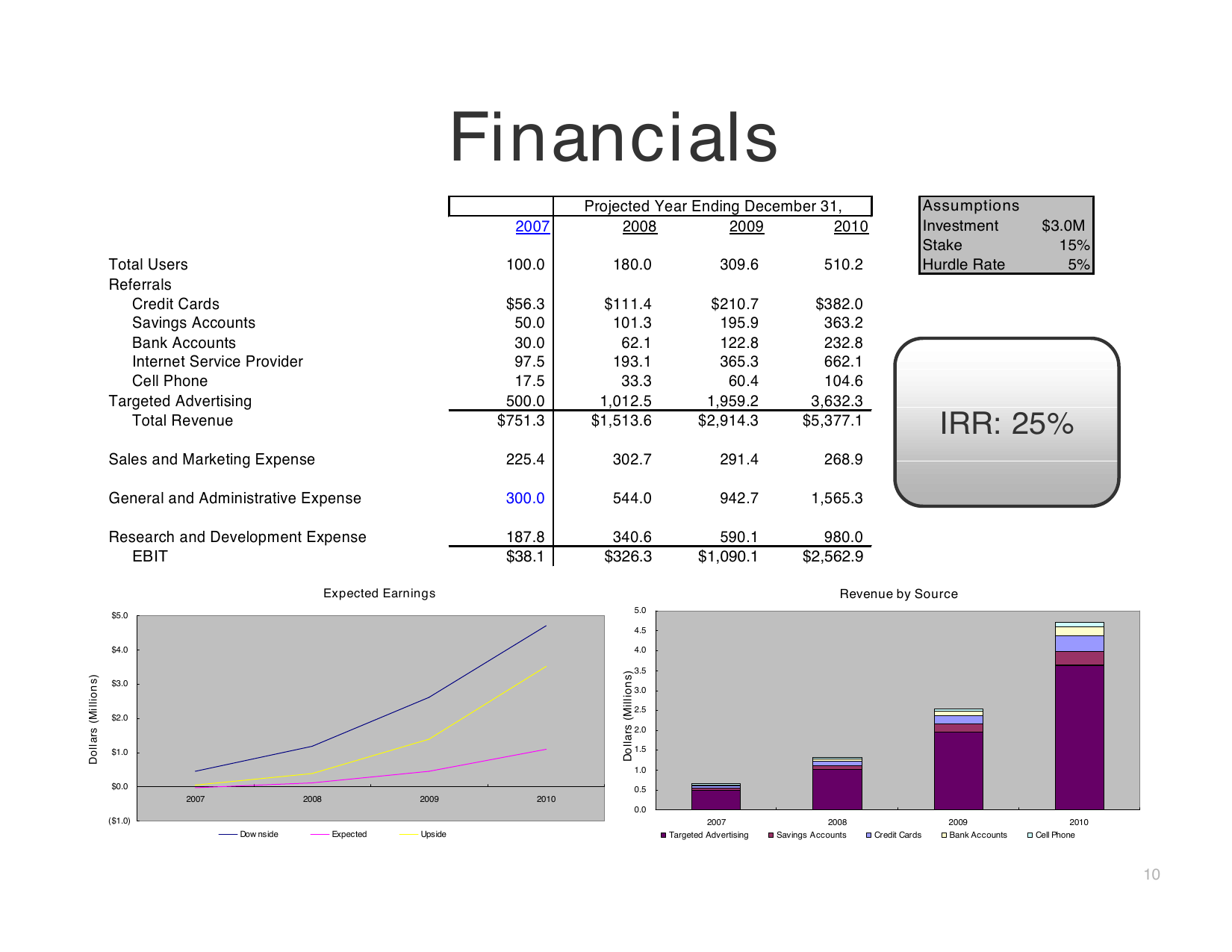
2007–2010 projections, users grow 100K to 510K, revenue $751K to $5.4M (mostly targeted advertising), EBIT turns positive at $38K rising to $2.6M; $3M investment for 15% stake at 25% IRR.
Why it works
Four-year horizon keeps the model digestible. Stacked bar chart shows revenue mix shifting toward ads while referrals diversify, investors see path to scale without one partner dependency.
Exit Strategy
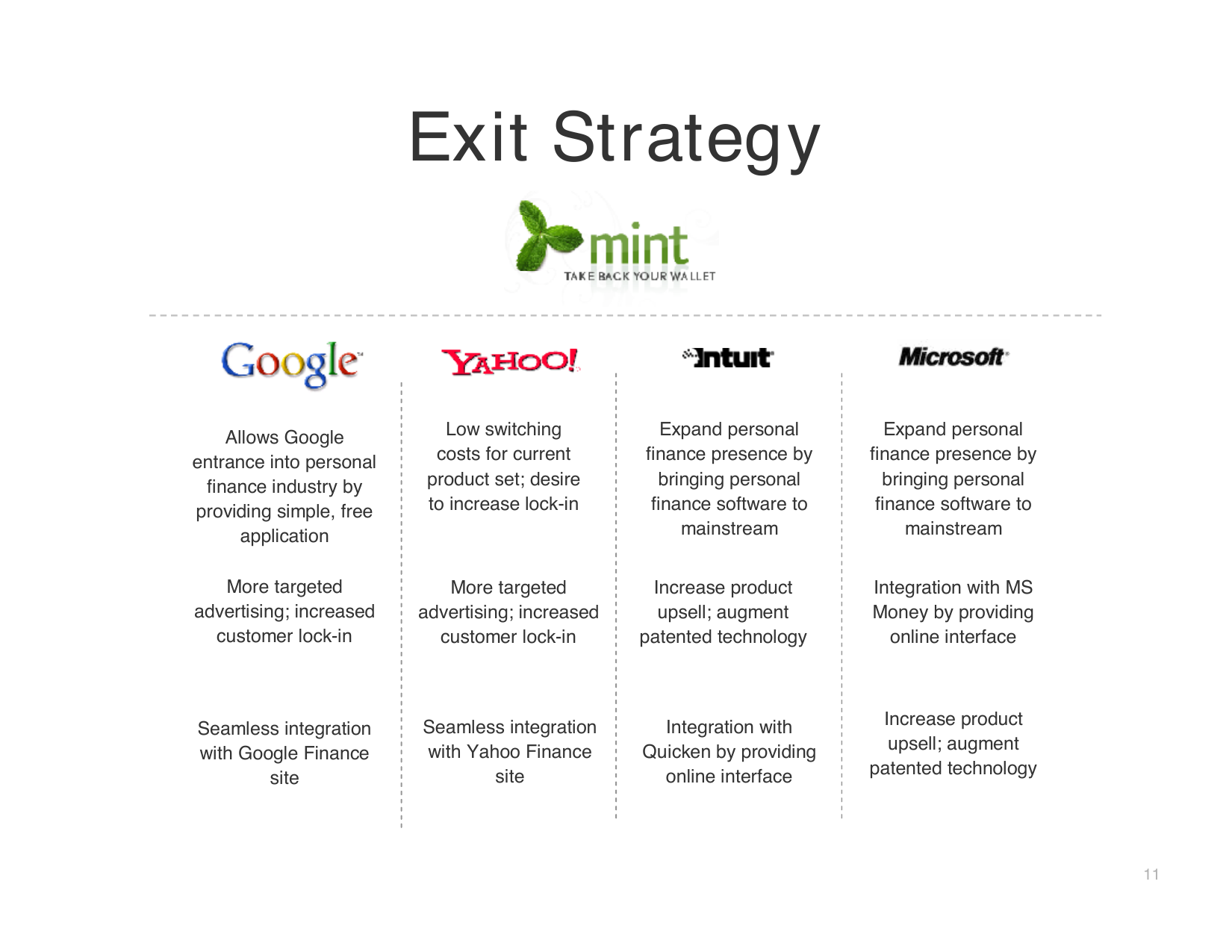
Four potential acquirers. Google, Yahoo, Intuit, Microsoft, each with lock-in, targeted advertising, and finance-product integration rationale.
Why it works
Naming four strategics with specific integration paths tells investors Patzer already thought like a portfolio manager. Intuit's bullet about bringing personal finance to the mainstream is exactly how the 2009 deal got framed.
Q&A
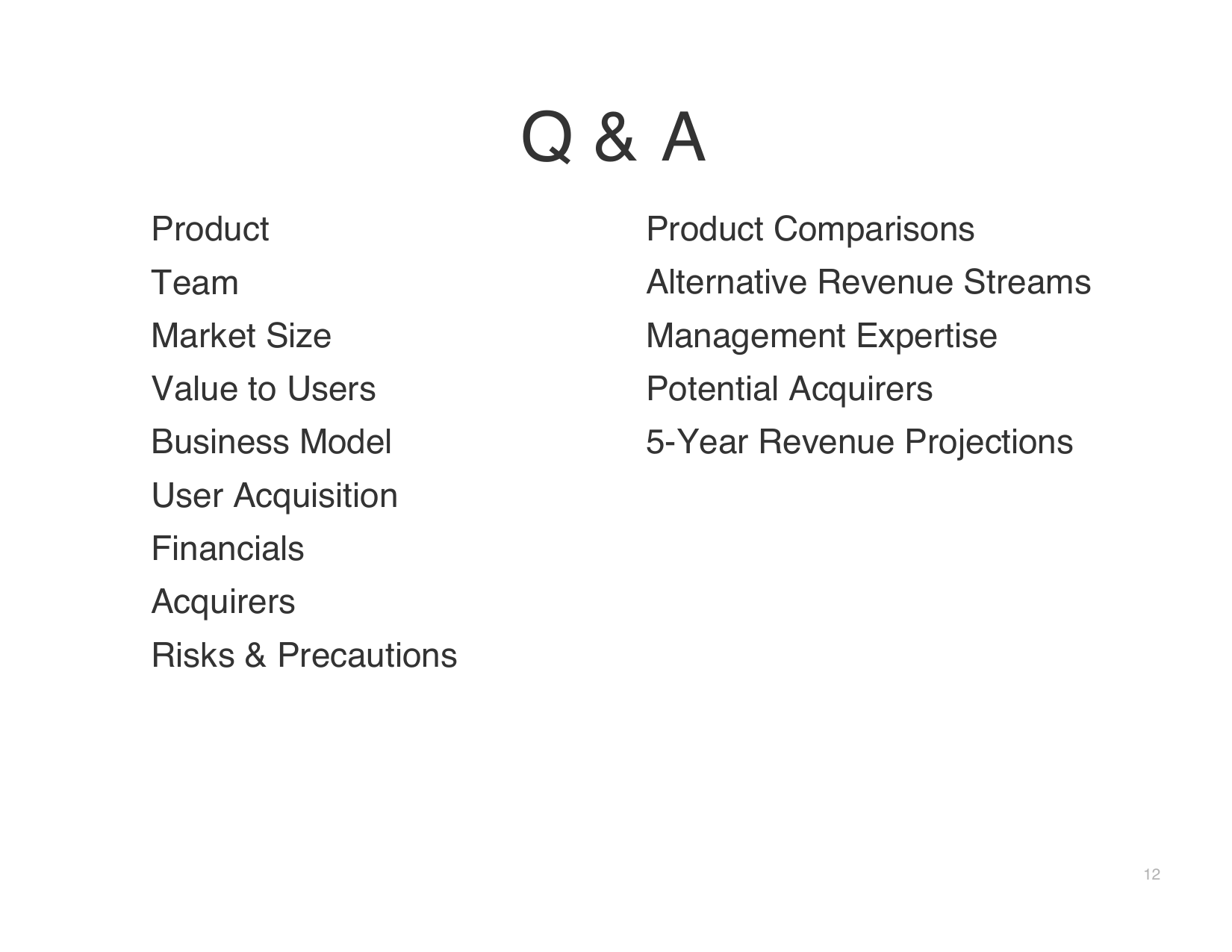
Backup slide index. Product, Team, Market Size, Business Model, Financials, Acquirers, Risks, Product Comparisons, Revenue Streams, Management, and 5-Year Projections.
Why it works
A Q&A menu signals depth without cluttering the main narrative. Founders can jump to appendix slides under investor pressure instead of flipping through blind.
Risks & Precautions
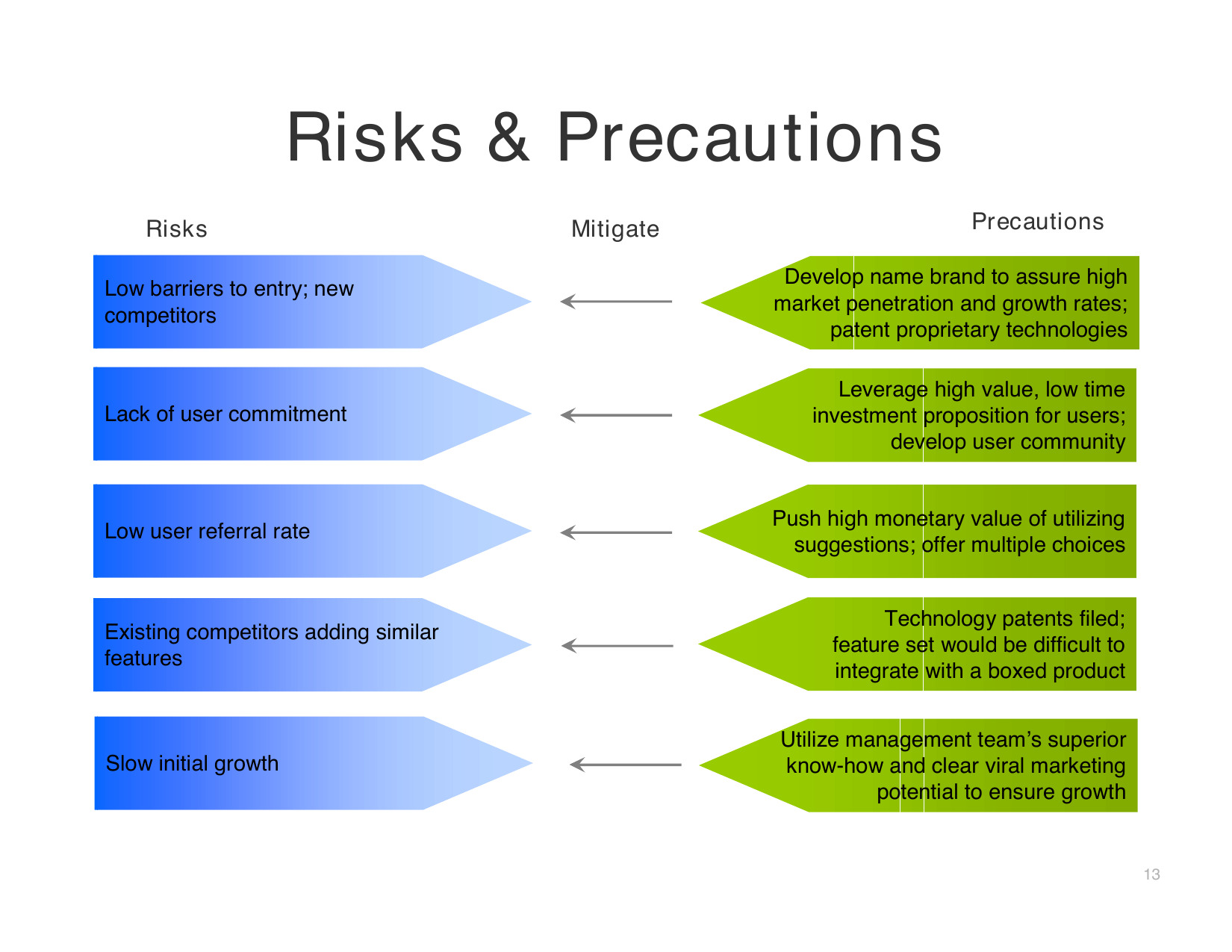
Five risk–mitigation pairs, low barriers to entry (brand + patents), user commitment (high value, low time), referral rates (monetary value of suggestions), incumbent feature copy (patents + cloud architecture), slow growth (team expertise + viral potential).
Why it works
Every risk gets a specific countermeasure, not hand-waving. Acknowledging low barriers while citing patents and switching costs shows investors the team has done the defensive homework.
Competitive Response
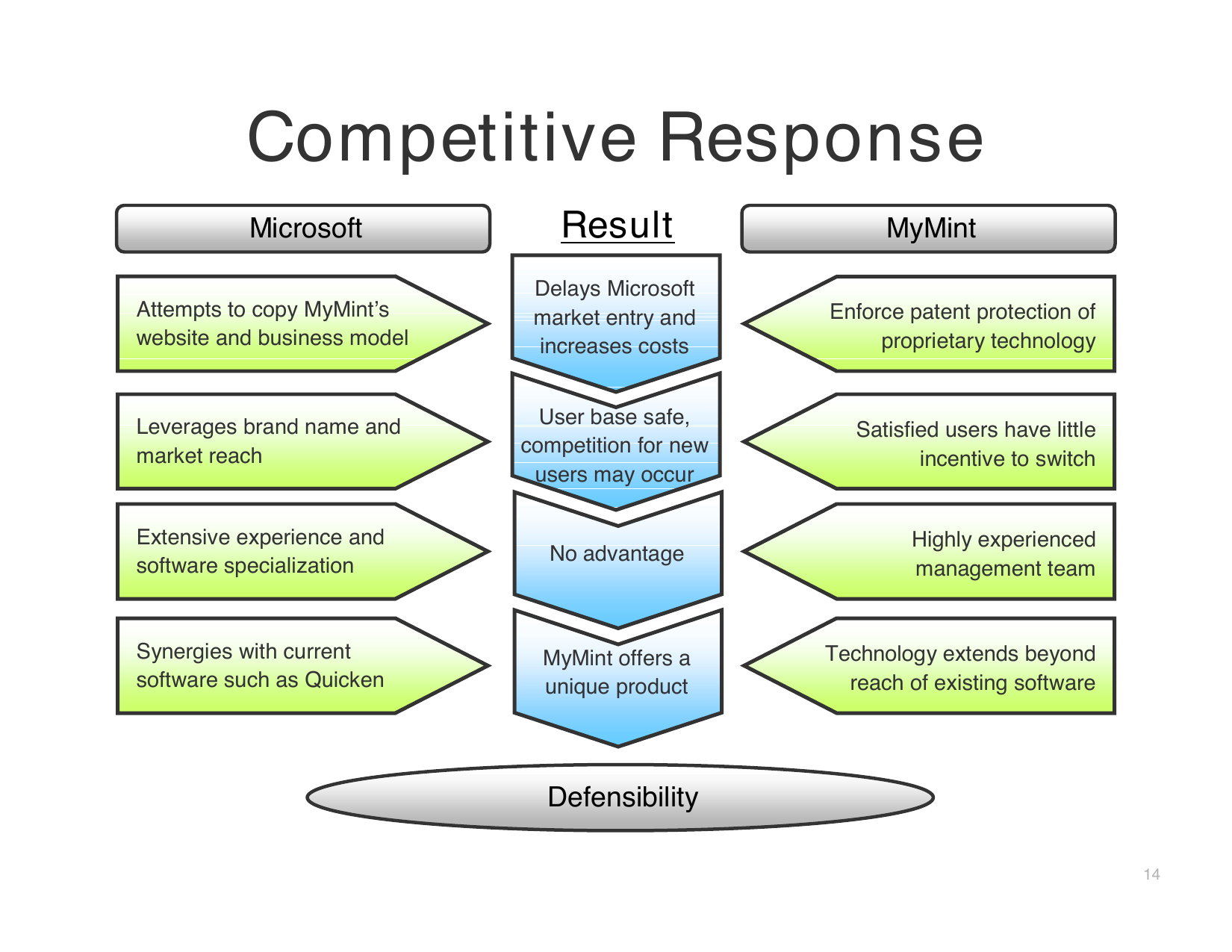
MyMint vs Microsoft scenario matrix, patent enforcement delays copycats, satisfied users resist brand leverage, experienced teams cancel out, and cloud aggregation extends beyond boxed Quicken.
Why it works
War-gaming one named incumbent (Microsoft) is more convincing than generic "what if Google enters." Each row ends in a defensibility outcome, the slide title could read "why we survive."
Financial Assumptions
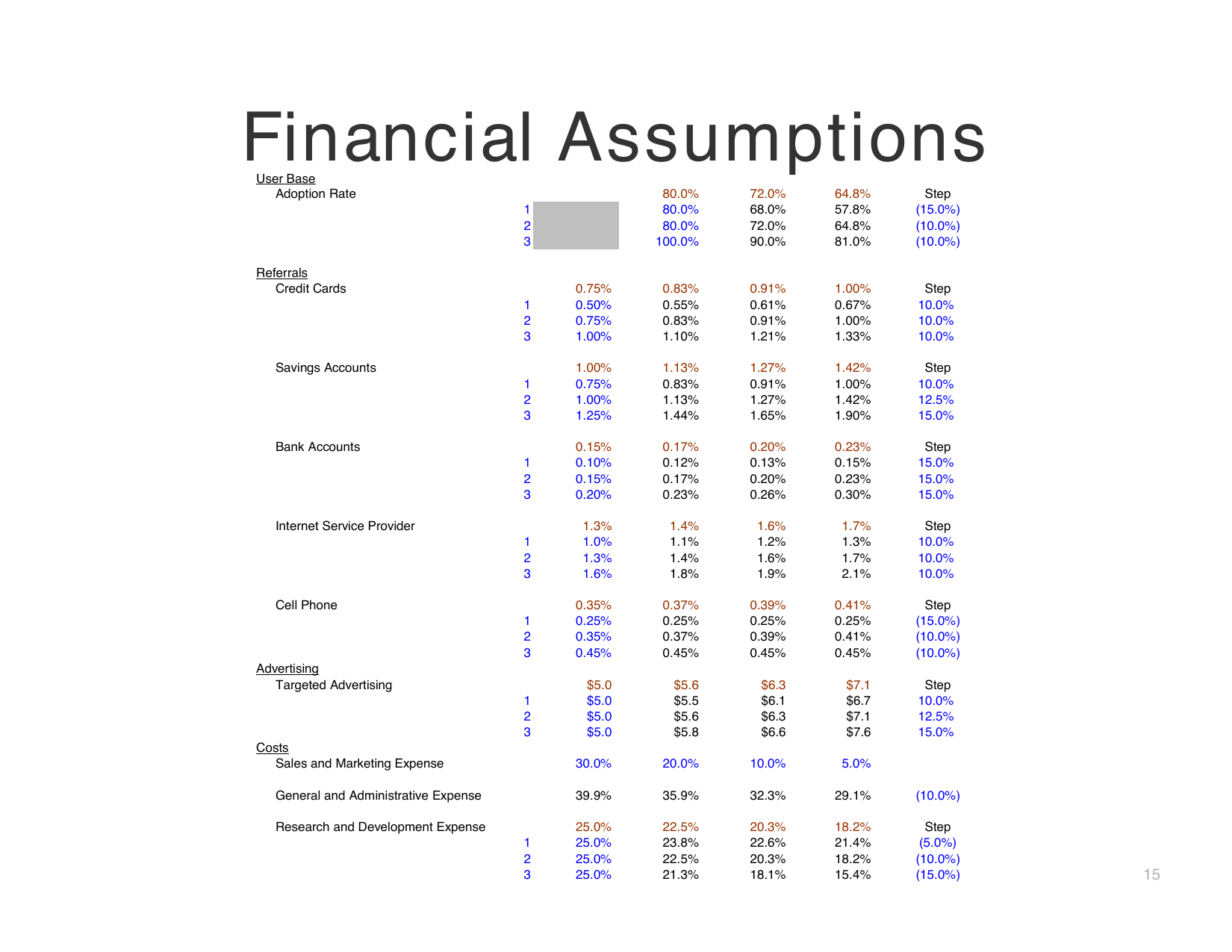
Model drivers, user adoption decay steps, referral conversion rates by product (credit cards 0.5–1.3%, savings 0.75–1.9%, etc.), targeted ad RPU growth, and declining S&M/G&A/R&D as percentages of revenue.
Why it works
Appendix transparency for diligencing investors, every top-line number on slide 10 traces back to assumption tables here. Conversion rates by vertical show the model isn't one blended guess.
Exit Calculation
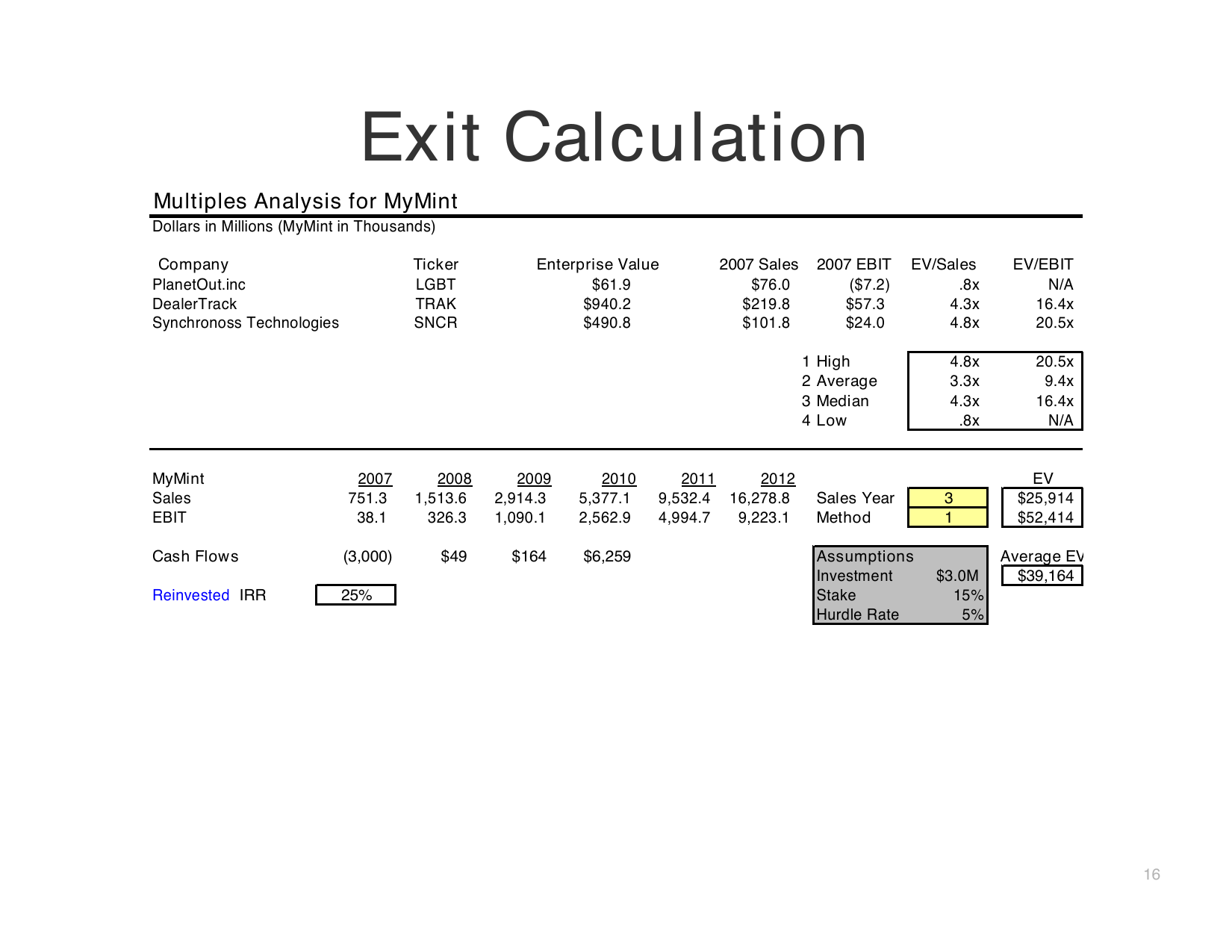
Comparable multiples from PlanetOut, DealerTrack, and Synchronoss, applied to MyMint 2007–2012 projections yield average enterprise value of $39M on $3M investment at 15% stake and 25% reinvested IRR.
Why it works
Exit math closes the loop opened on slide 11, comps, multiples, and IRR in one spreadsheet slide. Investors leave with a return scenario, not just a product story.
Compare similar investor decks
More series a and fintech presentations in the library.



Your pitch deck, ready before the meeting
Start with your website or idea and see your slides in minutes. Pay only when you download.
Generate a deck