
Brex pitch deck (2018)
Henrique Dubugras and Pedro Franceschi were 22 when Brex raised $57M Series B in 2018 — eighteen slides that lead with A-list backers, prove startup credit pain with real bank rejections, and close on negative churn math. The deck is famously rough around design, but the data story (referral-only beta growth, 100× spend multiplier, LTV tables) is what Silicon Valley remembered.
What founders can steal from Brex's deck
- Lead with borrowed credibility when the product is still early — team slide #2 stacks YC, Thiel, Levchin, and Visa alumni before the problem is fully explained.
- Show the pain with receipts — AMEX, Chase, and Capital One rejection screenshots beat a bullet list about 'access to credit.'
- Delay the product reveal until investors feel the market — six slides of problem, TAM, and ICP before the Brex card appears.
- Let traction rescue a messy middle — exponential volume chart and negative-churn funnel land after feature slides that reviewers called confusing.
- Quantify expansion revenue, not just logos — avg monthly spend from $1.5K pre-seed to $1.5M Series D makes the wedge obvious.
Historical round profile
- Stage
- Series B
- Year
- 2018
- Outcome / Raise
- $57M Series B (2018)
- Business model
- Corporate cards and spend management for startups
- HQ
- San Francisco, California
Slide-by-slide breakdown (18 slides)
Every slide in Brex's 2018 presentation, what job it performs in the room, and how to adapt the sequence for your own deck.
Cover

Dark textured backdrop with the Brex wordmark — white letters, orange slash through the X.
Why it works
Minimal cover, no tagline. Lets slide two's investor wall do the talking. Brand-forward before narrative.
Team and investors
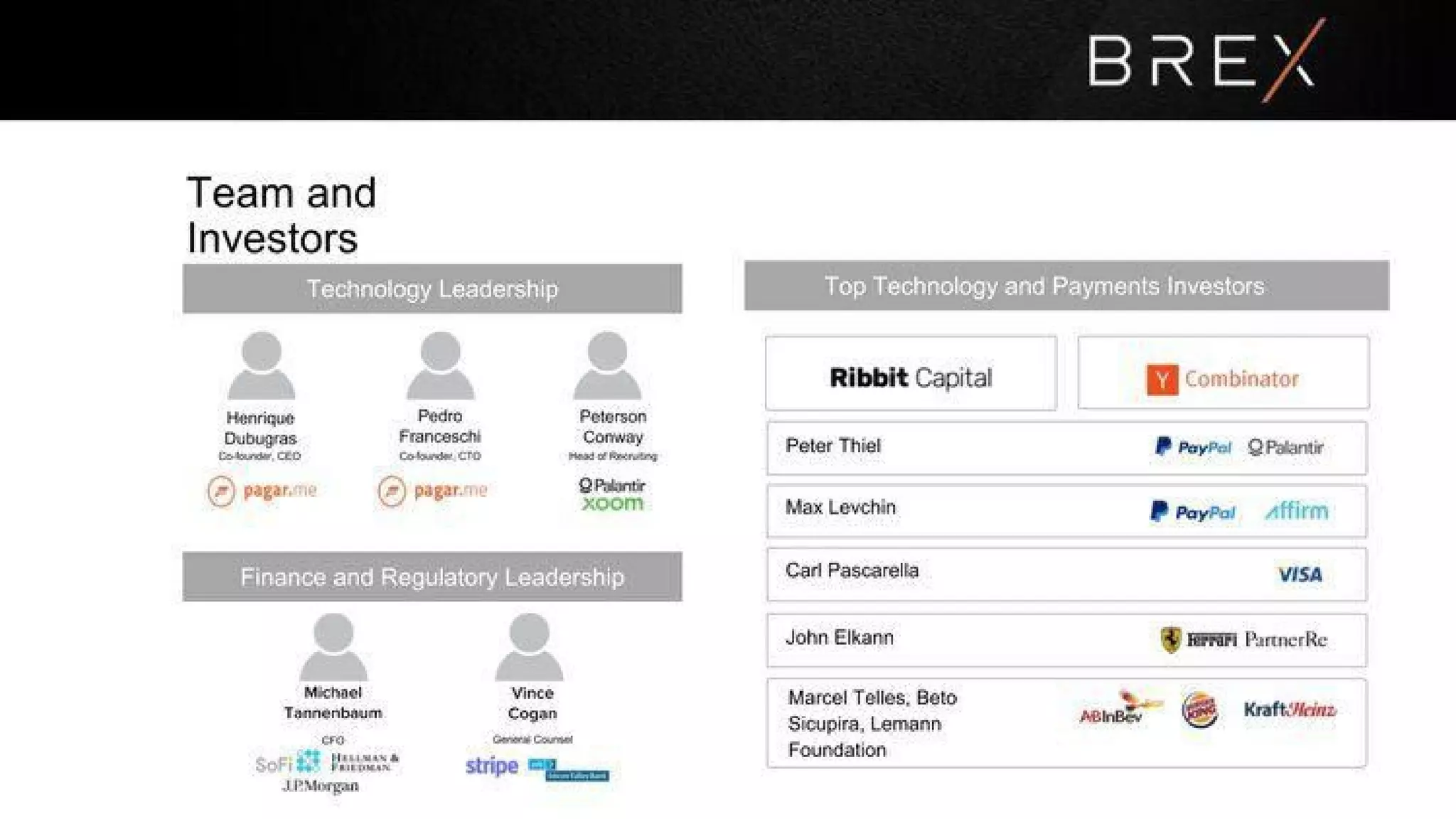
Co-founders Dubugras and Franceschi (Pagar.me), finance and regulatory hires, plus Ribbit, YC, Thiel, Levchin, Pascarella, and Elkann.
Why it works
Team before problem — unusual order, but the thesis is de-risk execution. Prior exit + payments royalty signals they can ship regulated fintech.
Problem — credit access
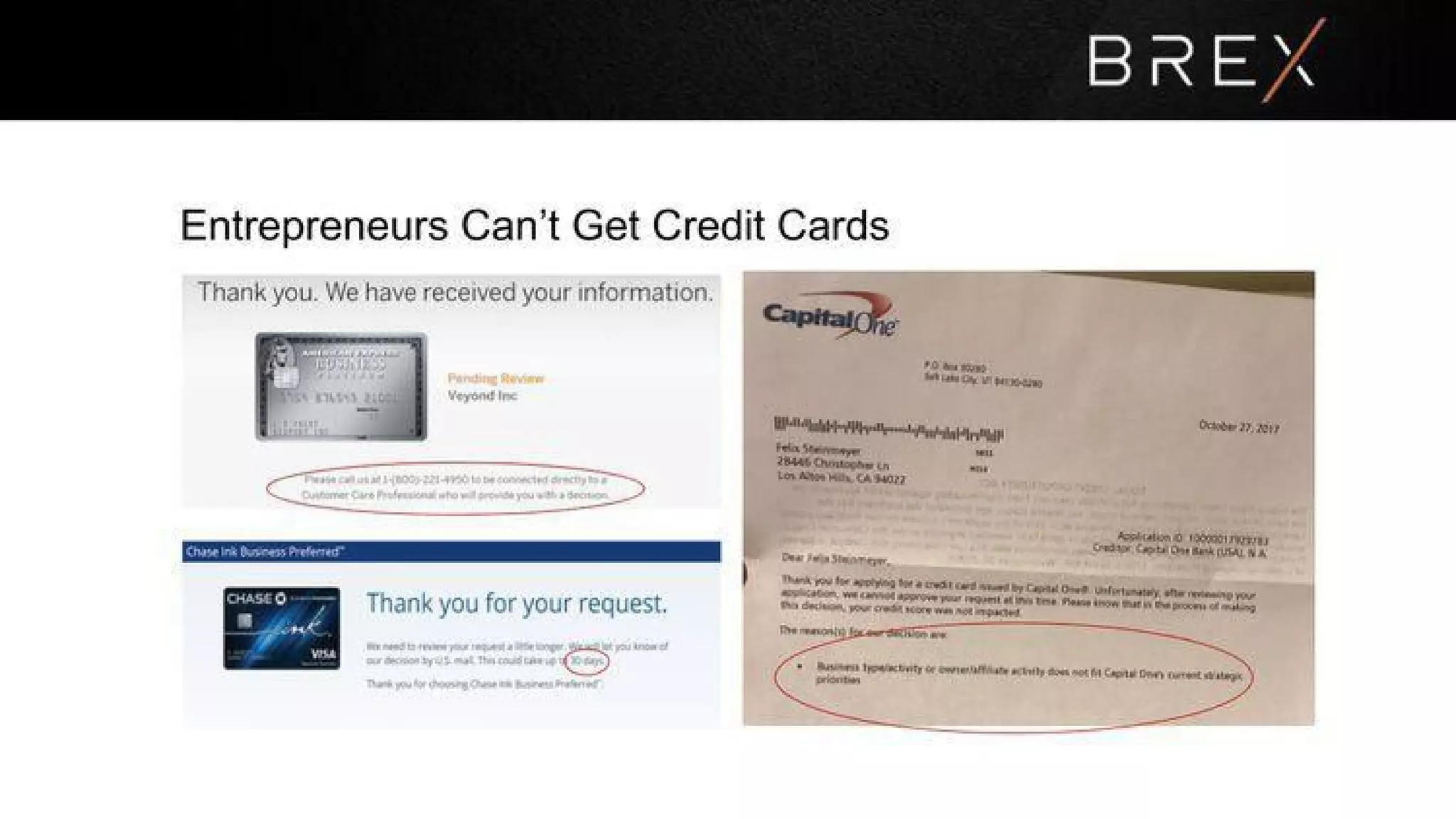
'Entrepreneurs can't get credit cards' — real AMEX pending review, Chase 30-day wait, and Capital One rejection letter screenshots.
Why it works
Show-don't-tell problem slide. Red circles on actual bank replies make the pain visceral; investors with portfolio companies have seen this exact email.
Problem — no controls
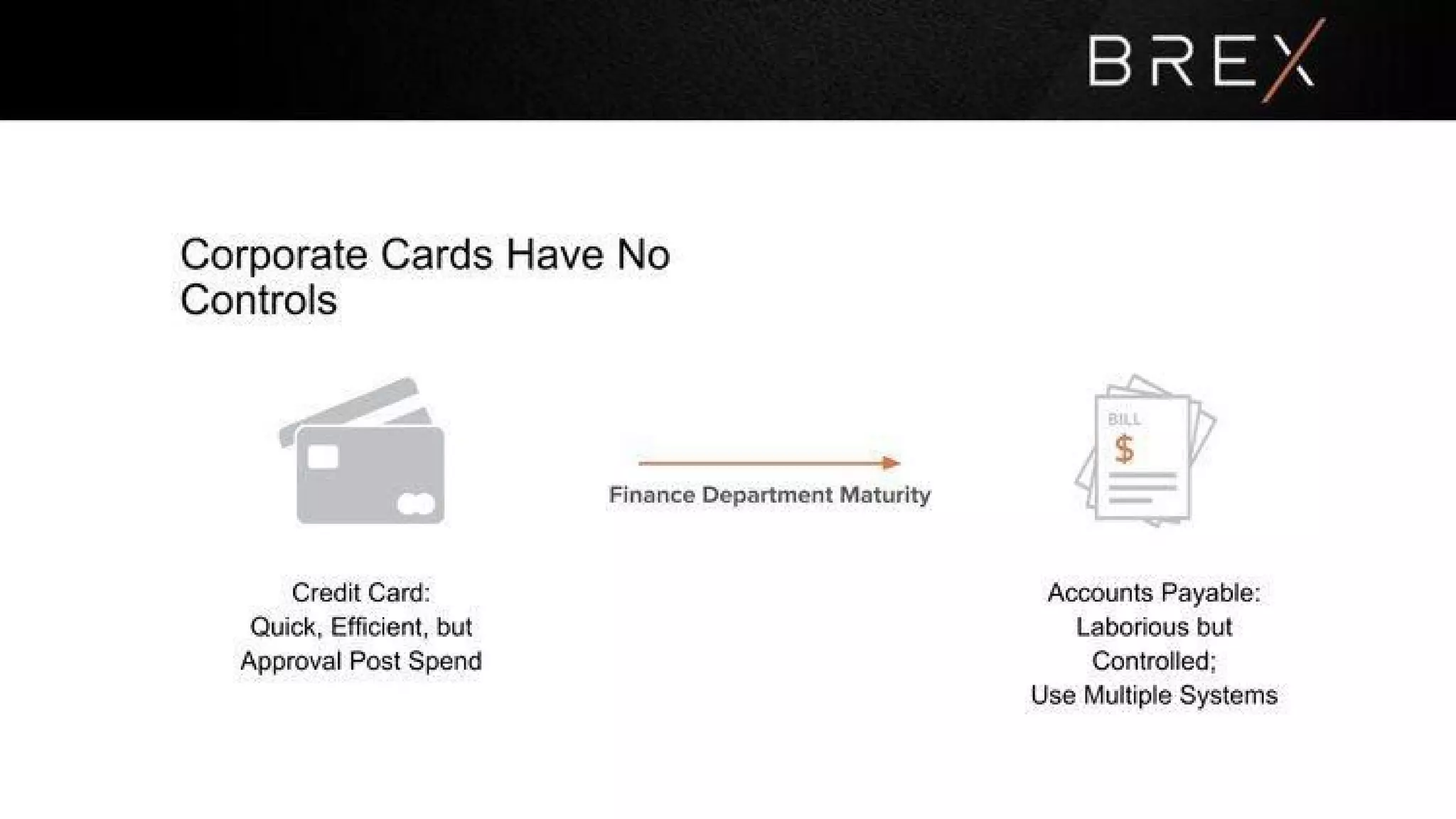
Credit cards are fast but post-spend approval; accounts payable is controlled but laborious — finance maturity arrow between the two.
Why it works
Second problem beat: spend velocity vs control. Sets up Brex as bridging corporate card convenience with AP-level policy.
Problem — legacy stack
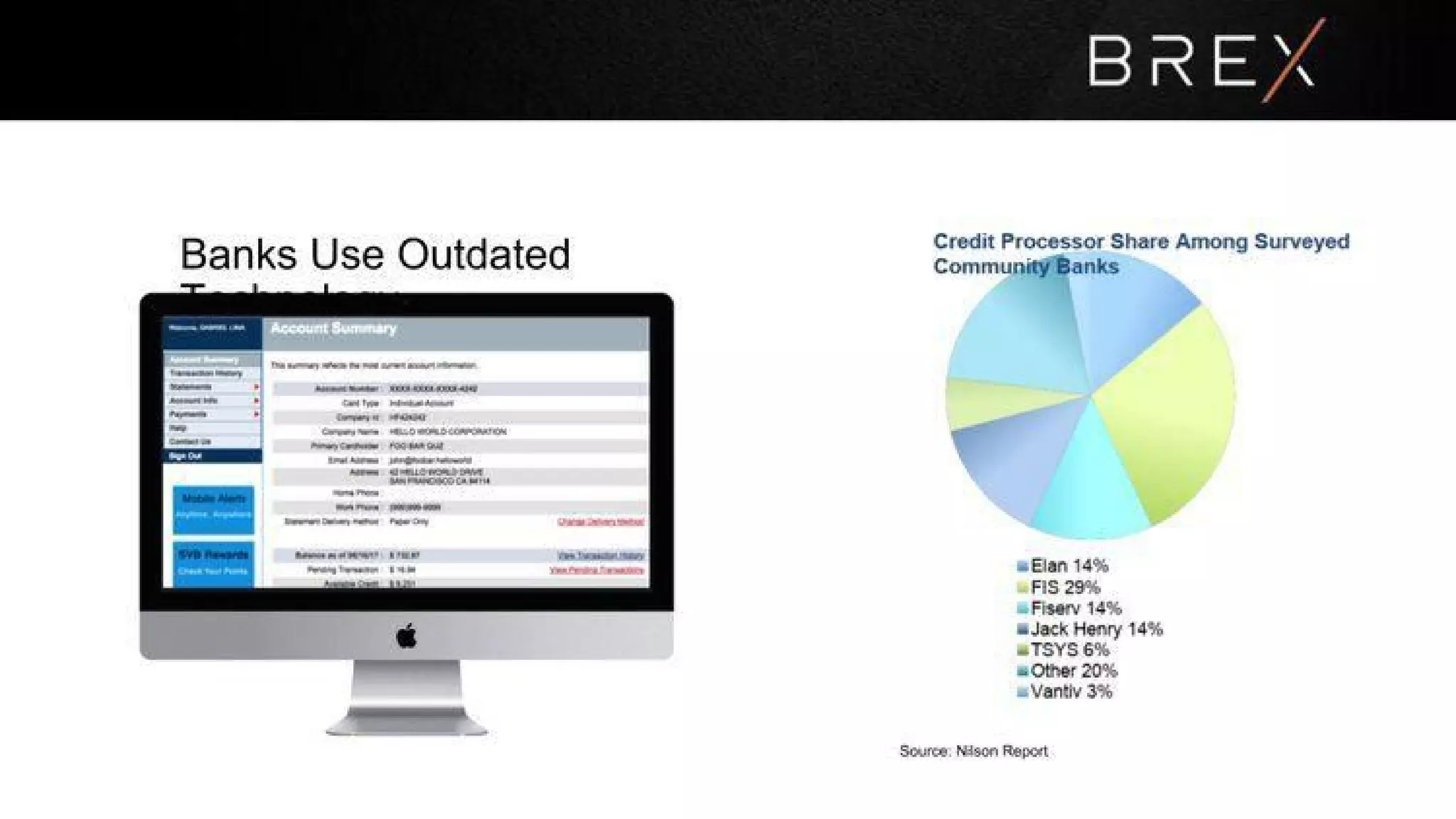
SVB-style 2000s card portal on an iMac plus pie chart of fragmented credit processor share among community banks.
Why it works
Infrastructure slide — ugly bank UI and processor fragmentation explain why incumbents can't move fast. Less polished, but the insight lands.
Market size
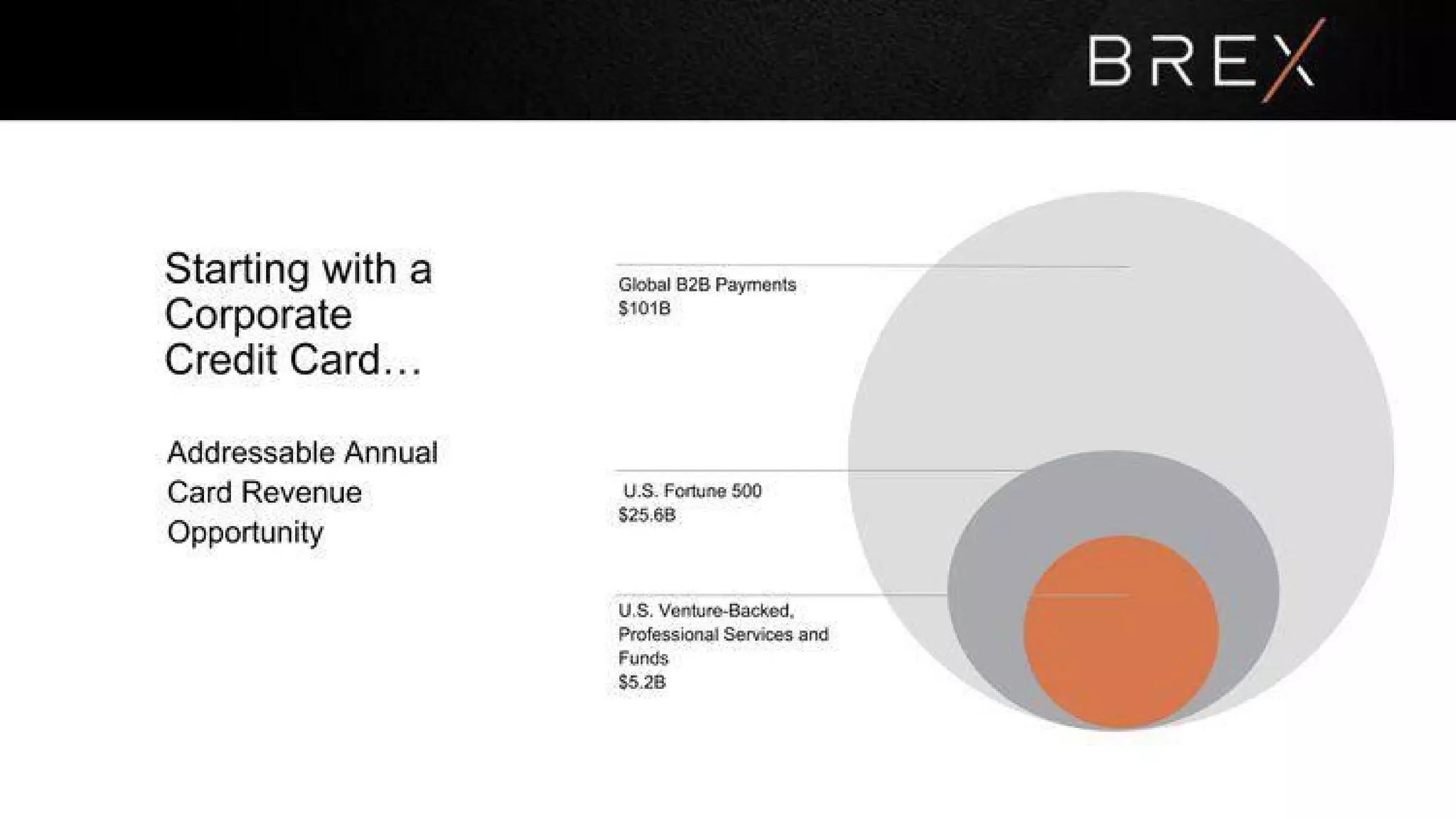
Concentric TAM: $101B global B2B payments → $25.6B U.S. Fortune 500 → $5.2B venture-backed professional services wedge.
Why it works
Classic nested circles with the startup wedge highlighted in orange. Anchors on corporate card revenue, not total payments fantasy.
Target customer
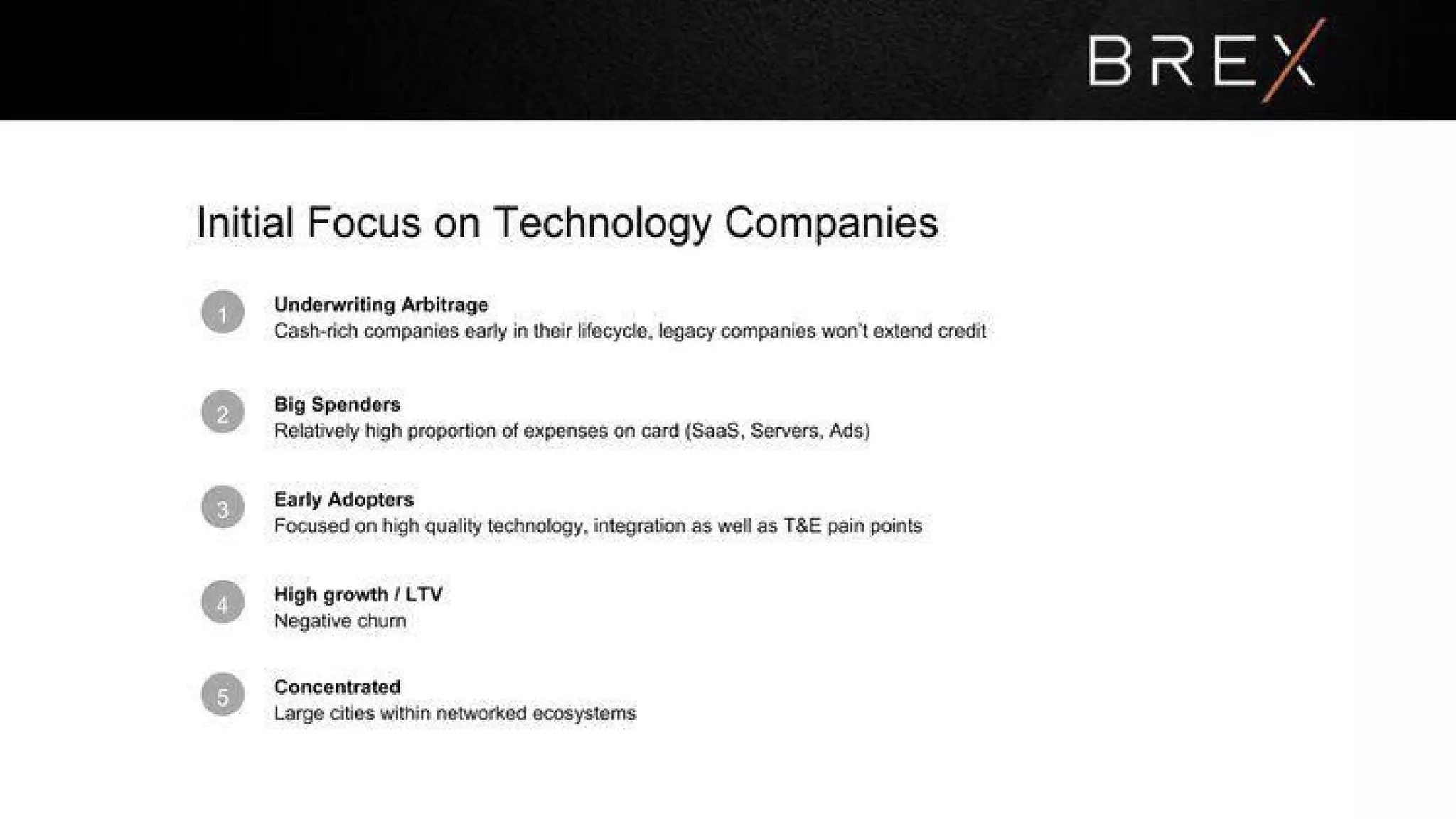
Five reasons to start with tech: underwriting arbitrage, high card spend (SaaS, servers, ads), early adopters, negative churn/LTV, geographic concentration.
Why it works
ICP slide before product — explains why YC companies first. Each bullet ties back to unit economics they'll show later.
Value proposition
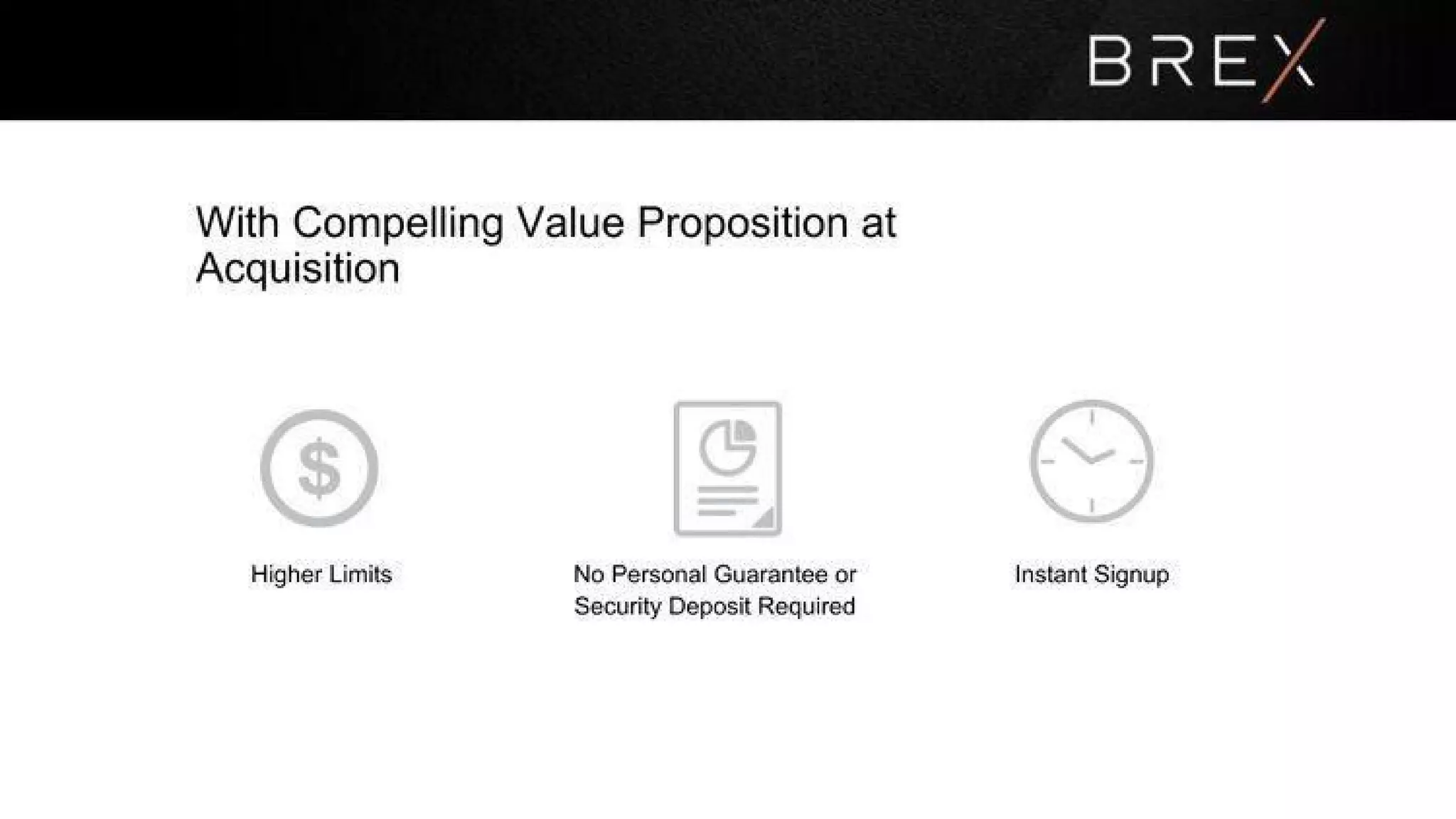
Acquisition hooks: higher limits, no personal guarantee or security deposit, instant signup.
Why it works
Three-icon value prop — concrete benefits founders can repeat. Direct answer to slides 3–4 pain without feature soup.
Retention thesis
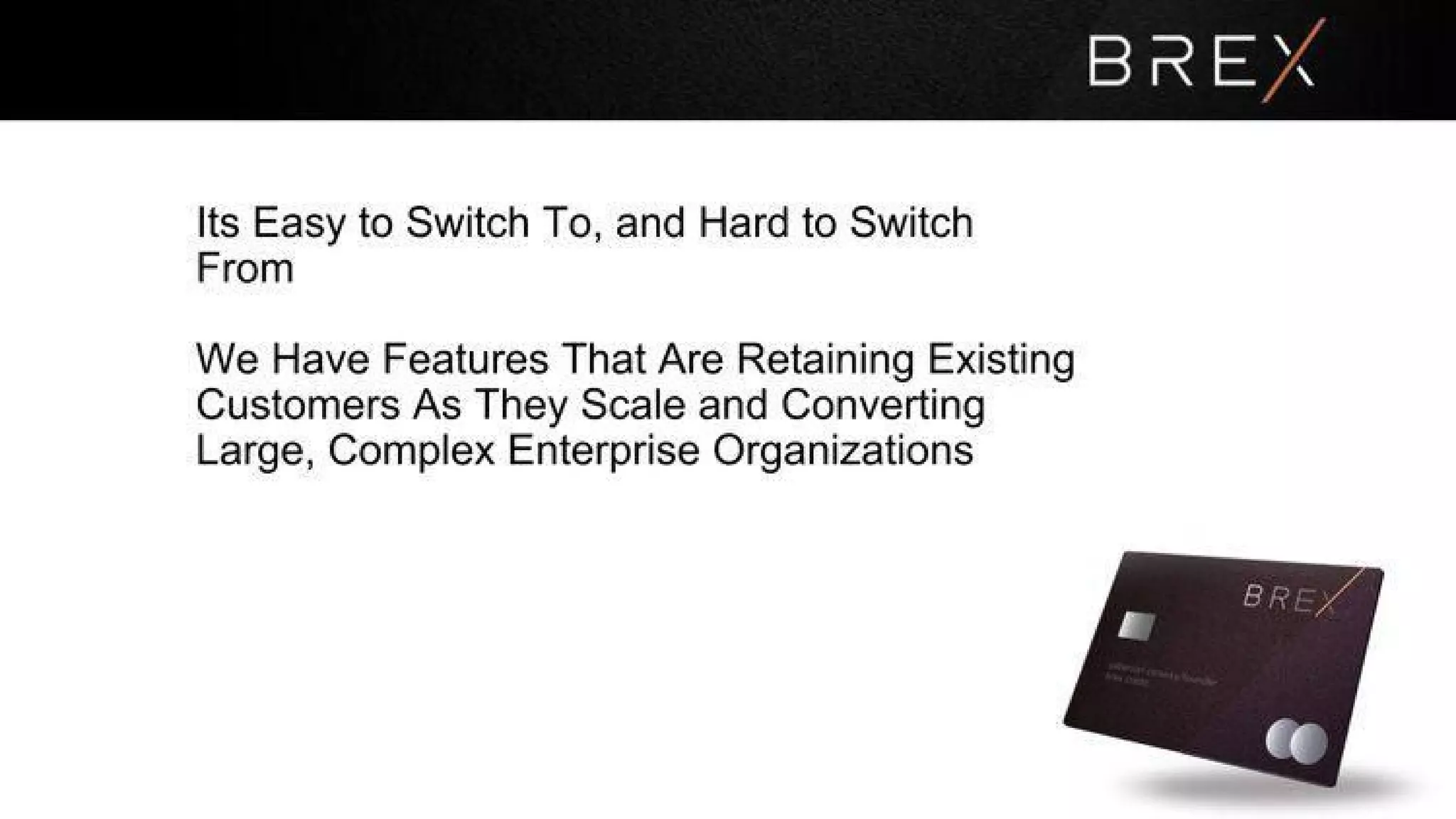
'Easy to switch to, hard to switch from' — Brex card render; features retain customers as they scale into enterprise.
Why it works
Moat framing before feature deep dives. Signals expansion revenue story coming — stickiness matters as much as signup.
Better data
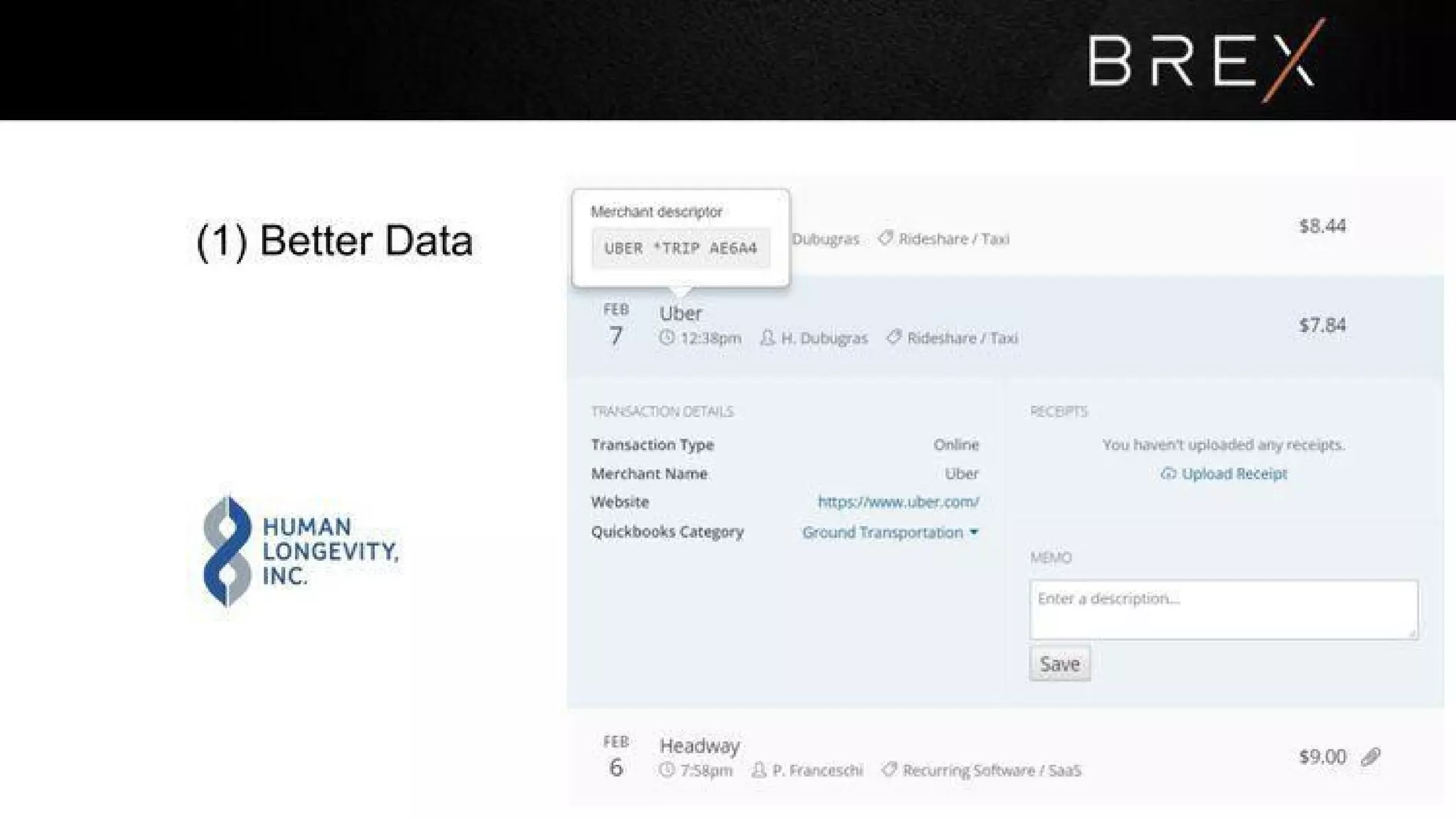
Product UI: enriched Uber transaction for Human Longevity — merchant name, category, QuickBooks mapping vs raw descriptor.
Why it works
Feature #1 with named customer logo. Shows accounting-ready data, not just a card — expense management wedge in one screenshot.
Better controls
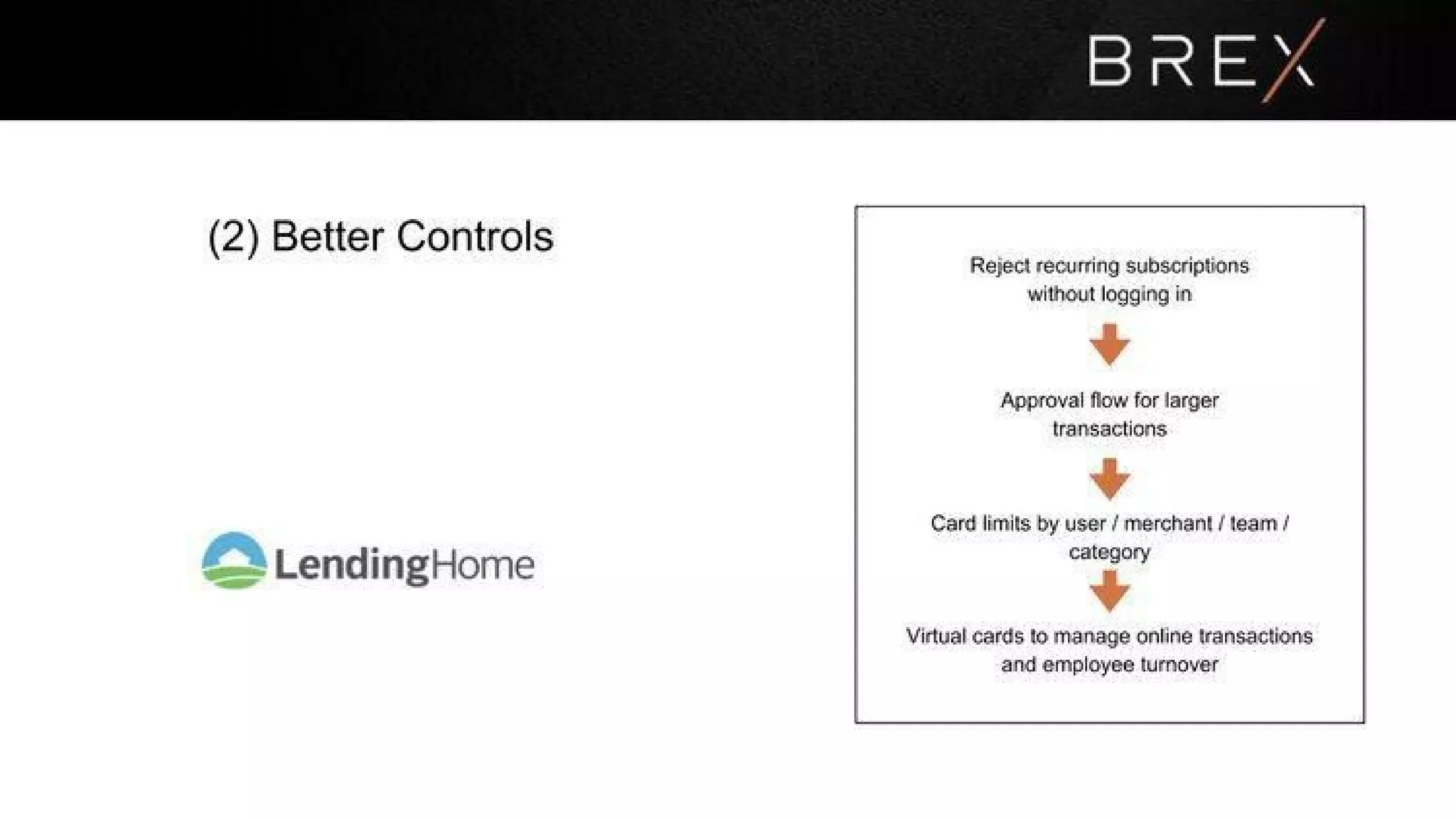
LendingHome example — reject recurring subs, approval flows, limits by user/merchant/team/category, virtual cards for turnover.
Why it works
Feature #2 as a flowchart. Addresses slide 4's control gap with operational policies finance teams actually configure.
Receipt capture
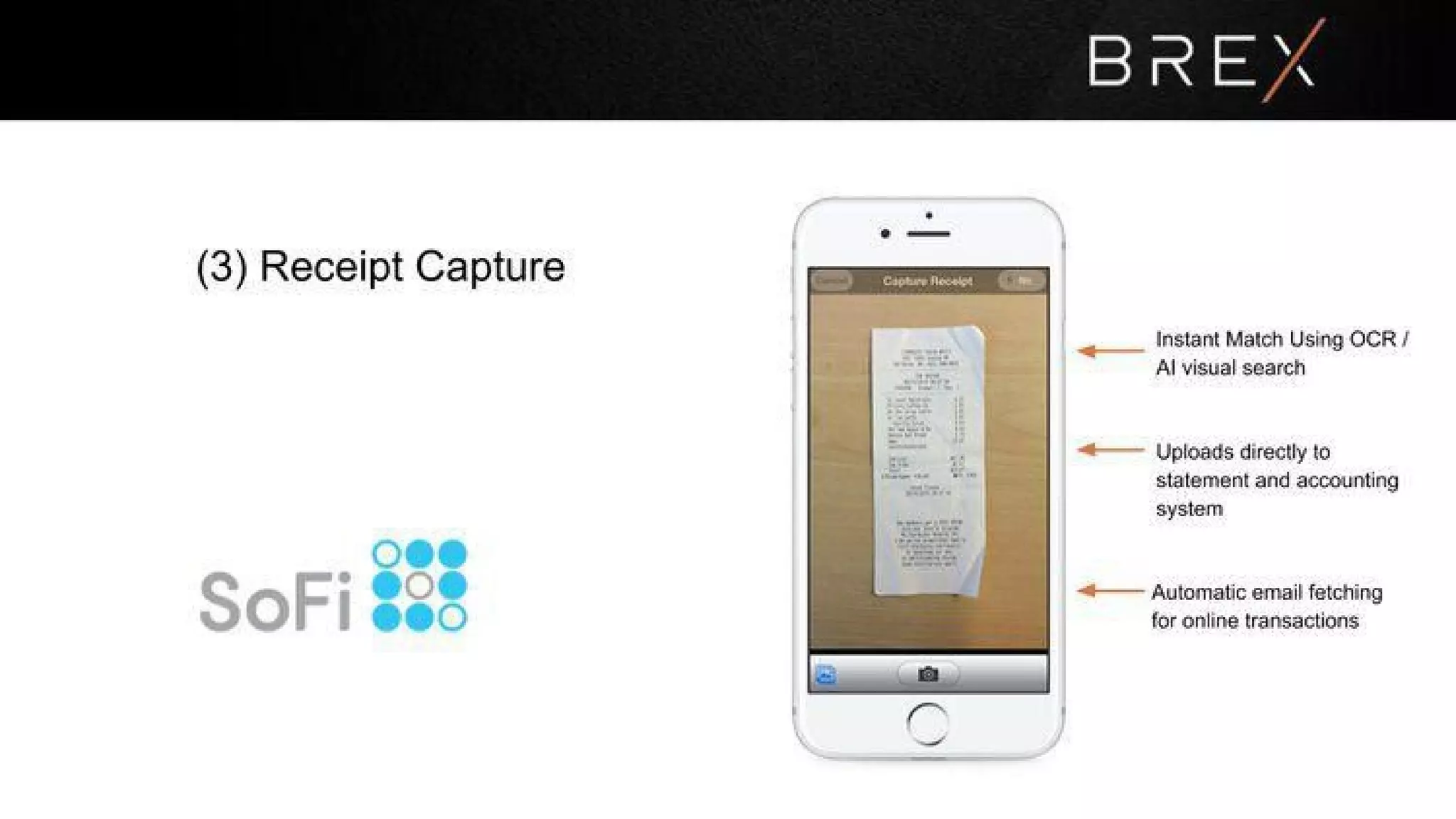
Mobile receipt photo with OCR match, auto-upload to statements/accounting, and email fetching for online purchases.
Why it works
Feature #3 — closes the loop on slide 10 data. SoFi logo adds another reference customer without a testimonial quote.
ERP integrations
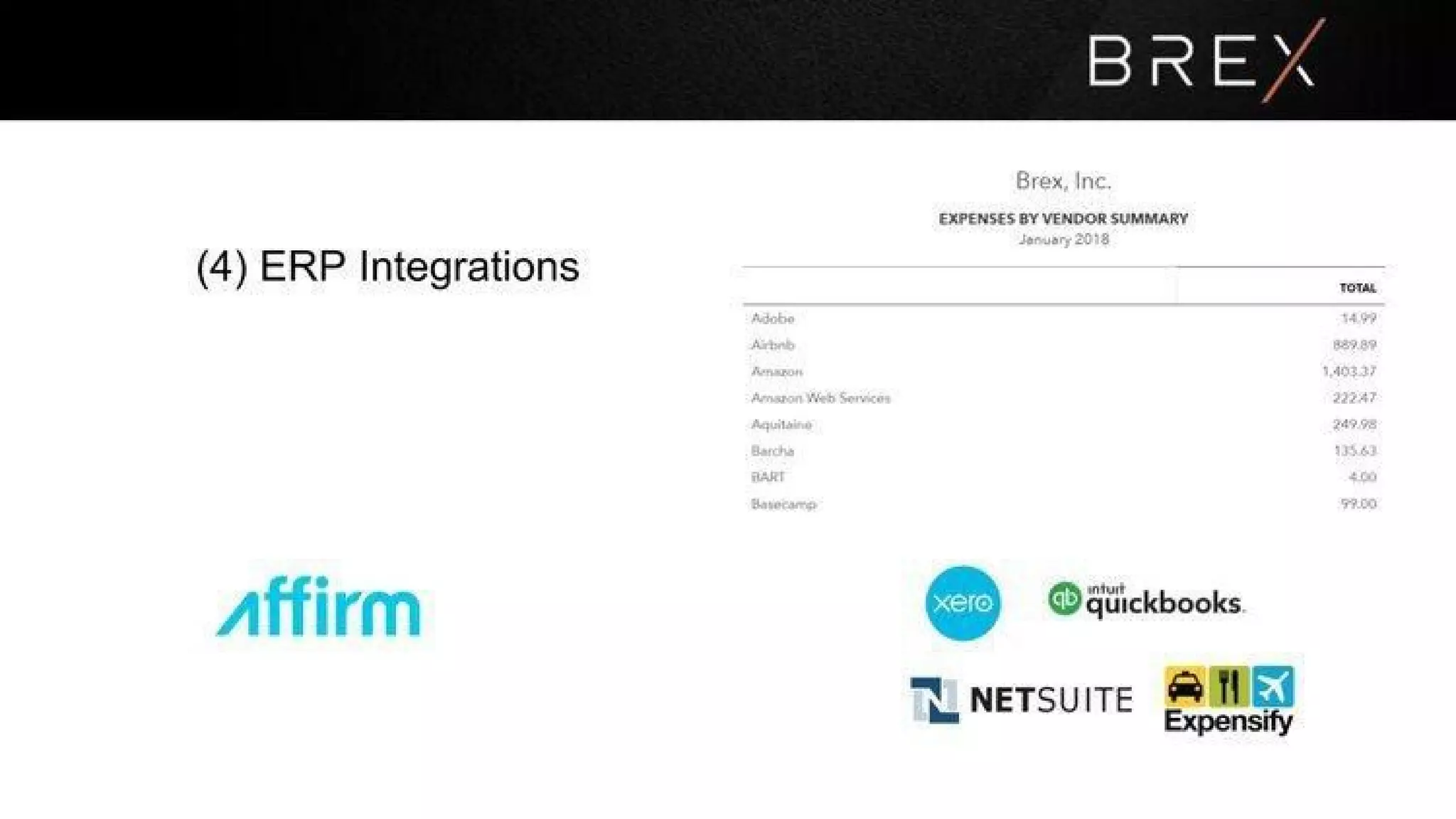
Expenses-by-vendor report plus Xero, QuickBooks, NetSuite, and Expensify logos — Affirm shown as customer.
Why it works
Feature #4 is the integration moat. Named accounting systems tell CFOs Brex slots into existing close processes.
Rewards retention
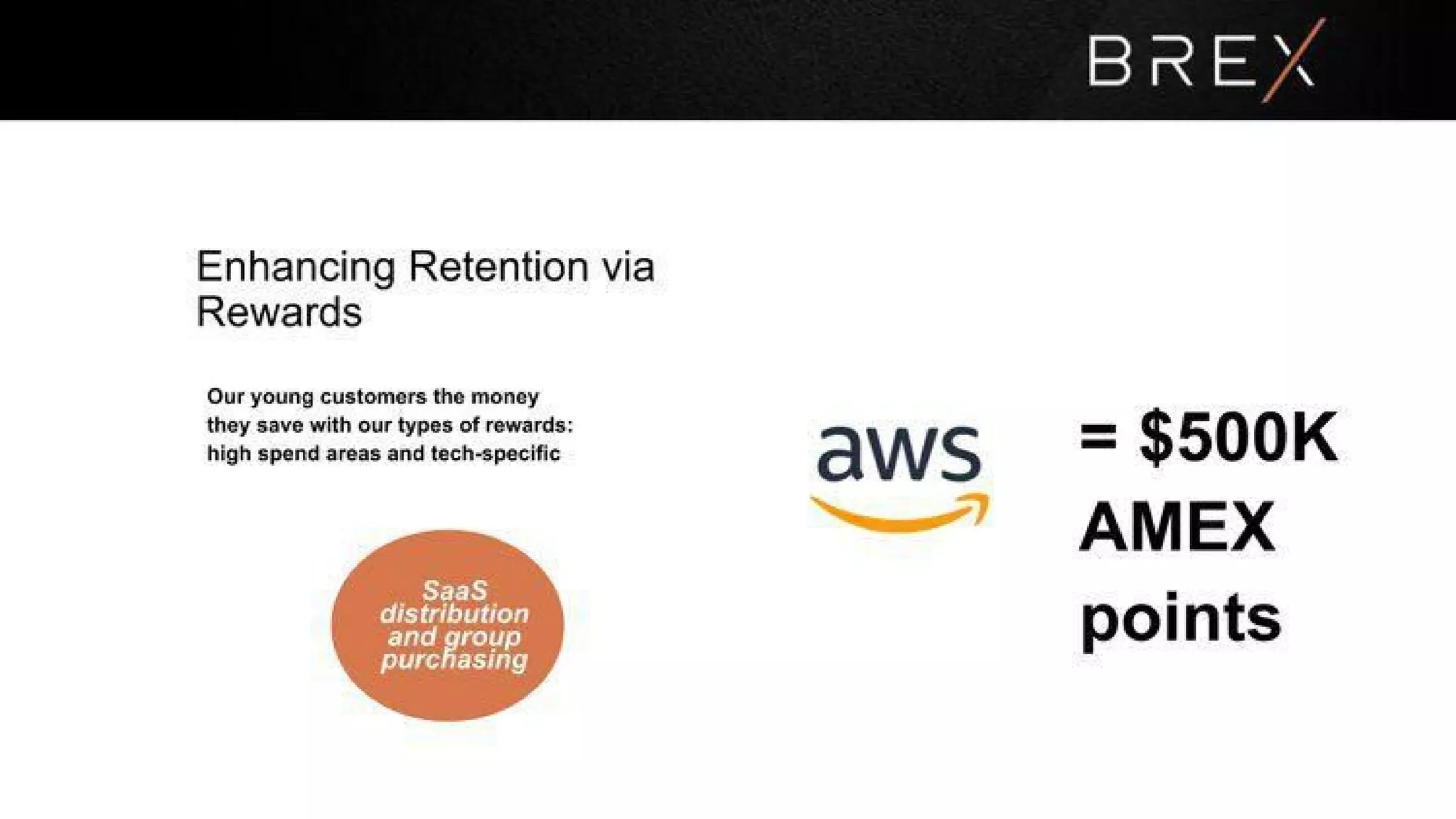
Tech-specific rewards — AWS spend mapped to $500K Amex-points equivalent; SaaS distribution and group purchasing callout.
Why it works
Retention lever beyond software. Rewards slide is sparse on design but hints at interchange economics and partner perks.
Traction — volume
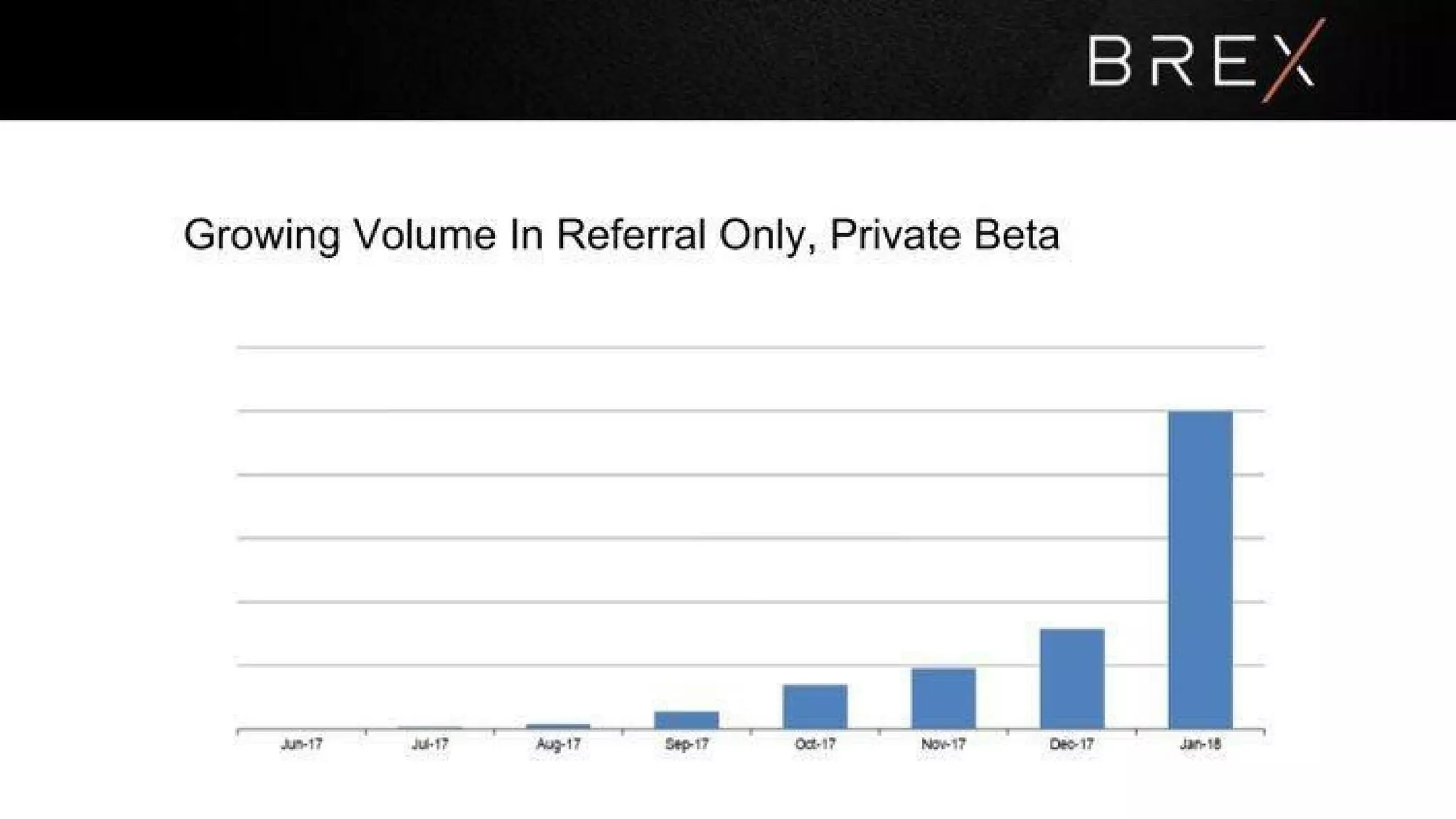
Bar chart: transaction volume Jun 2017–Jan 2018, hockey-stick in referral-only private beta.
Why it works
Inflection slide reviewers remember. Exponential bars on word-of-mouth alone — no paid GTM line item needed yet.
Negative churn
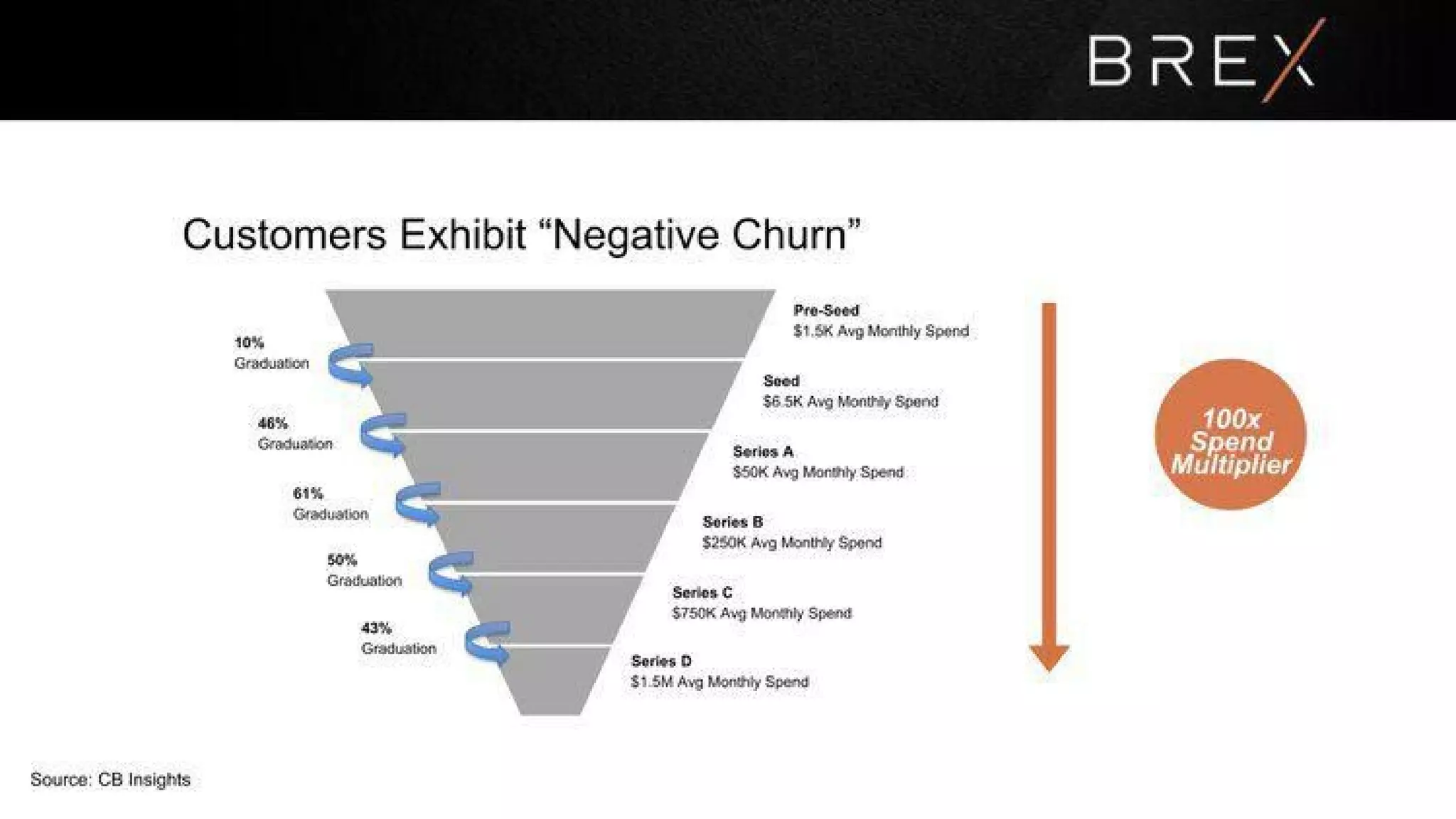
Funnel by funding stage: $1.5K pre-seed → $1.5M Series D avg monthly spend, graduation rates, 100× spend multiplier.
Why it works
CB Insights-sourced expansion math. 'Negative churn' in the title — customers spend more as they grow, not less.
Unit economics
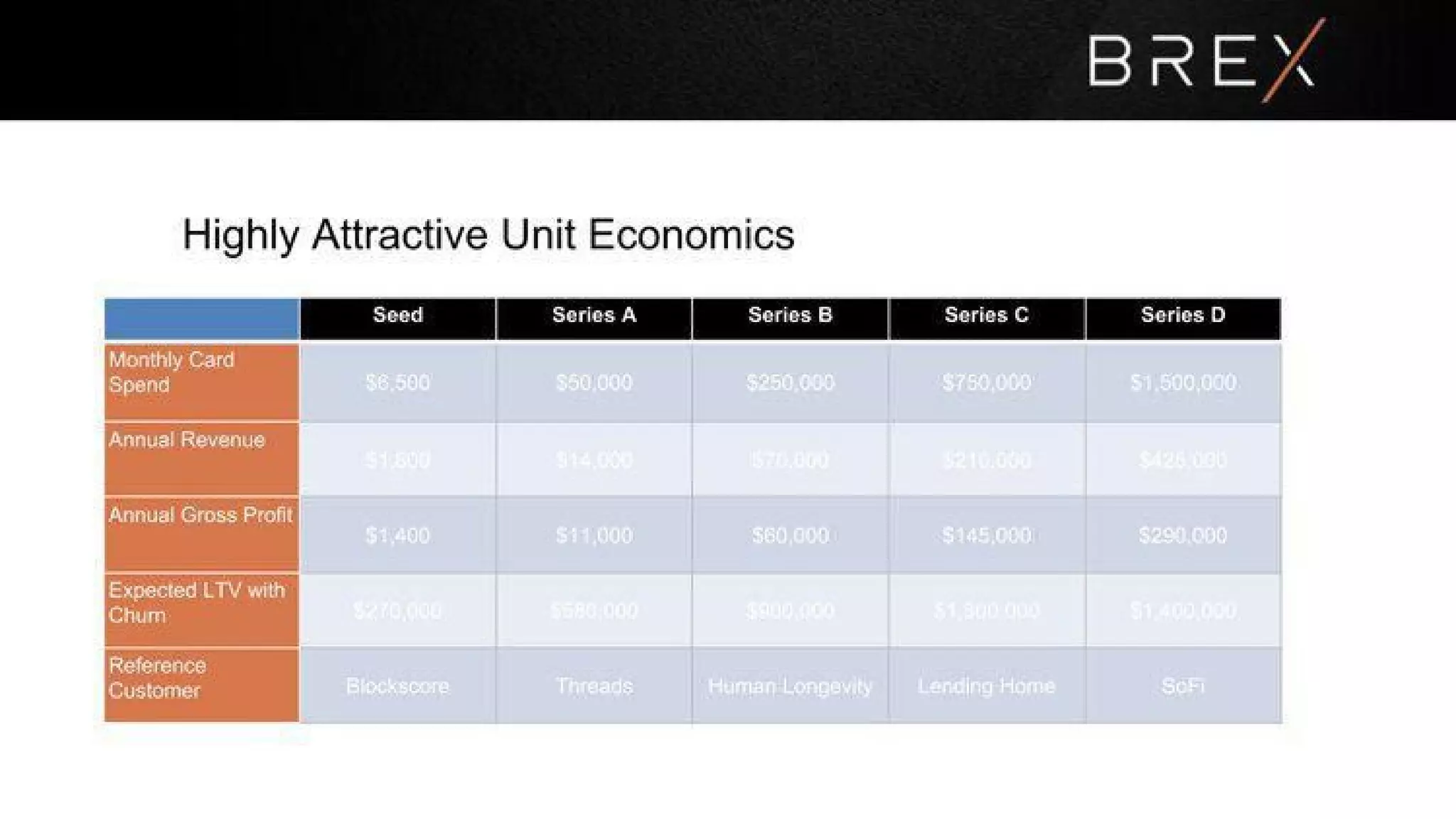
Table by stage: monthly card spend, annual revenue/gross profit, expected LTV — reference customers from Blockscore to SoFi.
Why it works
Investor-grade spreadsheet slide. Named accounts per stage make abstract LTV rows believable; gross profit column shows take rate.
Why us
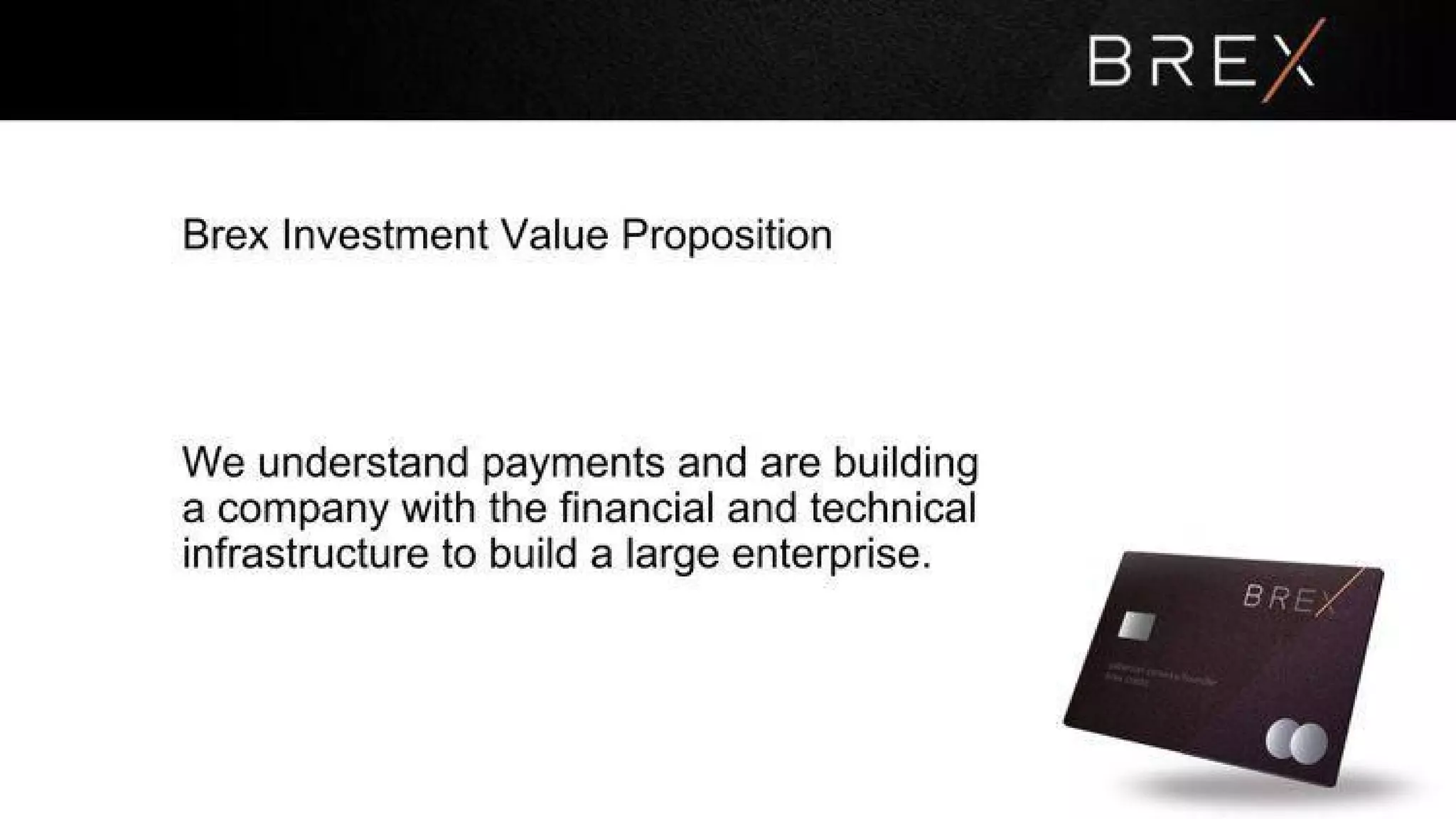
Closing value prop — payments expertise plus financial and technical infrastructure to build a large enterprise; Brex card visual.
Why it works
Mission reprise, not a fundraising ask slide. Circles back to team credentials: they can rebuild B2B payments rails, not just issue cards.
Compare similar investor decks
More series b and fintech presentations in the library.



Your pitch deck, ready before the meeting
Start with your website or idea and see your slides in minutes. Pay only when you download.
Generate a deck