
LinkedIn pitch deck (2004)
Reid Hoffman published LinkedIn's Series B deck after raising $10 million from Greylock in August 2004, with zero revenue, ~900K users, and Friendster/MySpace dominating the social narrative. The 37-slide pitch frames LinkedIn as "professional people search 2.0," steers straight into monetization, and anchors the story with eBay, PayPal, and Google analogies before proving Series A execution.
What founders can steal from LinkedIn's deck
- Steer into the investor's top objection first. Hoffman opened slide 2 with three revenue streams because post-crash VCs doubted consumer internet could make money.
- Pitch by analogy to companies investors already trust, eBay, PayPal, and Google each show how networks beat flat directories before LinkedIn claims the same pattern for careers.
- Show a promise kept from the last round. Series A growth projection vs, actual curve on slides 10–11 is worth more than any forward-looking hockey stick.
- Own a quadrant on the competition matrix, professional vs, social, internet service vs, enterprise software puts LinkedIn alone where the business model lives.
- Build the network first, monetize second, slides 9 and 19–21 argue reputation systems stay free while InLeads, Opportunities, and Network Plus sit on top.
Historical round profile
- Stage
- Series B
- Year
- 2004
- Outcome / Raise
- $10M Series B (Greylock, 2004)
- Business model
- Professional network with recruiting and ads
- HQ
- Sunnyvale, California
Slide-by-slide breakdown (37 slides)
Every slide in LinkedIn's 2004 presentation, what job it performs in the room, and how to adapt the sequence for your own deck.
Cover
LinkedIn Series B, August 2004, logo and tagline "Your network is bigger than you think."
Why it works
Minimal cover: round, date, confidentiality stamp. No vision paragraph. Hoffman saves the investment thesis for slide 2 and repeats it on slide 37 for Q&A.
Professional People Search 2.0
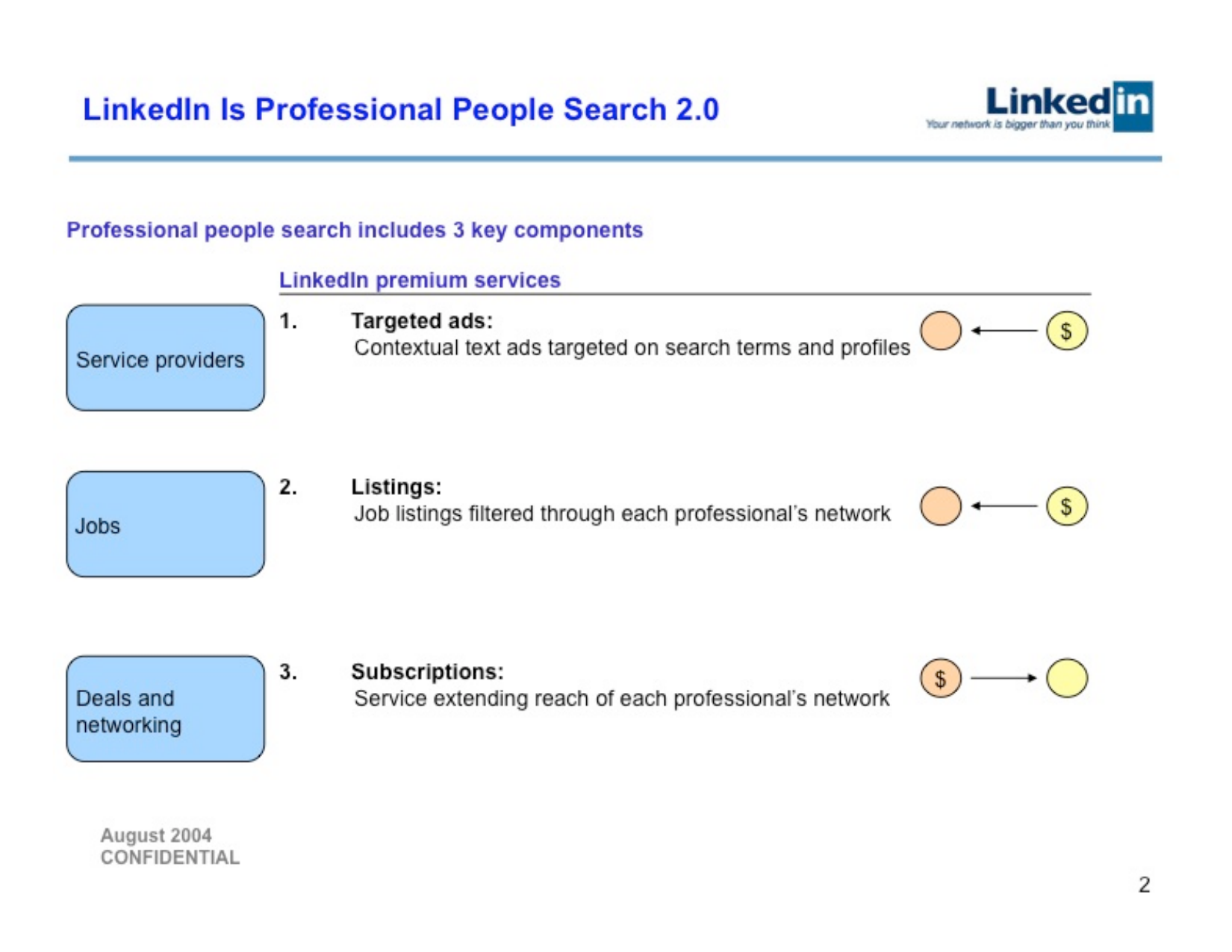
Three premium services mapped to markets: targeted ads for service providers, job listings filtered through networks, and subscriptions extending professional reach.
Why it works
Hoffman's boldest move, revenue before traction. In 2004's post-crash climate, consumer internet decks died on "how do you make money?" He answers it in the first two minutes.
Problem
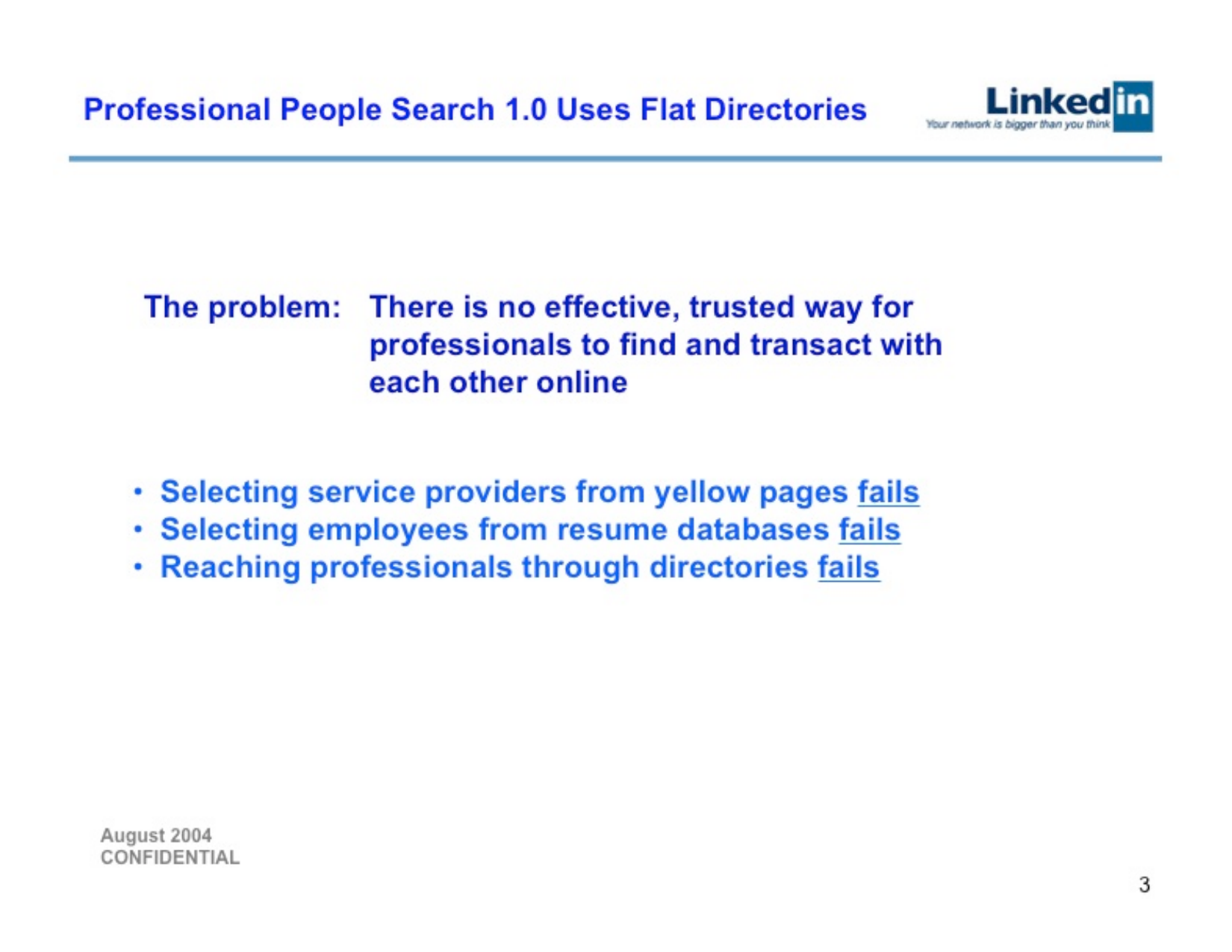
Professional people search 1.0 uses flat directories, yellow pages, resume databases, and offline directories all fail to find and transact with professionals online.
Why it works
Three named failure modes with underlined "fails." Each maps to adverse selection: sellers misrepresent quality, top talent opts out, and directories need critical mass. Sets up the network as the fix.
Solution
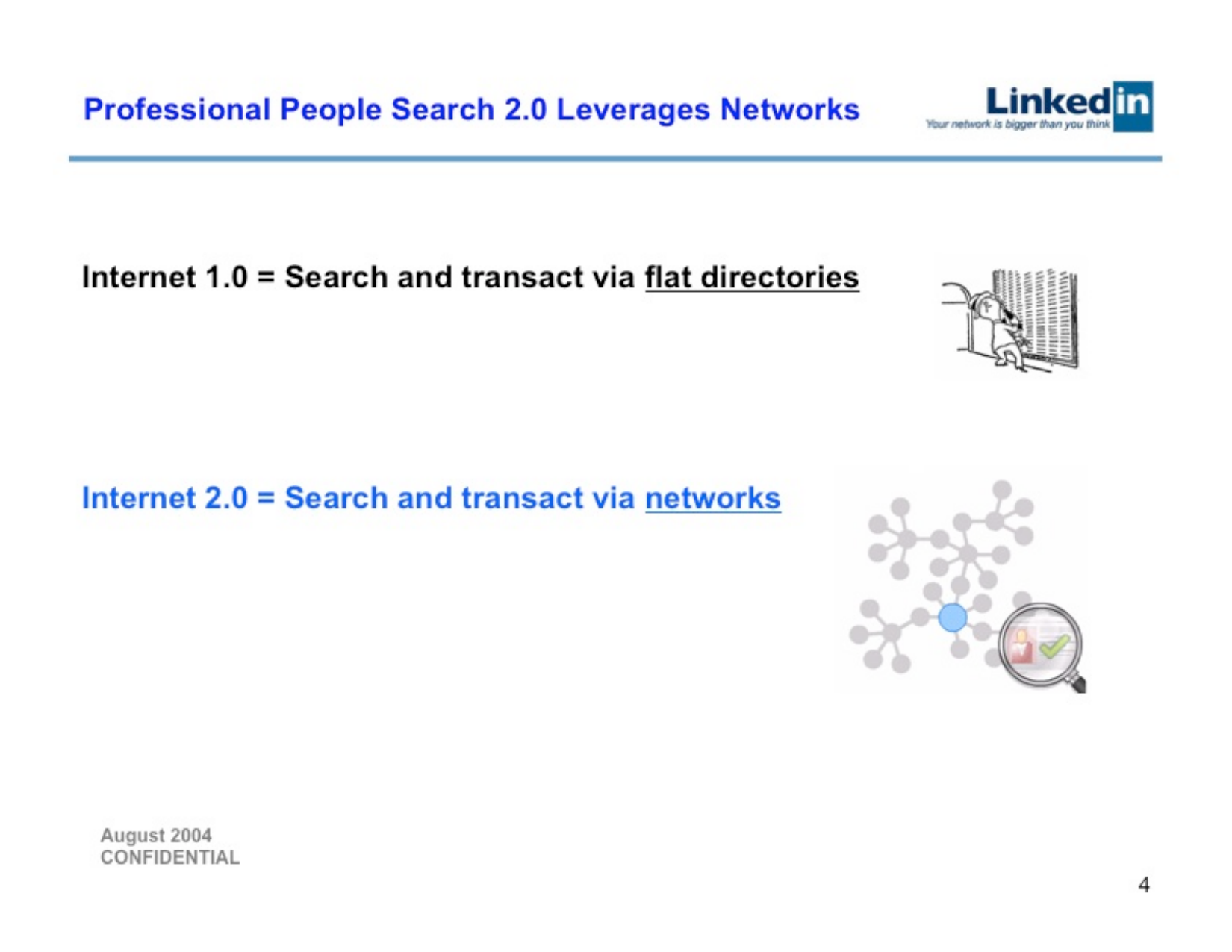
Internet 2.0 searches and transacts via networks, not flat directories, illustrated with a network graph and magnifying glass over a verified profile.
Why it works
Coined "Internet 2.0" before O'Reilly popularized Web 2.0. One simple concept slide: the network is the platform for a new kind of people search that supports many businesses on top.
eBay analogy
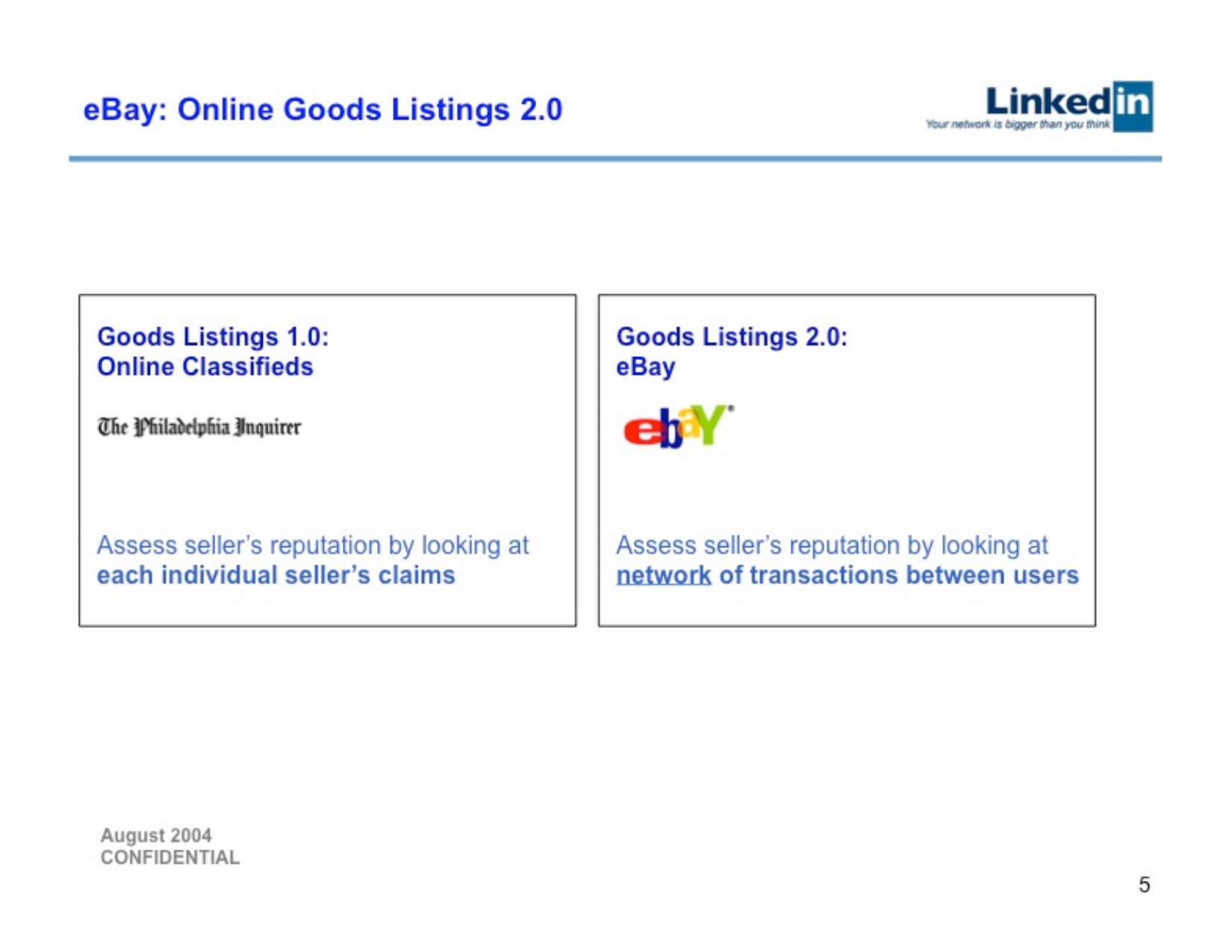
Online classifieds assess sellers by individual claims; eBay assesses reputation through a network of transactions between users.
Why it works
First of three analogy slides. Newspaper classifieds vs, eBay makes the 1.0→2.0 shift concrete, investors already understood eBay's trust layer was the product.
PayPal analogy
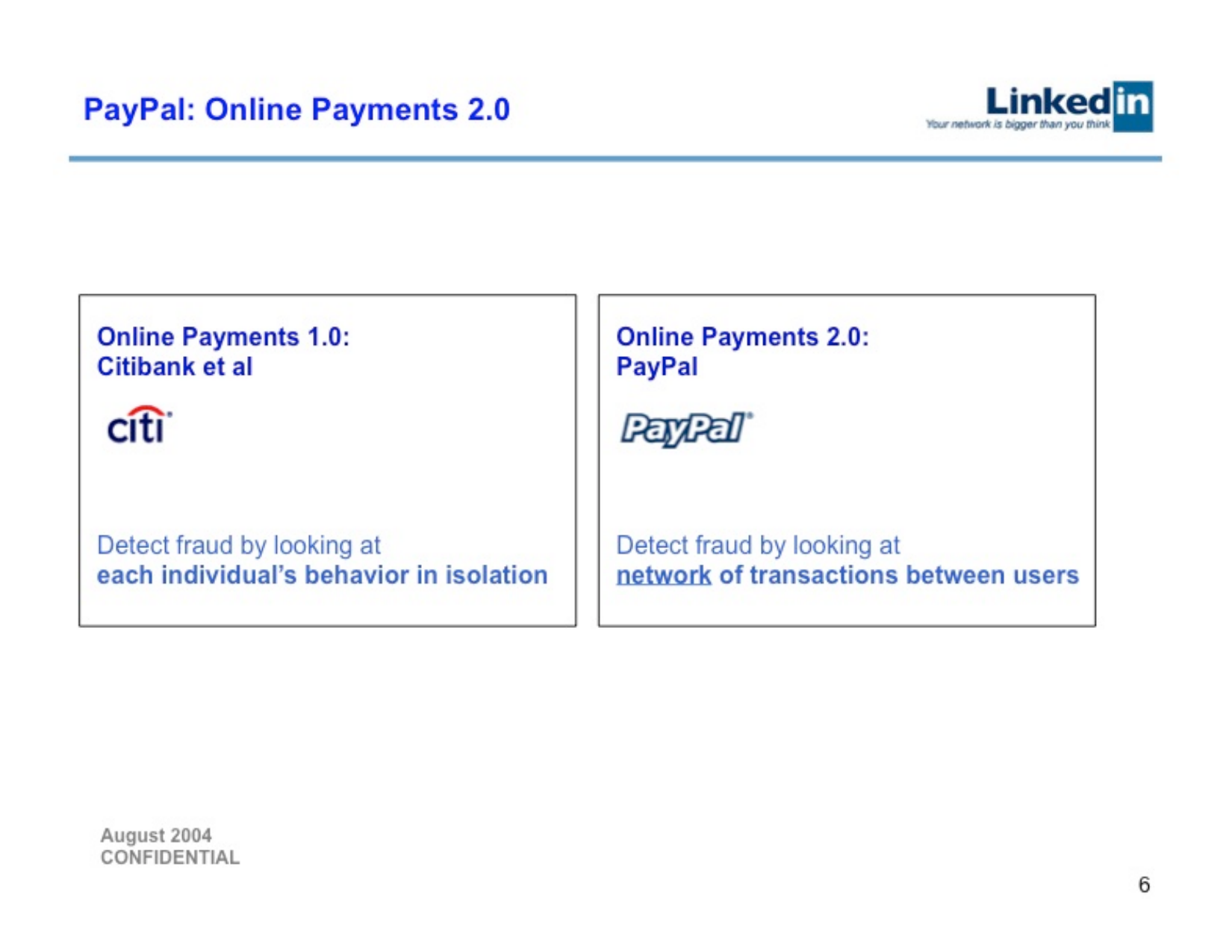
Citibank detects fraud by looking at each user in isolation; PayPal detects fraud through the network of transactions between users.
Why it works
PayPal also reminds the room Hoffman co-founded it, show, don't tell. Network data beats isolated signals; the same logic applies to professional trust and reference checking.
Google analogy
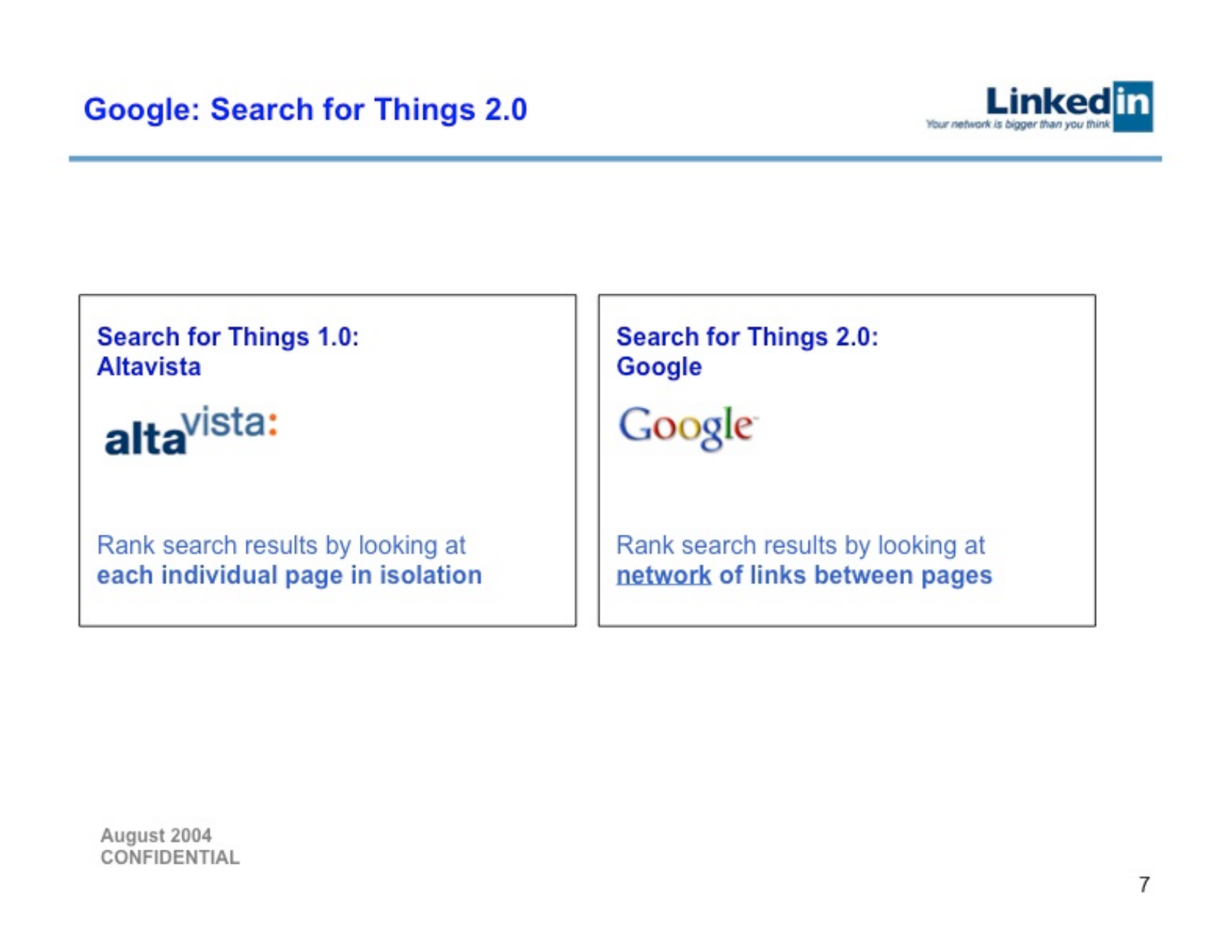
AltaVista ranks pages in isolation; Google PageRank ranks search results using the network of links between pages.
Why it works
Third analogy lands the pattern: networks amplify value in goods (eBay), payments (PayPal), and search (Google). LinkedIn is the professional-people variant investors can extrapolate from.
LinkedIn positioning
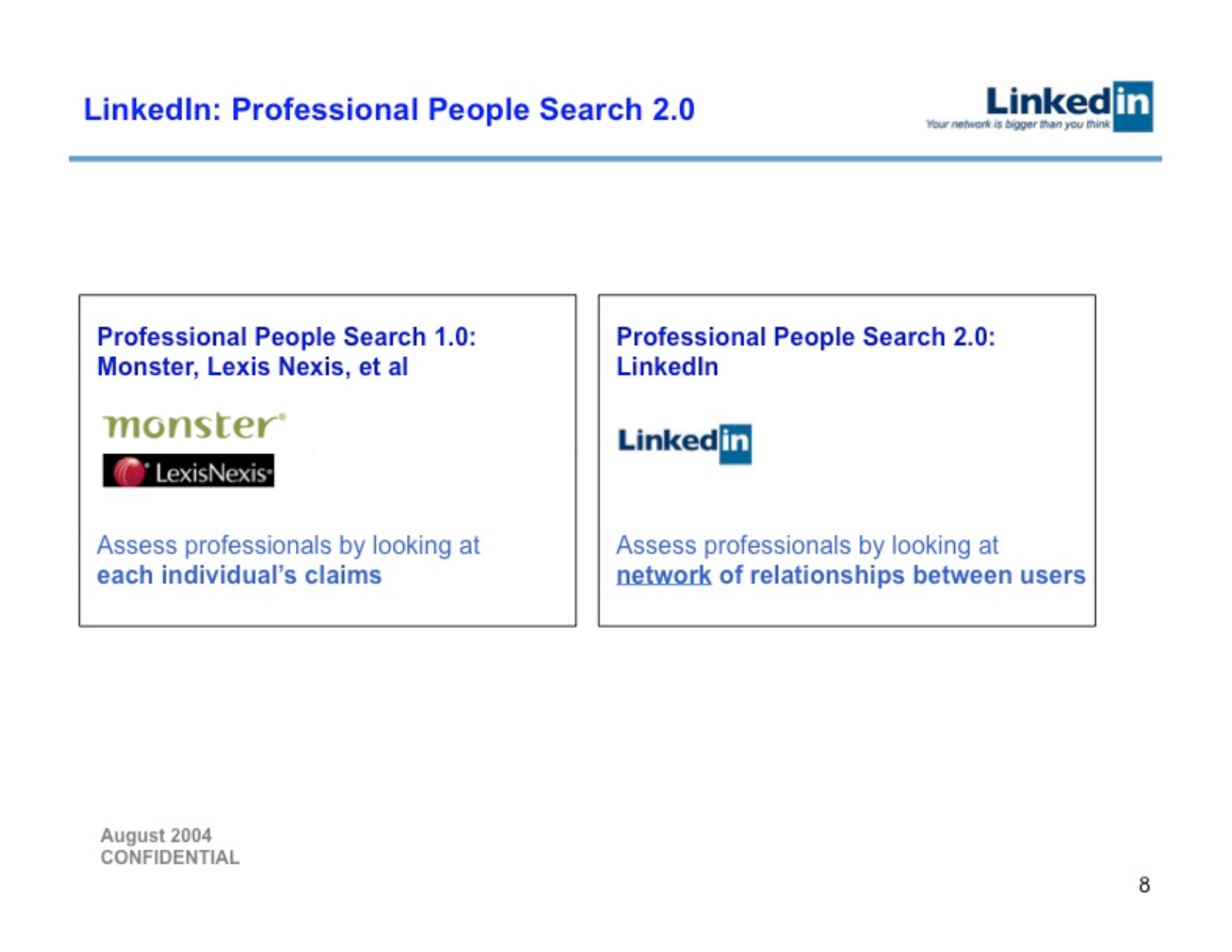
Monster and LexisNexis assess professionals by individual claims; LinkedIn assesses them through the network of relationships between users.
Why it works
Applies the 2.0 template directly to the category. Monster and LexisNexis are named comparables with real revenue. Hoffman asks investors to apply the same network multiplier to LinkedIn.
Establishing the network
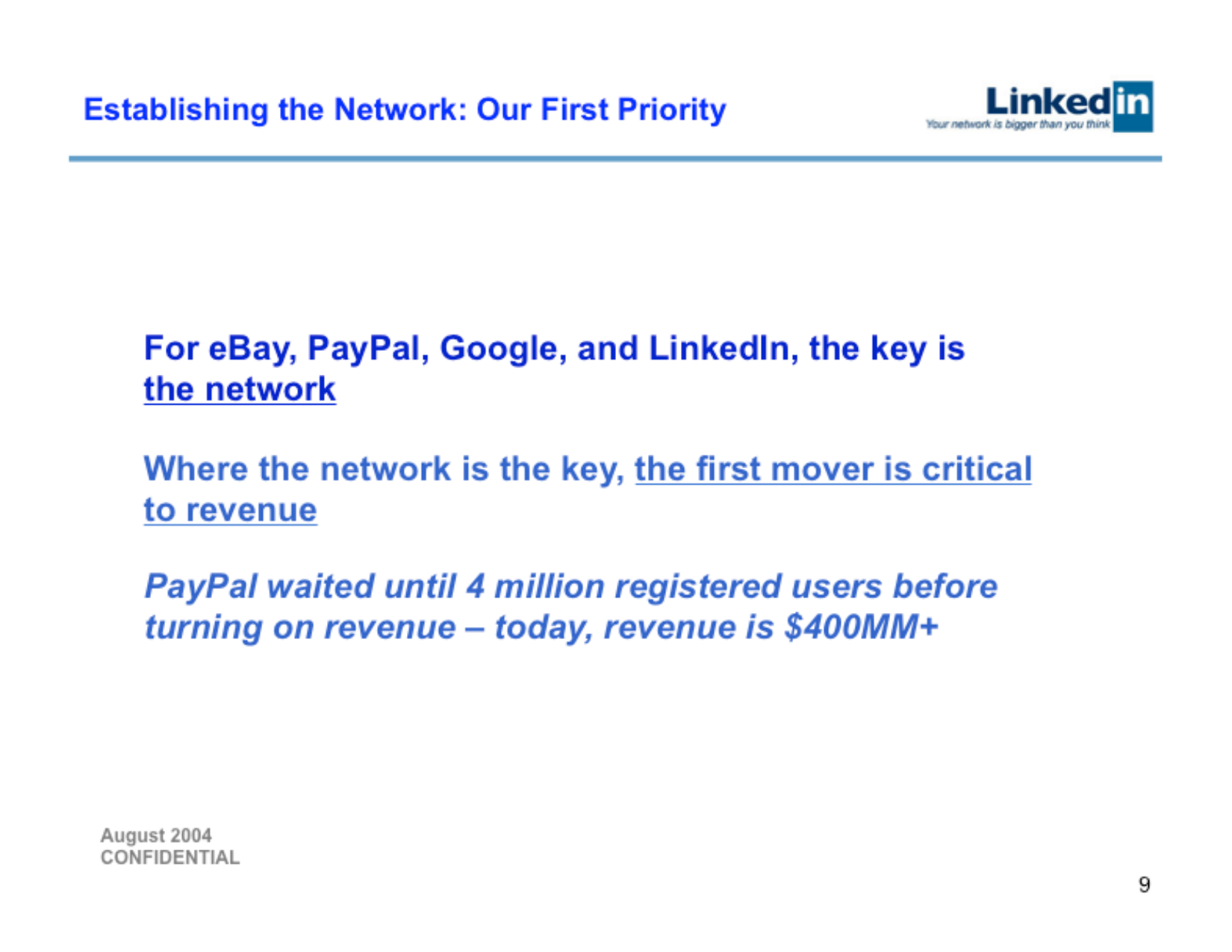
For eBay, PayPal, Google, and LinkedIn the network is the key; first mover is critical to revenue. PayPal waited until 4M users before monetizing to $400M+.
Why it works
Defends spending Series A on growth with zero revenue. PayPal precedent tells Greylock: build the graph first, turn on money later. First-mover framing justifies the $10M ask.
Series A commitment
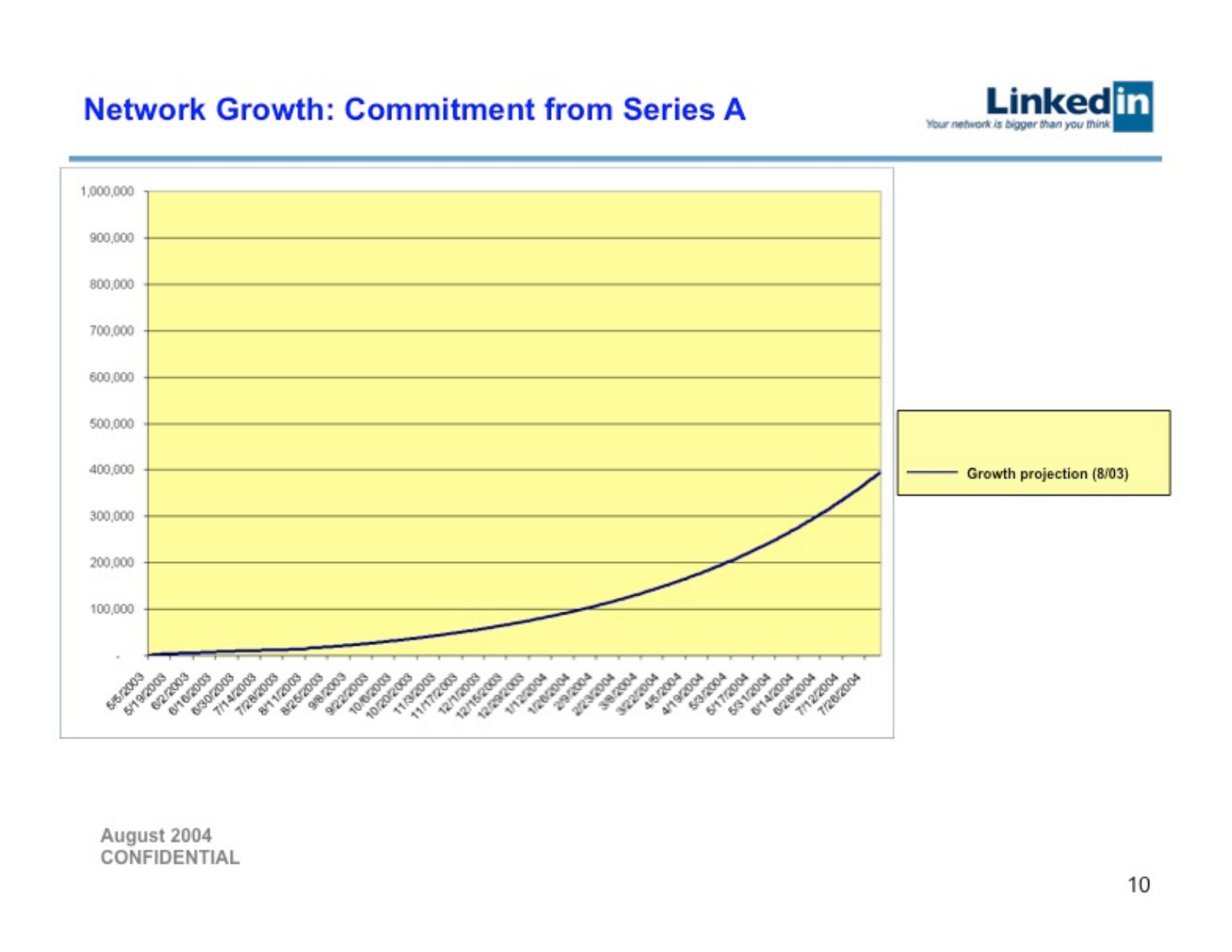
Network growth projection from the August 2003 Series A pitch, curve toward ~400K users by mid-2004.
Why it works
Sets up the next slide's punchline. Hoffman deliberately under-promised in Series A so he could over-deliver here, founder credibility beats any forward projection.
Network growth success
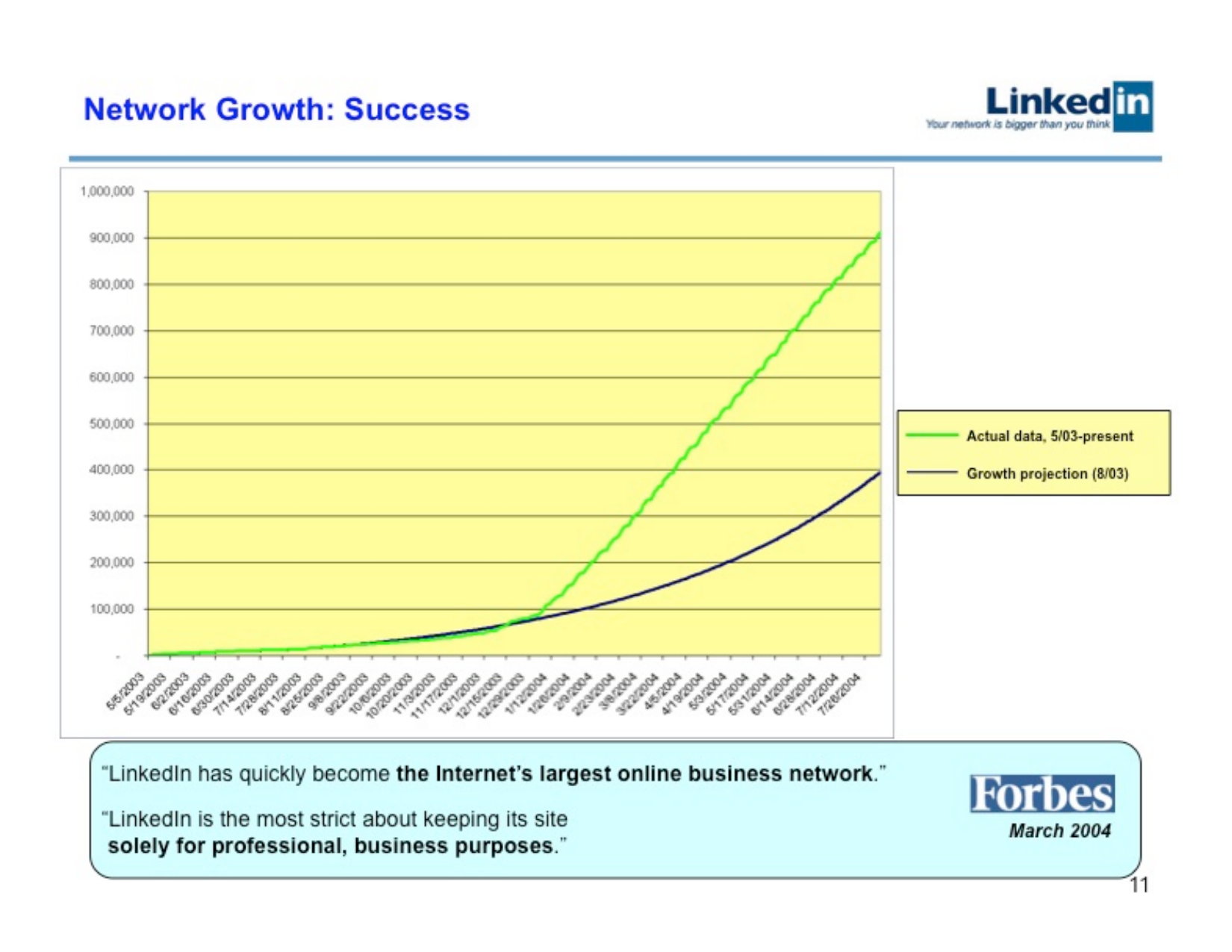
Actual user growth far exceeds the Series A projection, approaching 1M users by July 2004, with Forbes calling LinkedIn the largest online business network.
Why it works
Green actual line vs, blue projection is the deck's trust anchor. Forbes quotes add third-party validation. Investors fund teams that keep promises, not teams that only promise.
Market leadership
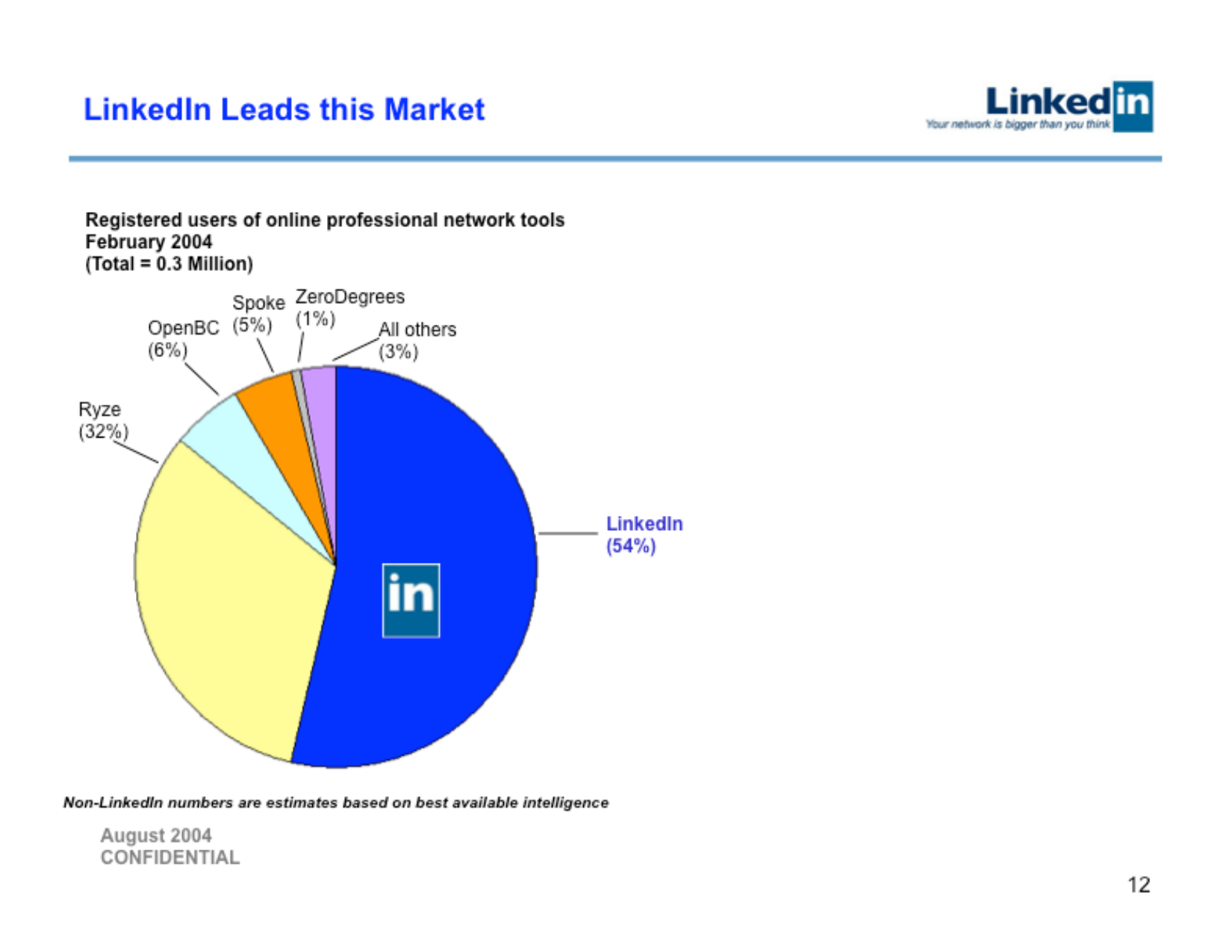
February 2004 pie chart: LinkedIn holds 54% of registered users in online professional network tools (0.3M total market), ahead of Ryze, OpenBC, and Spoke.
Why it works
Category creation slide, defines "online professional network tools" and shows LinkedIn already winning half. Small absolute numbers, but winner-take-most dynamics start here.
Growing the lead
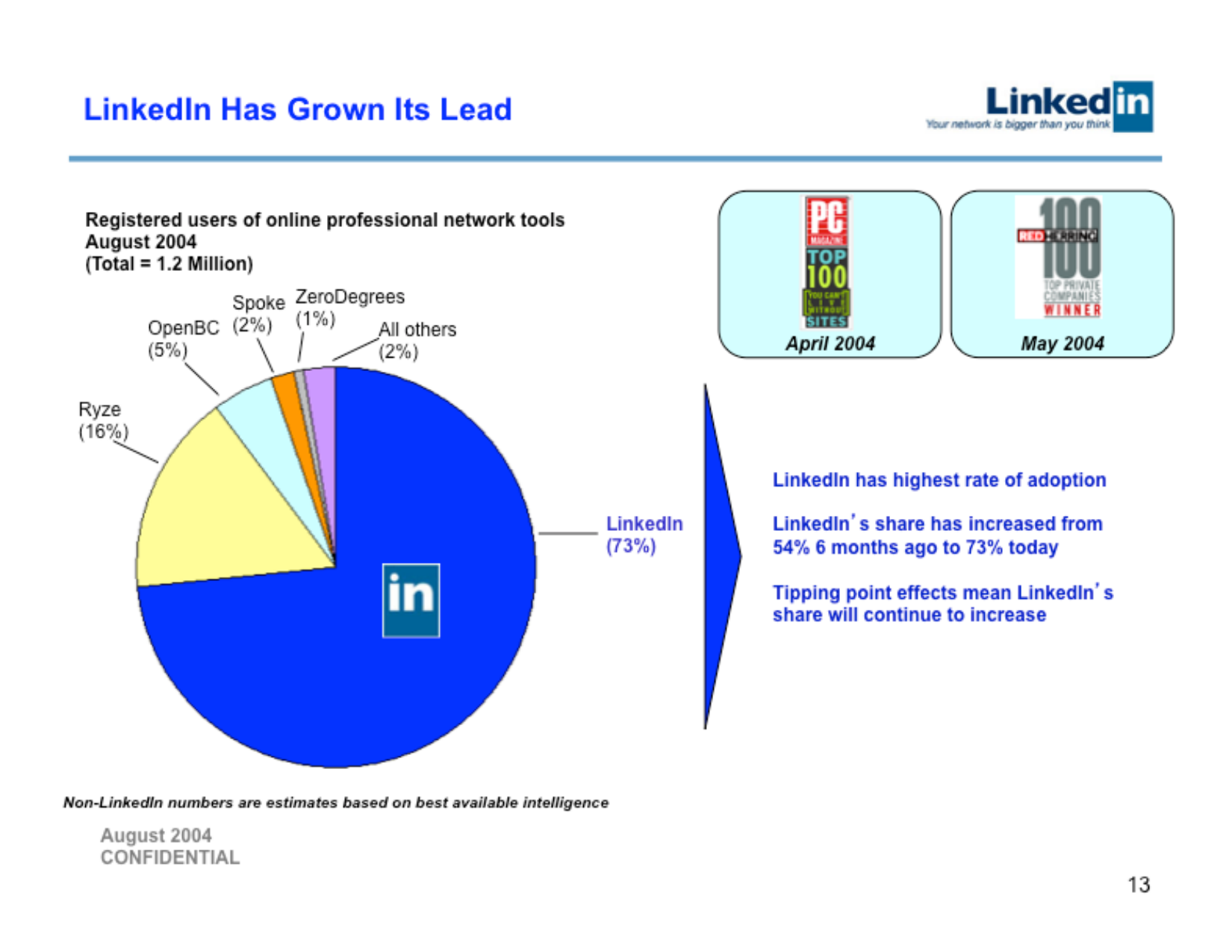
August 2004: LinkedIn's share rises from 54% to 73% of 1.2M registered users; PC Magazine and Red Herring awards reinforce tipping-point momentum.
Why it works
Six-month share gain in one chart. "Tipping point effects" language signals network effects before that term was startup cliché. Trend beats absolute scale when you're sub-Friendster.
Competition
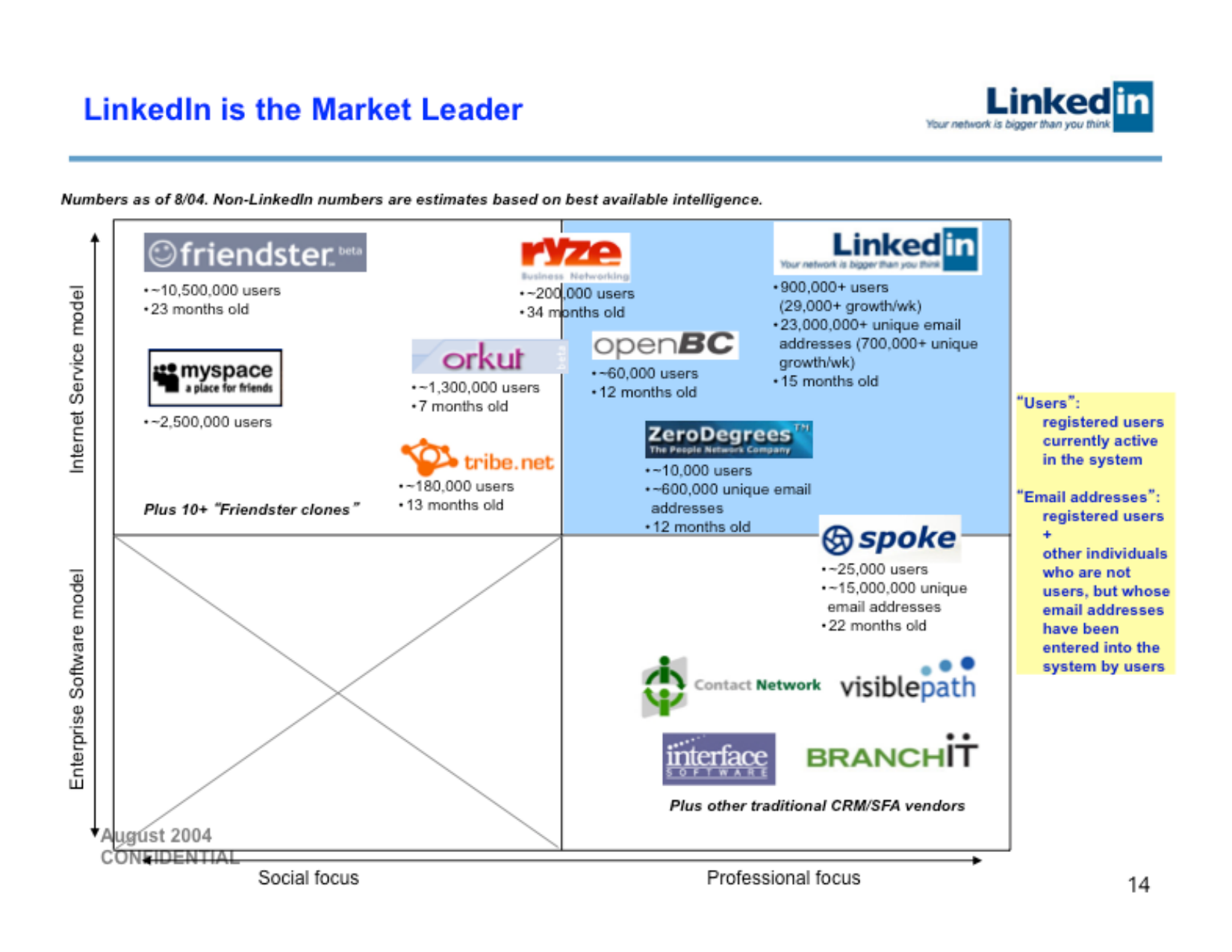
2×2 matrix: social vs, professional focus, enterprise software vs, internet service. LinkedIn alone in professional-internet with 900K+ users, 29K weekly growth, and 23M email addresses.
Why it works
Friendster and MySpace sit in social-internet; Spoke and BranchIT in enterprise-professional. LinkedIn owns the quadrant that matches its business model, the wedge is visual, not a feature list.
Groups and brand endorsement
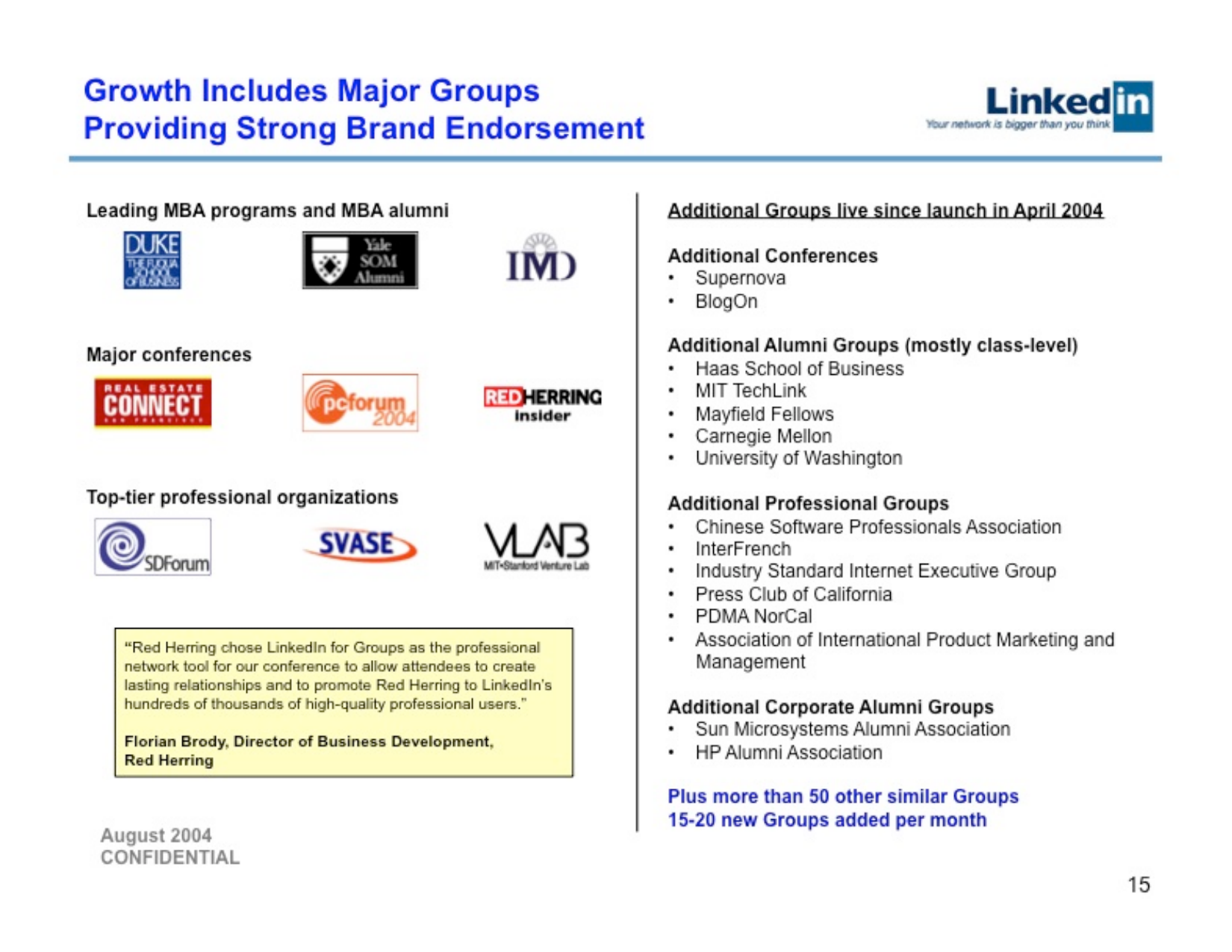
MBA programs, conferences, and professional orgs (Fuqua, Red Herring, SDForum) use LinkedIn Groups. 50+ live, 15–20 new per month since April 2004.
Why it works
Hoffman later calls this a mistake for consumer internet, enterprise customer logos rarely predict grassroots adoption. Included because Series B traction was thin and nerves were high.
Series A results
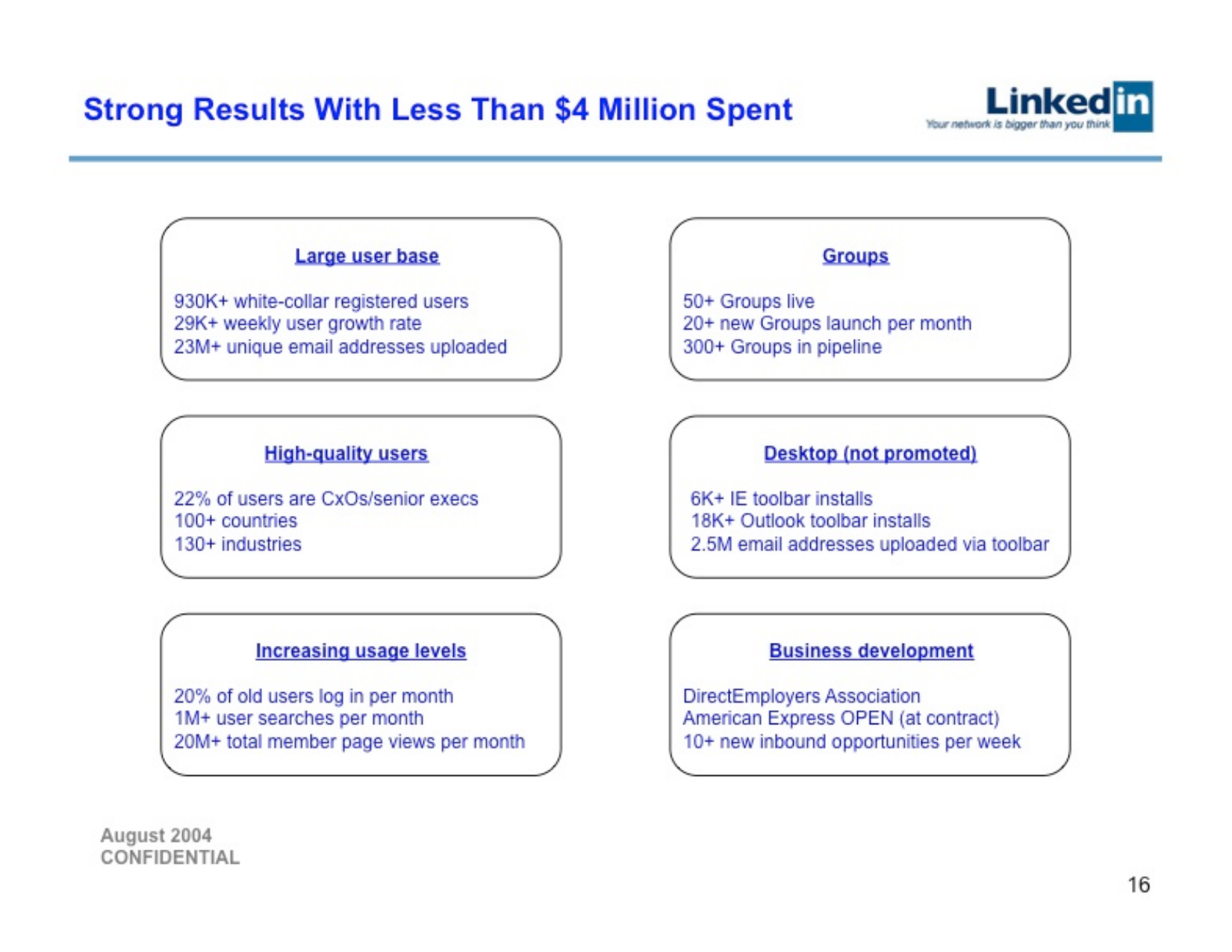
Six boxes on <$4M spent: 930K+ users, 50+ Groups, 22% CxO/senior execs, 1M+ searches/month, toolbar uploads, and inbound BD opportunities.
Why it works
Execution proof after the concept pitch. Dense metrics grid shows capital efficiency, every Series A dollar bought users, engagement, and pipeline before revenue existed.
Business development
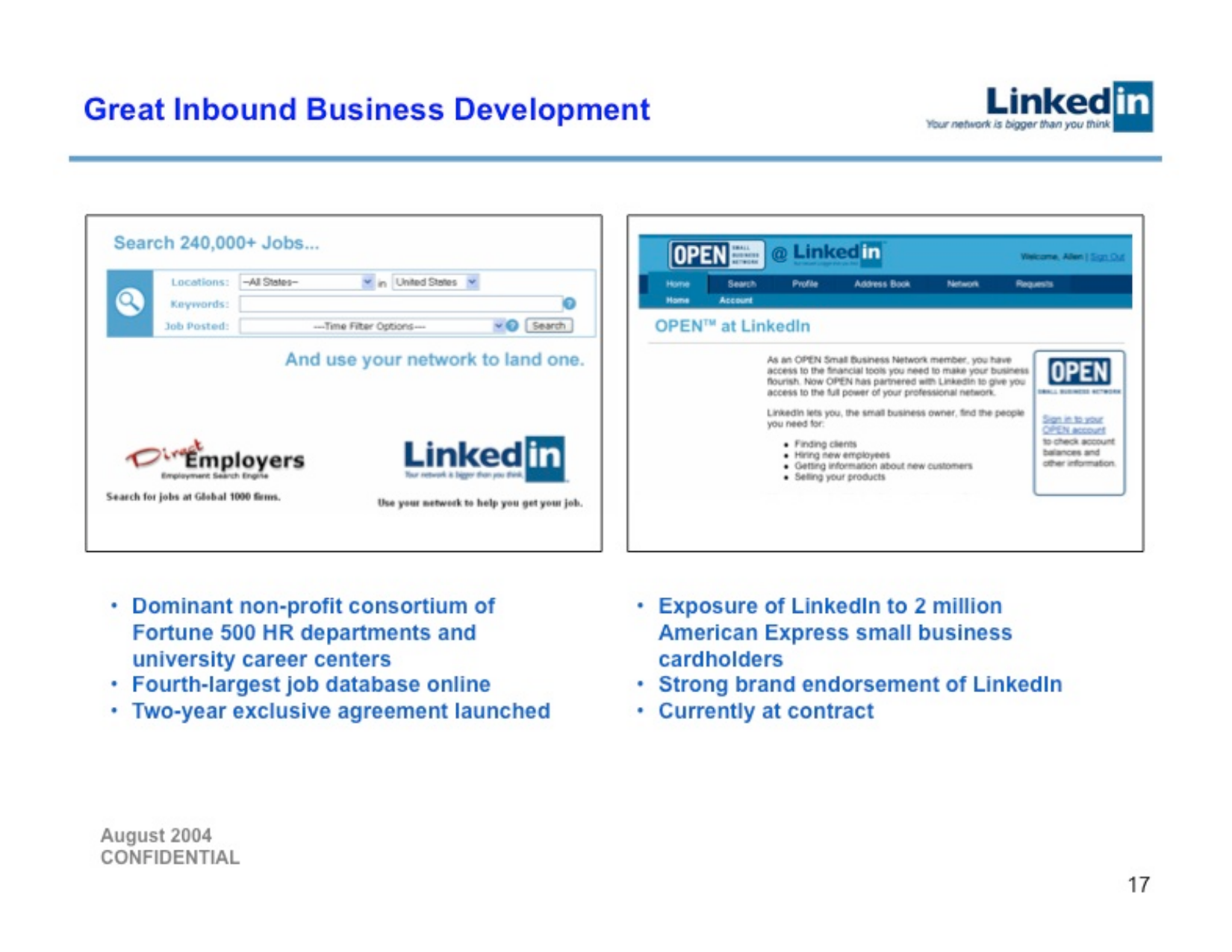
DirectEmployers two-year exclusive job search partnership and American Express OPEN co-brand exposing LinkedIn to 2M small-business cardholders.
Why it works
Partnership slide hedges organic-growth anxiety. Hoffman admits neither deal delivered lasting value, but in the room they signaled enterprise interest in the professional graph.
Barriers to entry
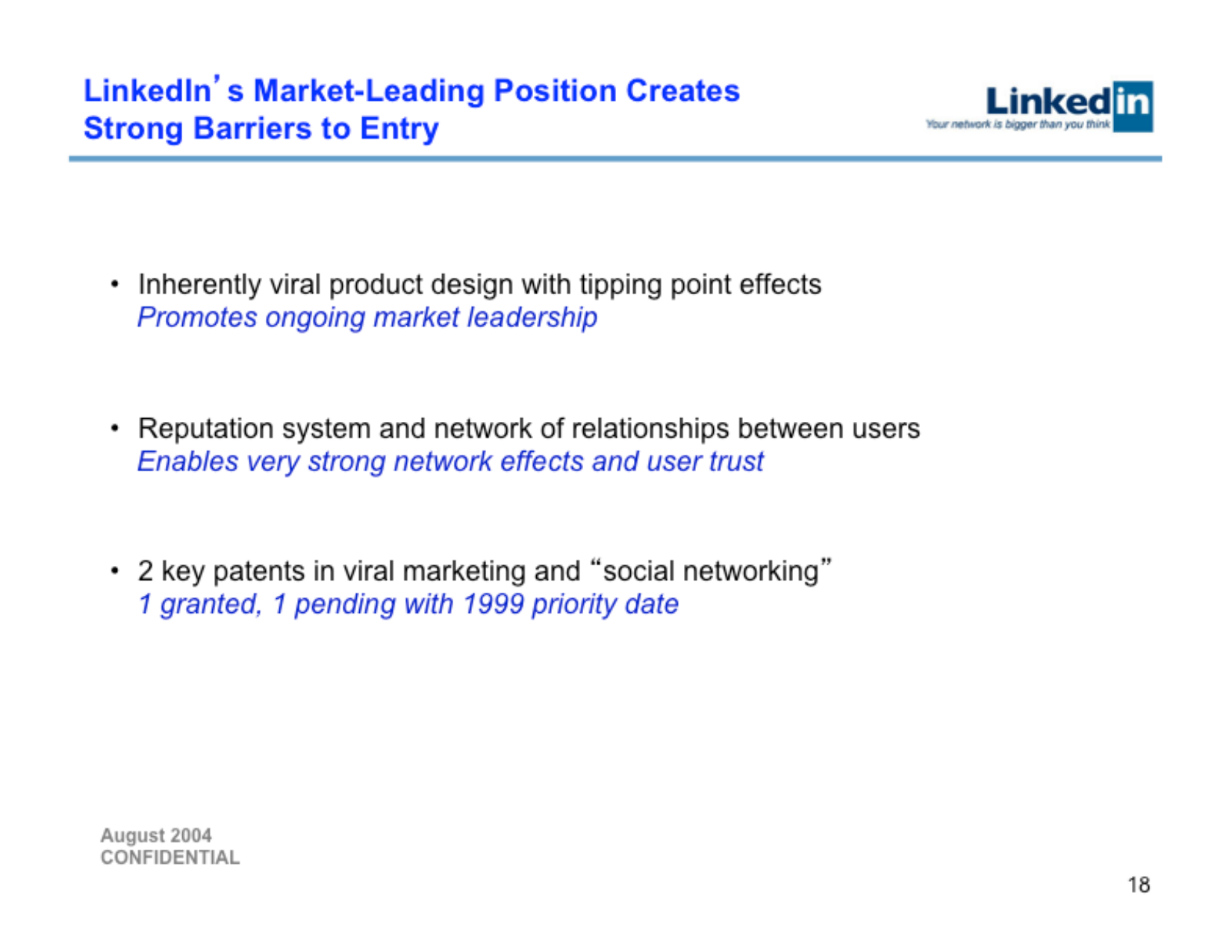
Viral product design with tipping points, reputation-driven network effects, and two patents in viral marketing and social networking (one granted, one pending).
Why it works
Moat slide without buzzwords, virality, trust graph, and IP. Asserts network effects rather than proving viral mechanics (Hoffman saved that for the live pitch).
Network enables revenue
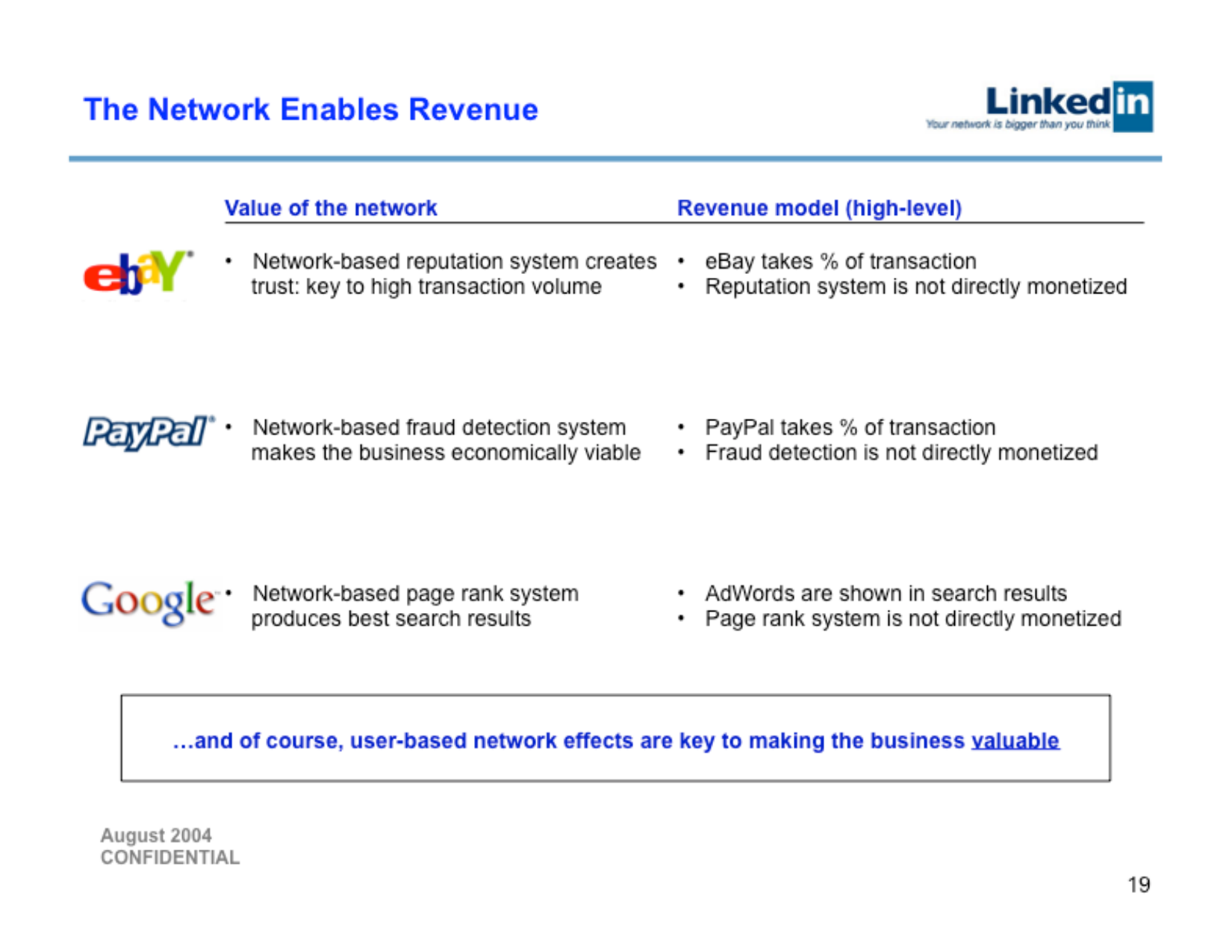
eBay, PayPal, and Google each monetize transactions and ads while keeping reputation, fraud detection, and PageRank free, network effects make the business valuable.
Why it works
Bridges analogy section to LinkedIn monetization. Pattern: free network layer, paid applications on top. Investors who bought the eBay/PayPal/Google story can accept the same architecture here.
LinkedIn revenue model
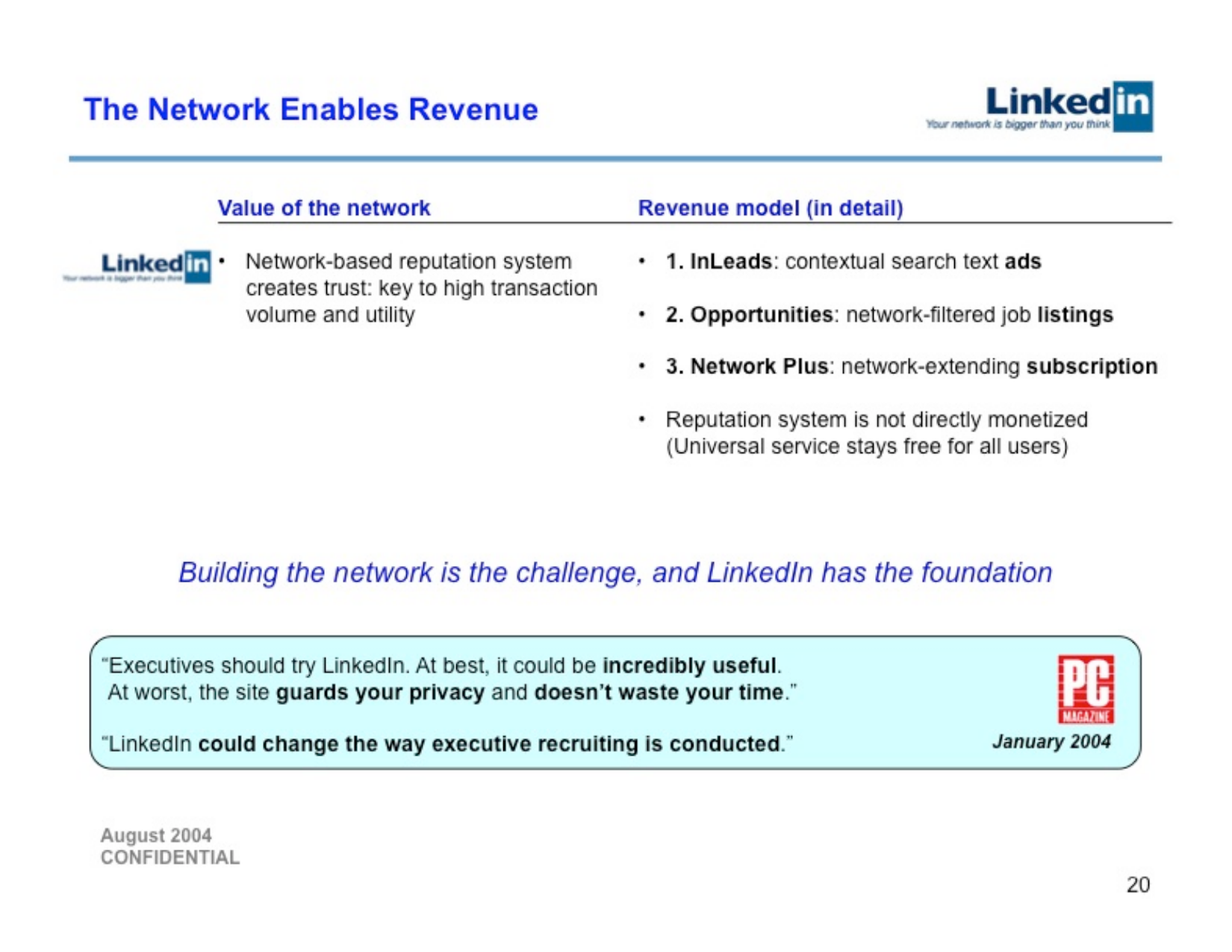
LinkedIn's network trust enables three products: InLeads (contextual search ads), Opportunities (network-filtered job listings), and Network Plus (subscription), universal service stays free.
Why it works
Maps the slide-2 revenue question to named SKUs. PC Magazine quotes on executive recruiting reinforce the recruiting wedge Greylock actually bet on.
Network then revenue
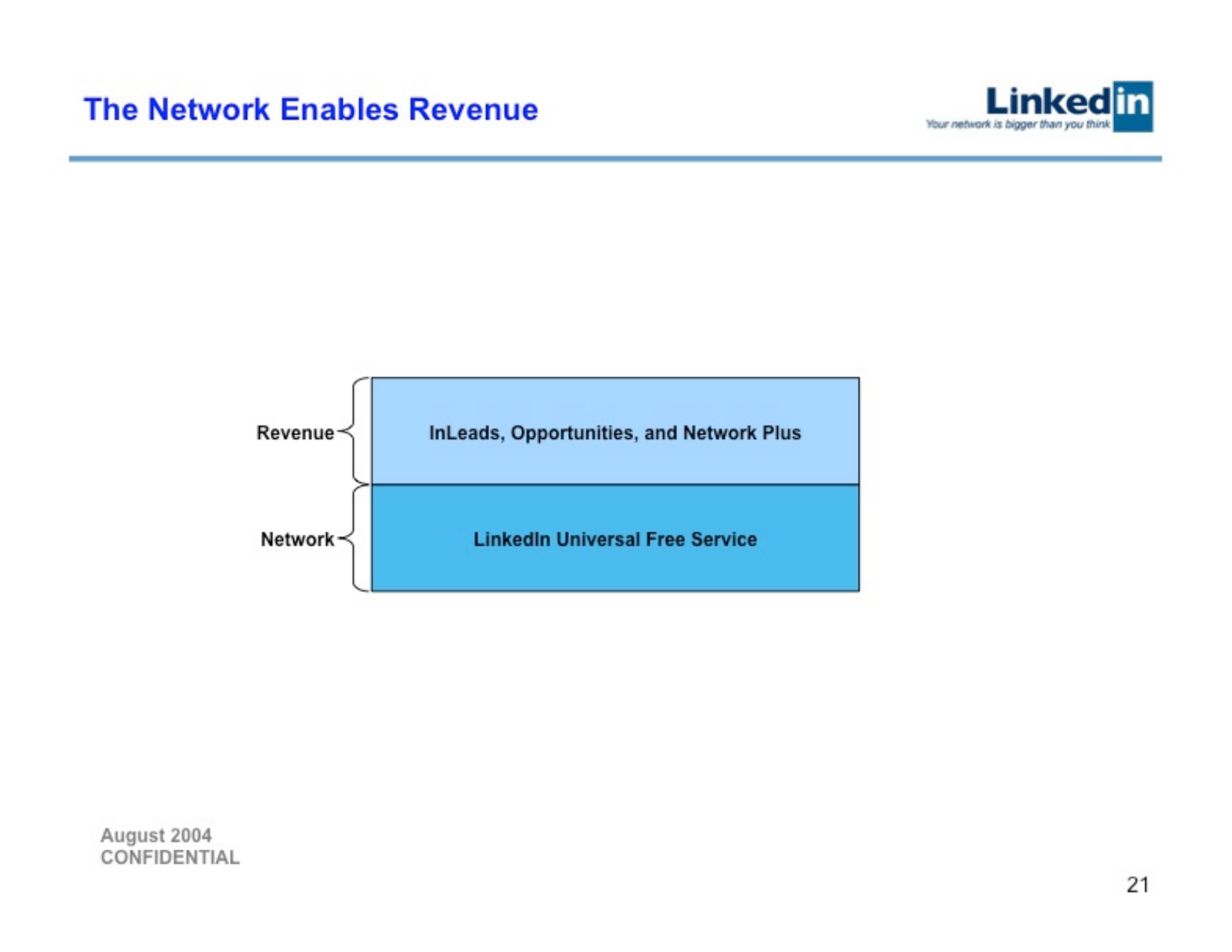
Stacked diagram: LinkedIn Universal Free Service forms the network base; InLeads, Opportunities, and Network Plus sit on top as the revenue layer.
Why it works
Visual thesis in one frame, build graph first, stack businesses second. Hoffman reused this concept across three slides to reinforce a idea investors had never funded at scale.
Market opportunity
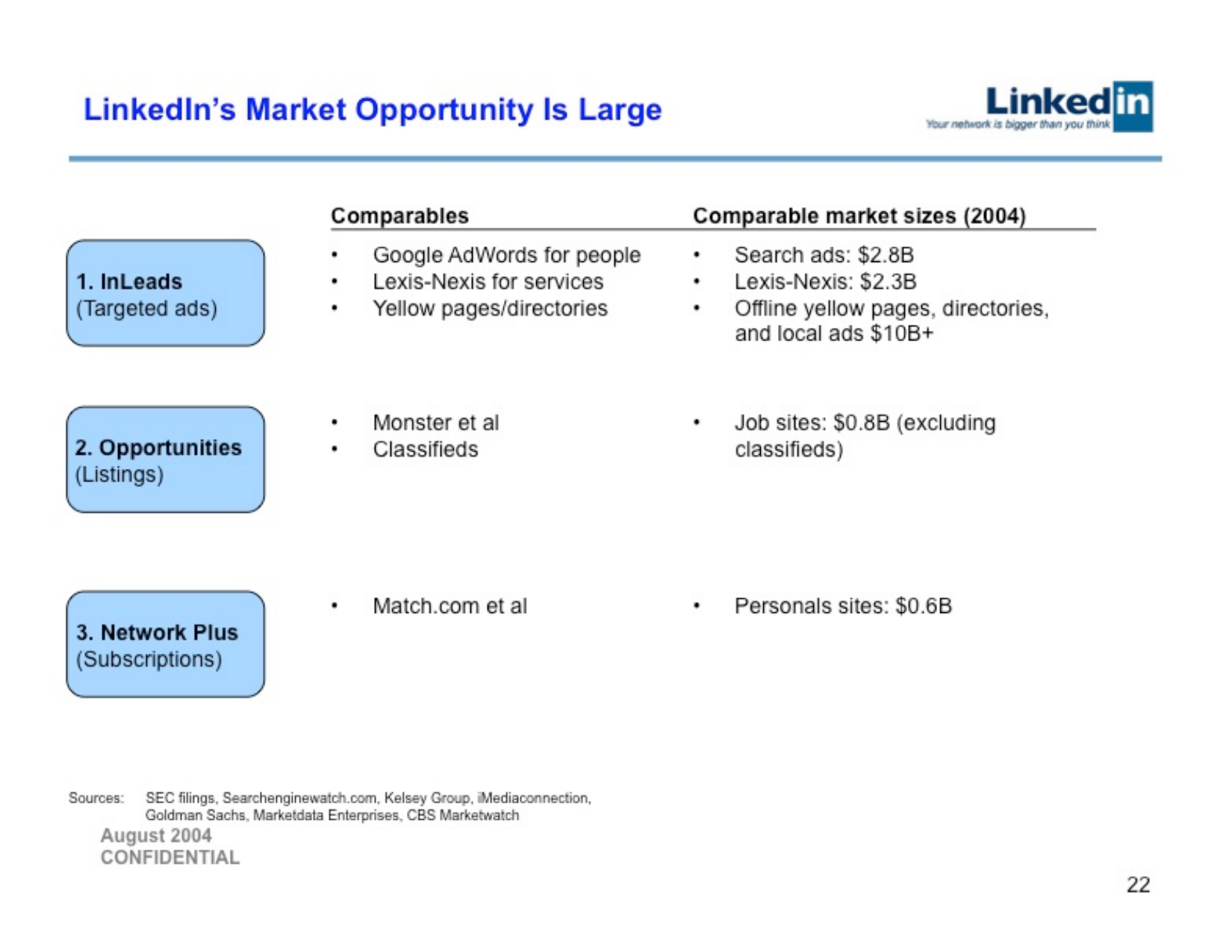
TAM comparables for three products: search ads and directories ($2.8B–$10B+), job sites ($0.8B), and personals/subscriptions ($0.6B).
Why it works
Anchors each revenue line to markets investors already sized. Job sites and personals are deliberately smaller, the deck spends more slides on recruiting than on ads.
InLeads product
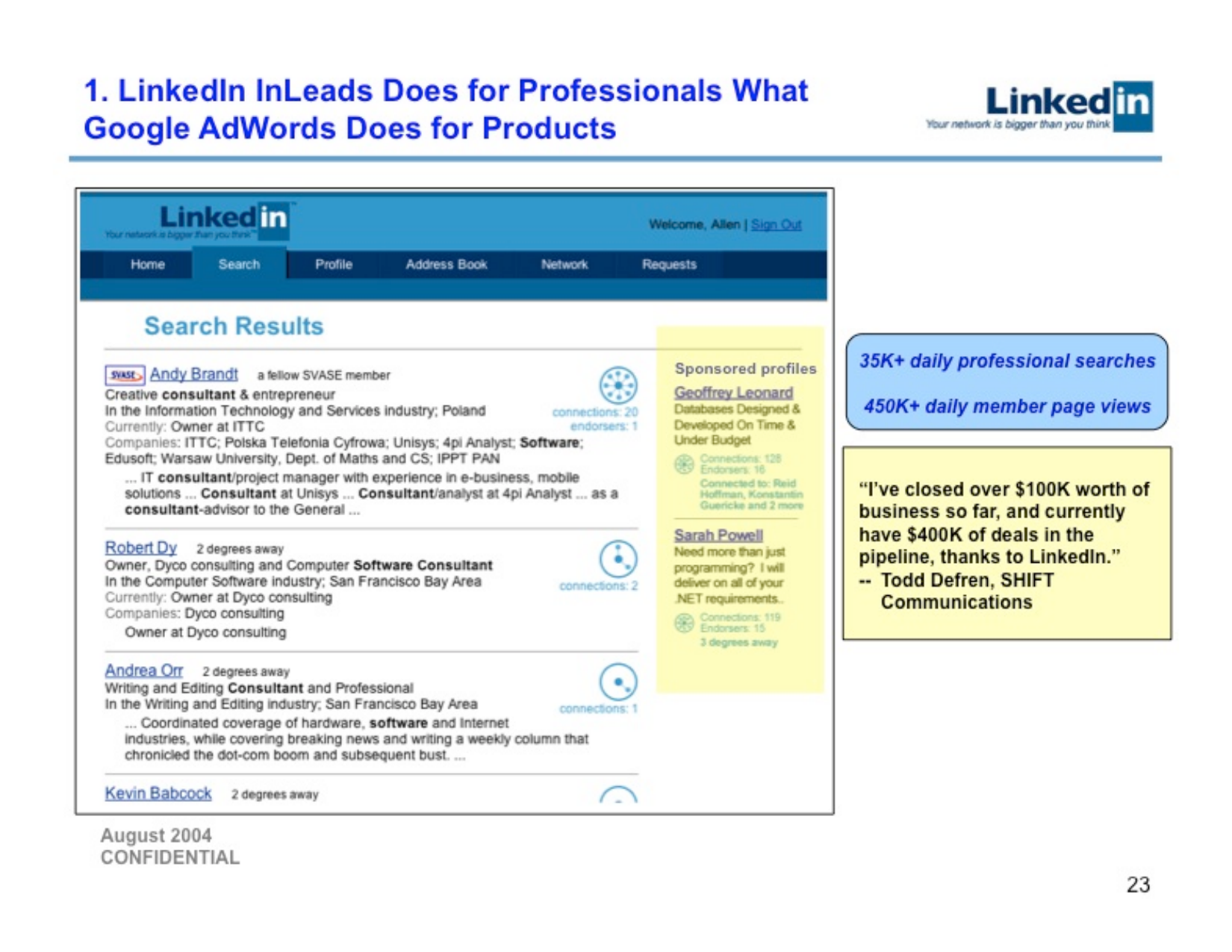
Search UI mockup with sponsored profiles in results. 35K+ daily professional searches, 450K+ daily page views, plus a $100K+ closed-business testimonial.
Why it works
Mockup beats roadmap language. Led with AdWords analogy because every 2004 investor understood search ads; InLeads was never launched, recruiting became the real business.
InLeads market
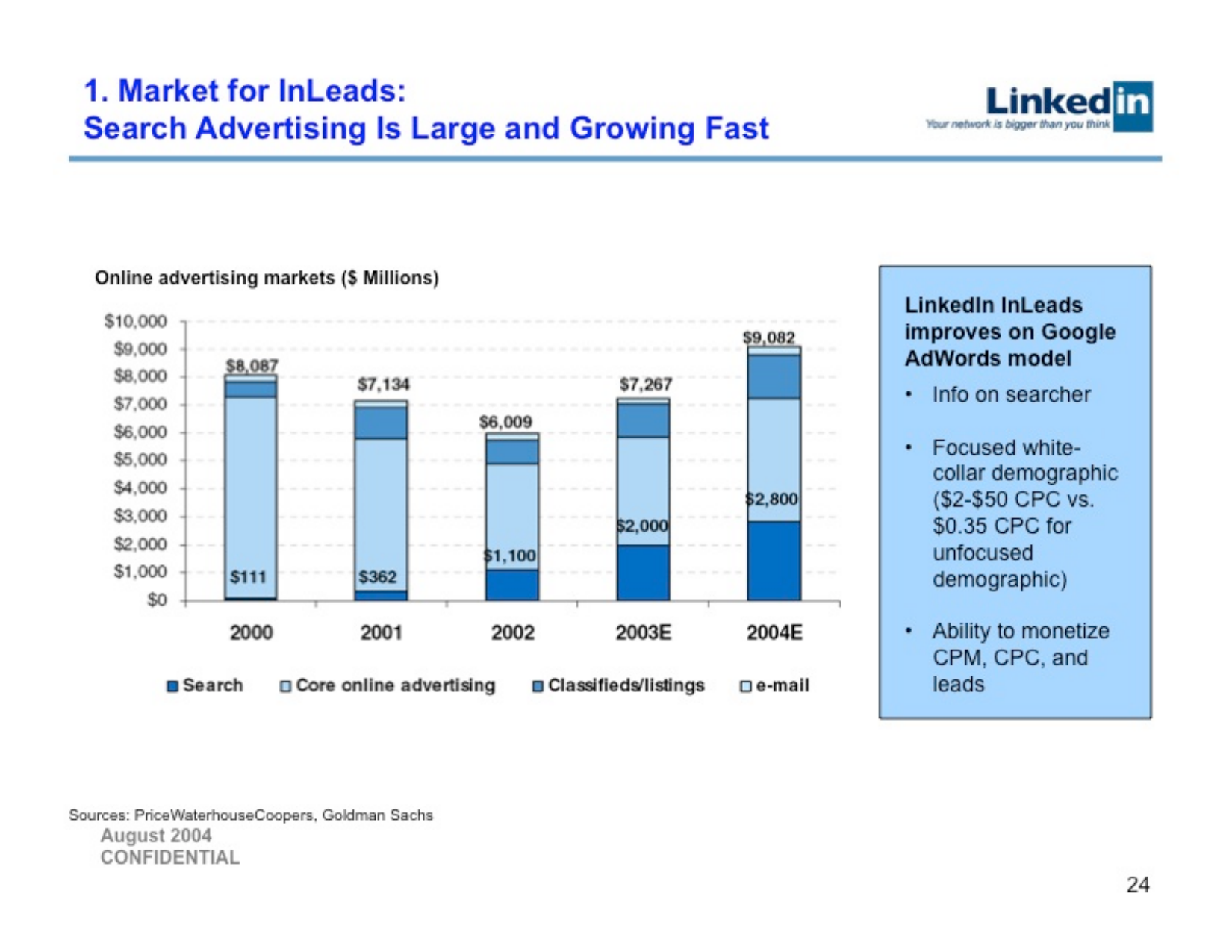
Search advertising grows from $111M (2000) to $2.8B (2004E) in a stacked bar chart; LinkedIn targets white-collar CPCs of $2–$50 vs. $0.35 unfocused.
Why it works
Trend chart makes a small current business feel inevitable. Demographic premium argument, professionals pay more per click, is the AdWords upside case in one sidebar.
Opportunities product
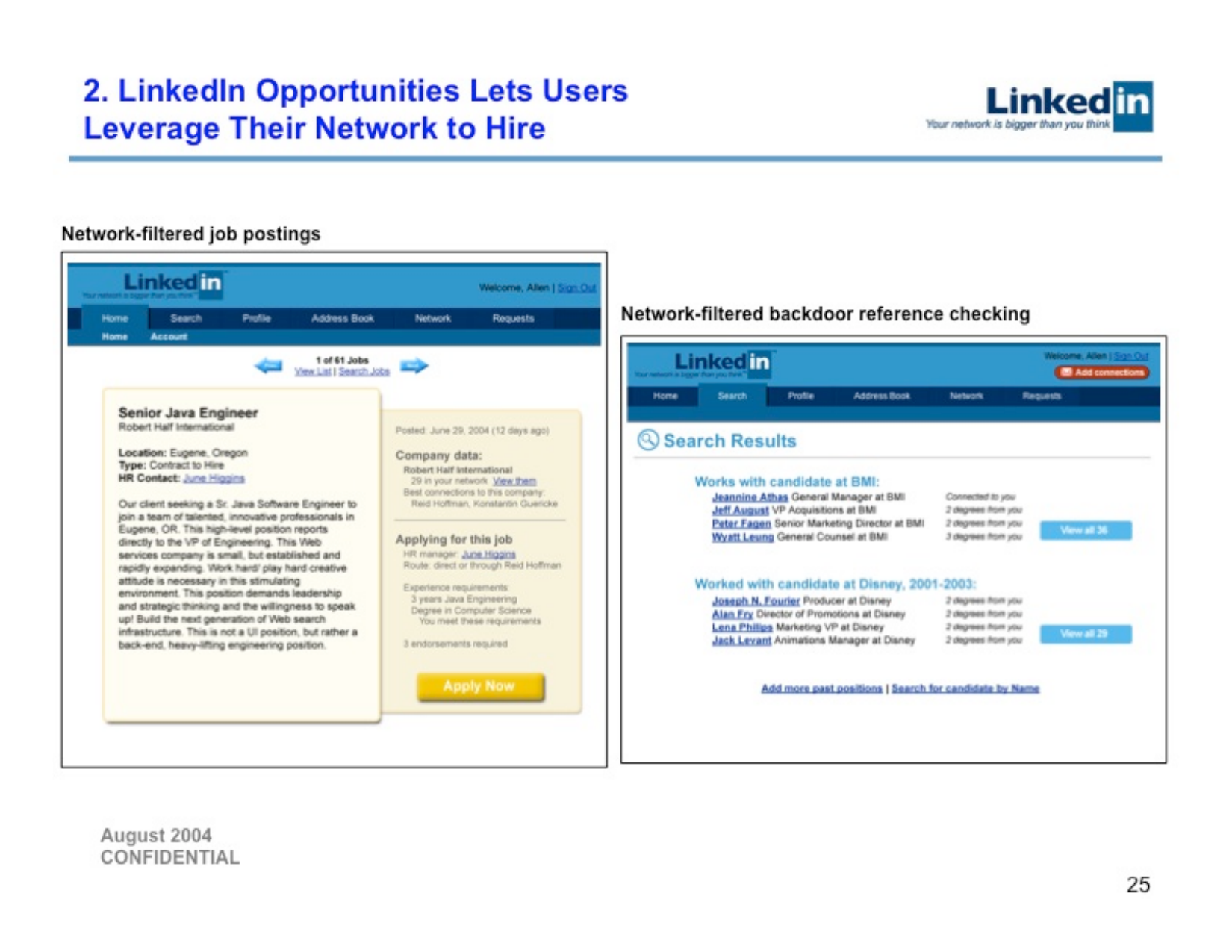
Mockups of network-filtered job postings (connections at the hiring company) and backdoor reference checking through shared employers.
Why it works
Shows product-market fit for recruiting before revenue, jobs filtered through trusted paths beat Monster's resume warehouse. This is the slide Greylock's thesis rested on.
Recruiting testimonials
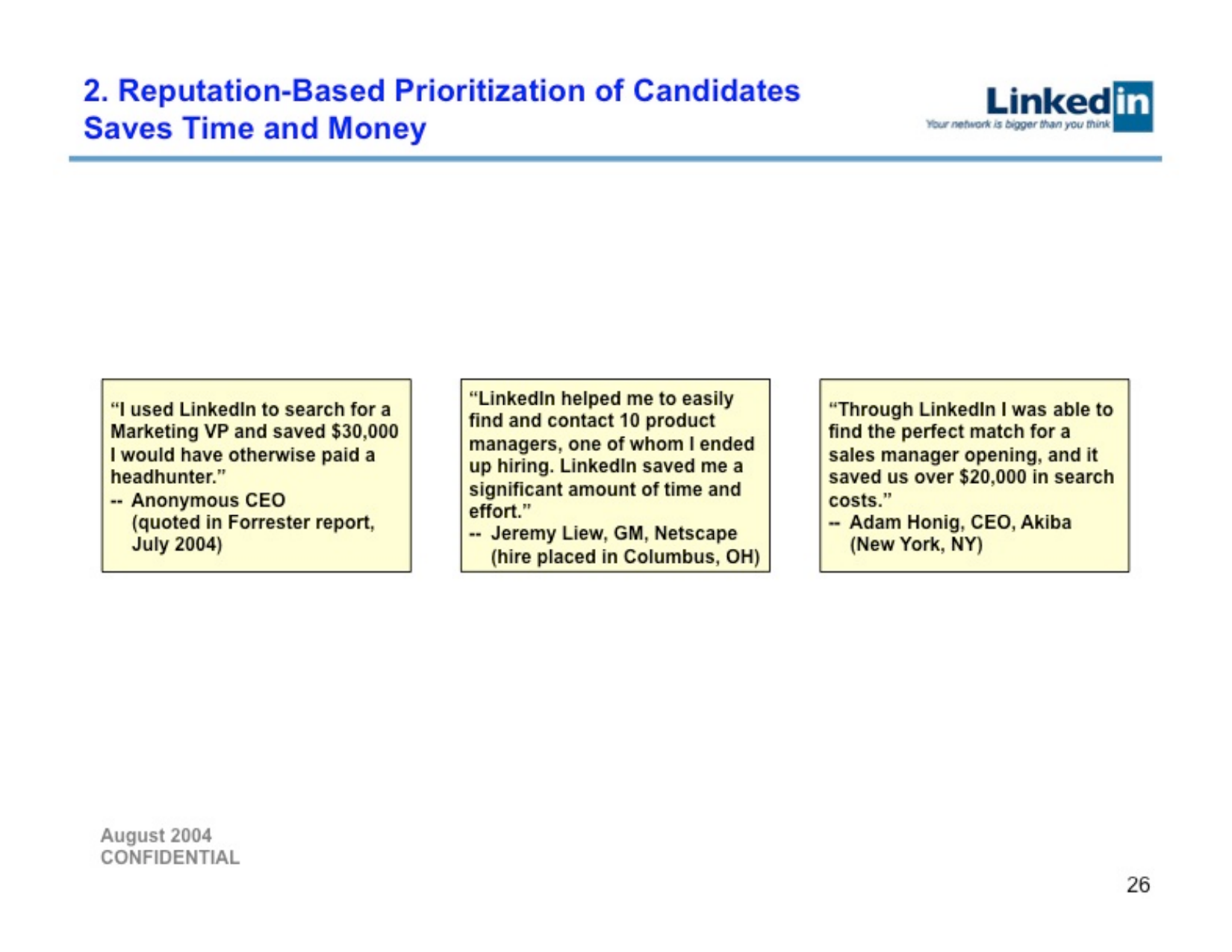
Three quotes on hiring via LinkedIn, saving $20K–$30K vs, headhunters, from a CEO, Netscape GM Jeremy Liew, and Akiba CEO Adam Honig.
Why it works
Hoffman calls this weak in hindsight, anecdotal quotes don't move skeptical investors. Works as social proof only if the buyer already believes network hiring saves money.
Job market size
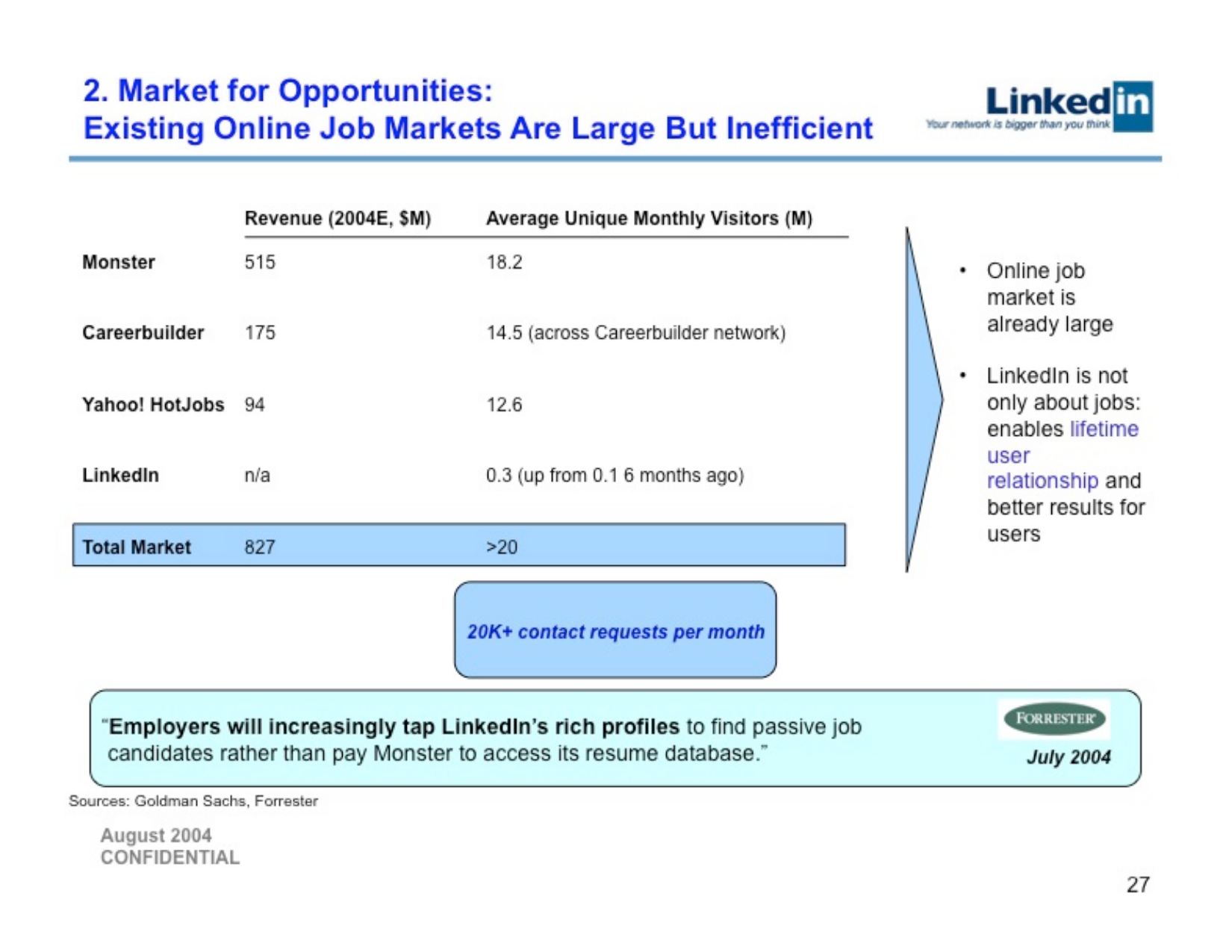
Monster ($515M), CareerBuilder ($175M), and HotJobs ($94M) vs. LinkedIn at 0.3M monthly visitors, plus Forrester quote on passive candidate search.
Why it works
Acknowledges LinkedIn is tiny on traffic but frames a lifetime relationship vs, transactional job boards. 20K+ contact requests/month shows intent even pre-monetization.
Network Plus product
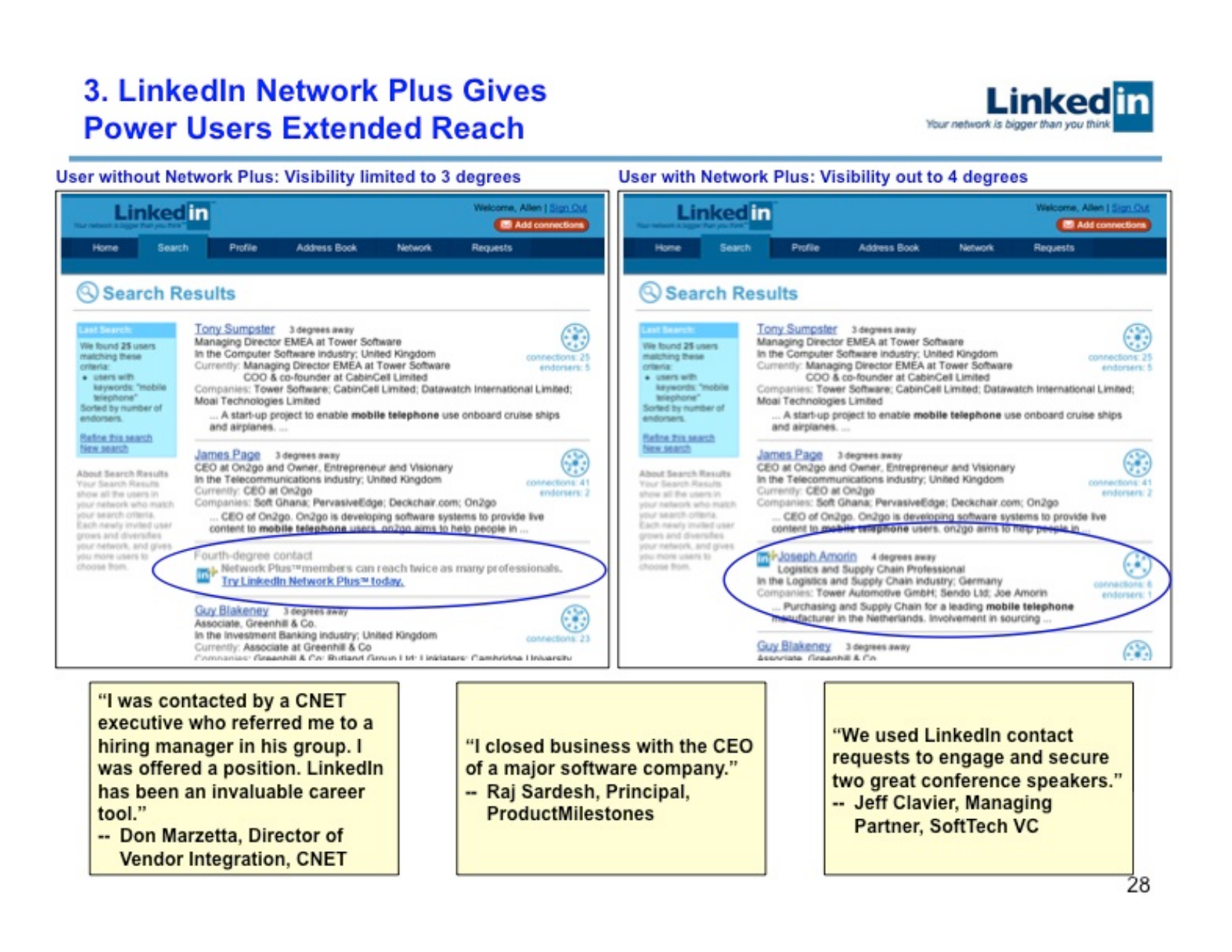
Free users see three degrees; Network Plus extends visibility to four degrees, mockup plus testimonials from CNET, a consultant, and SoftTech VC's Jeff Clavier.
Why it works
Freemium wedge explained visually. Underpromised four degrees publicly while planning broader paid access, classic under-promise, over-deliver for a trust-sensitive network.
Subscriptions market
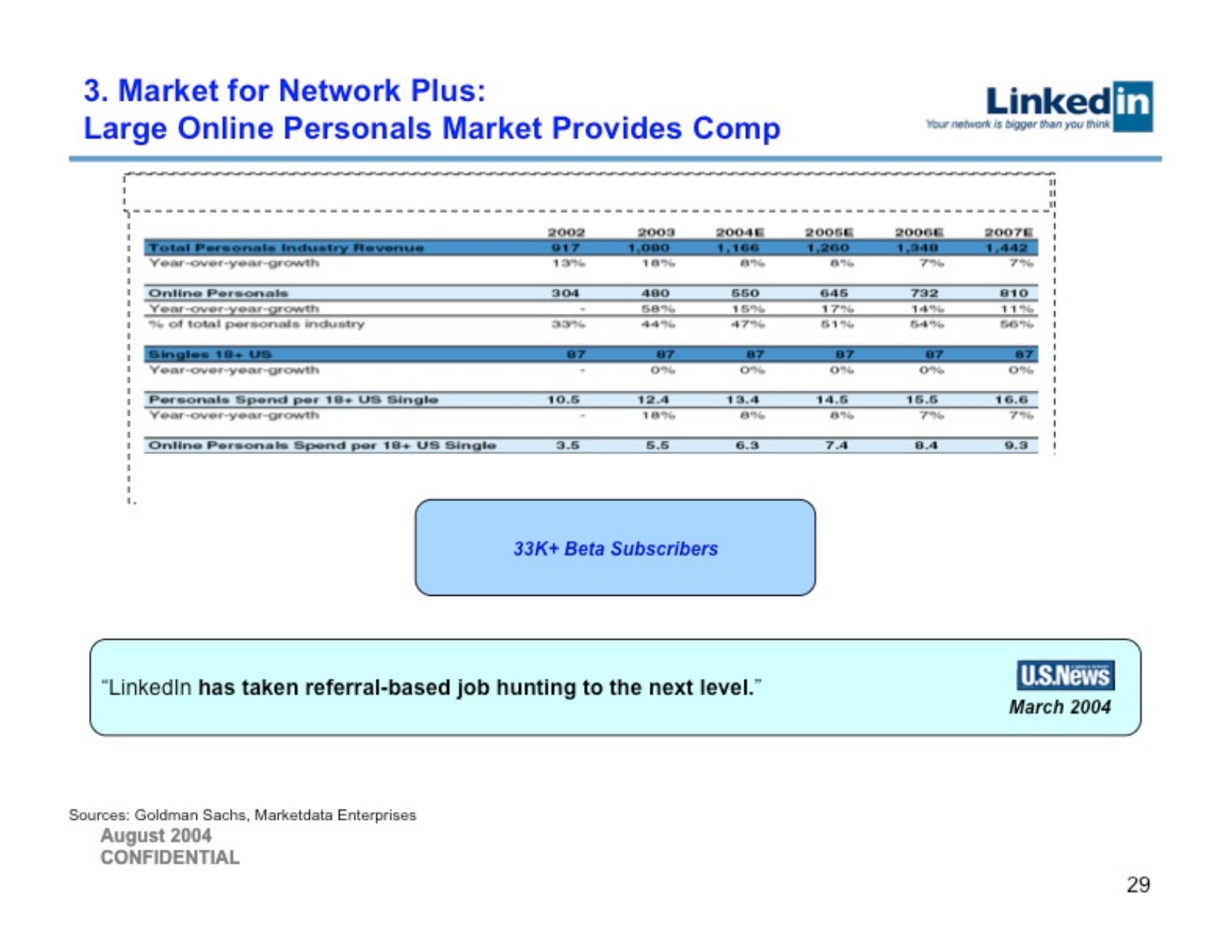
Online personals revenue projected from $304M (2002) to $810M (2007E); 33K+ beta subscribers and U.S. News quote on referral-based job hunting.
Why it works
Dating subscriptions proved consumers pay for connection online, unusual 2004 argument when most VCs saw ads as the only consumer internet model. LinkedIn helped change that assumption.
Revenue timeline
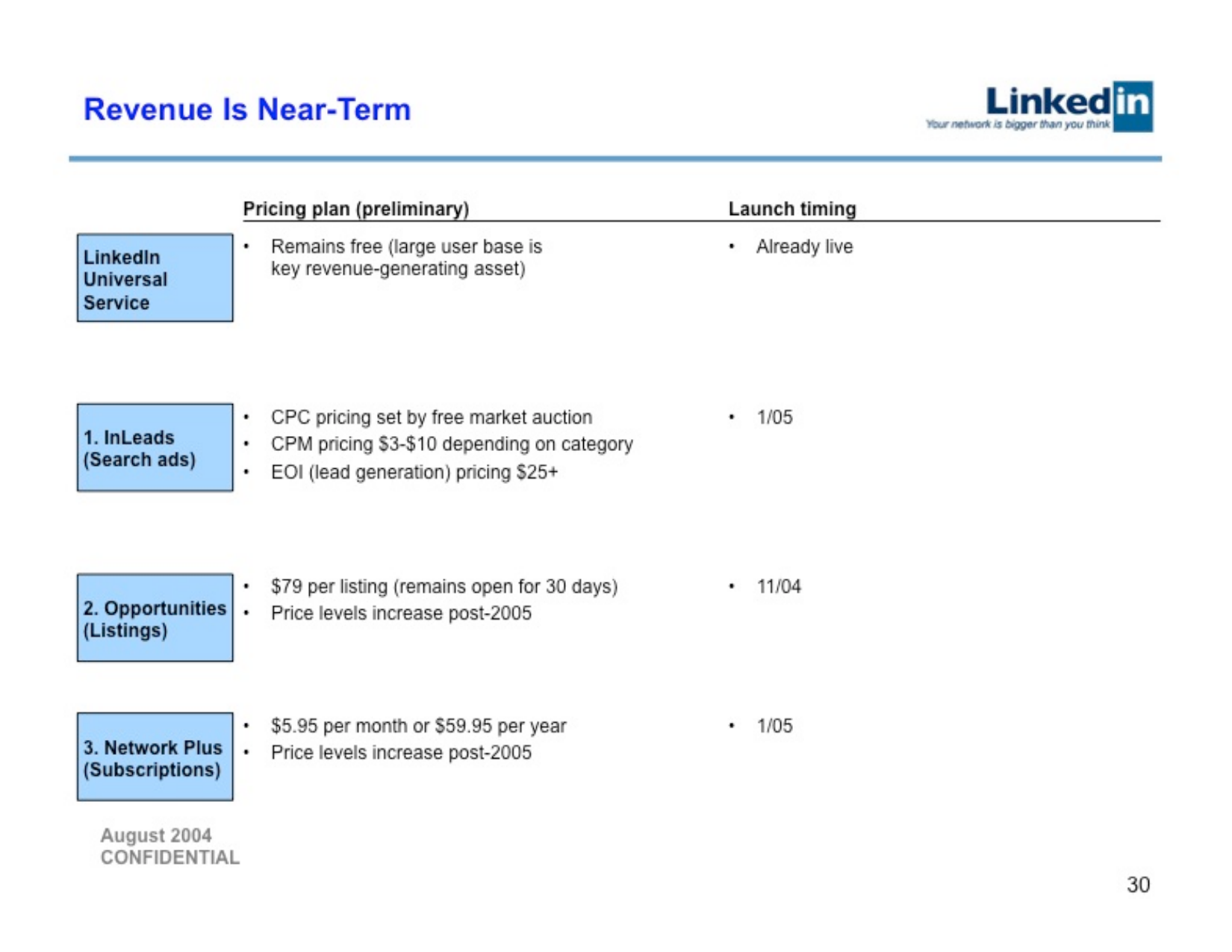
Pricing and launch dates: Opportunities listings at $79 in Nov 2004; InLeads CPC/CPM and Network Plus at $5.95/month launching Jan 2005; free tier stays live.
Why it works
Decisive shipping calendar, specific dates signal execution discipline. Listings first because they show every member the network's hiring value before subscriptions scale.
Business model
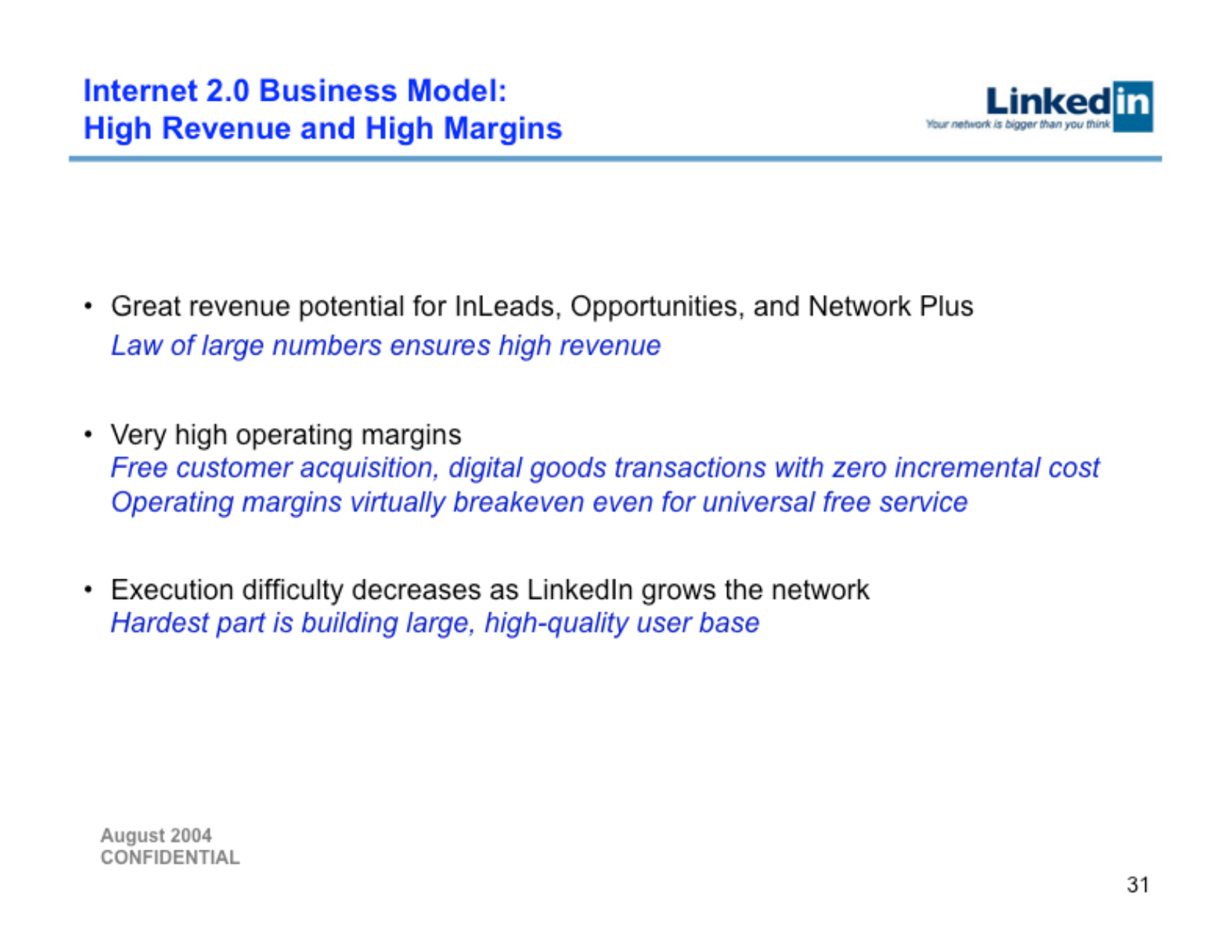
Internet 2.0 model: high revenue potential across three products, very high margins on digital goods with free acquisition, execution gets easier as the network grows.
Why it works
Margin story for a zero-revenue company, viral acquisition and zero marginal cost on transactions. "Very high" margins reveal Hoffman's revenue anxiety (he later wished he'd said "high").
Model assumptions
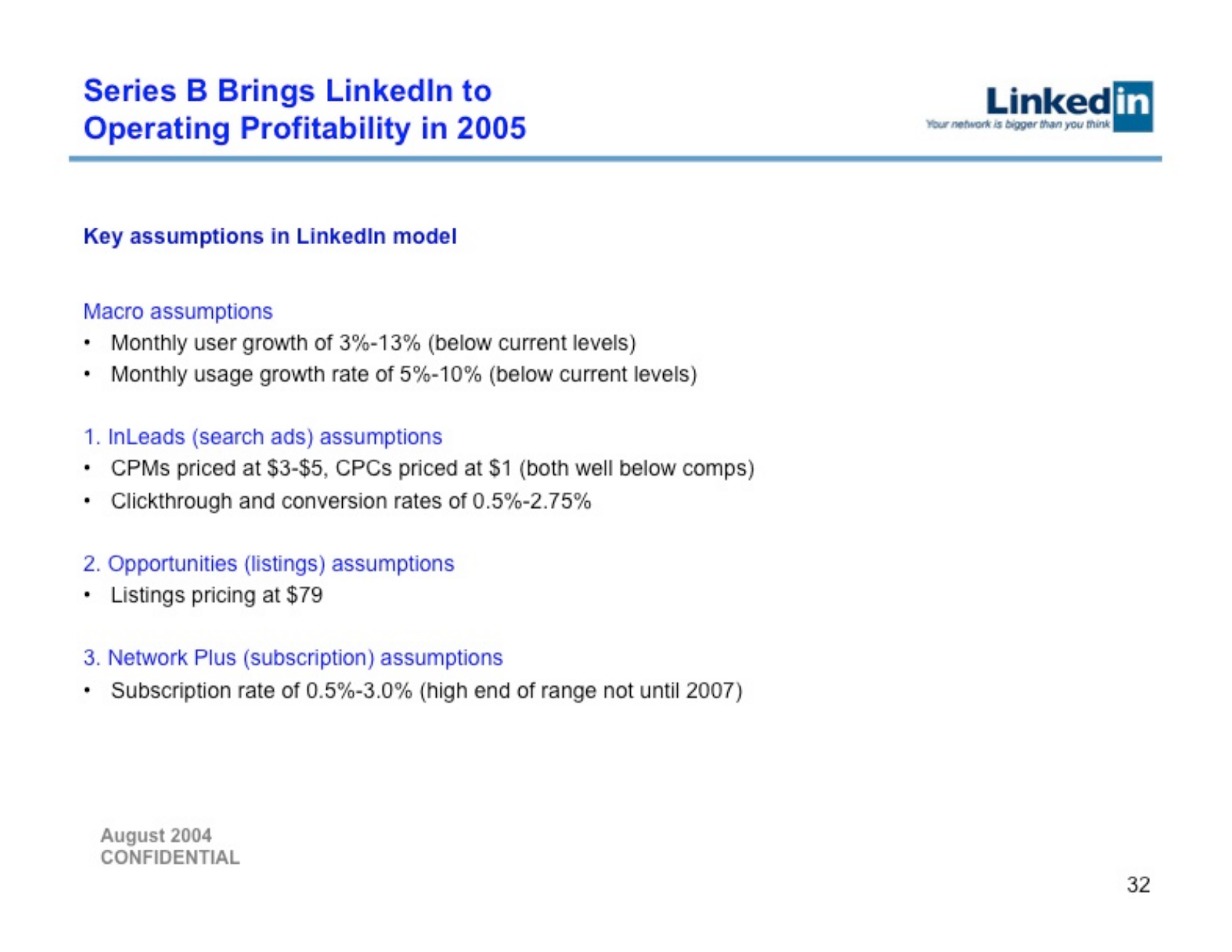
Conservative inputs: 3–13% monthly user growth, InLeads CPMs at $3–$5, $79 listings, 0.5–3.0% subscription conversion, all below current run-rate.
Why it works
Assumptions slide investors skim but trust exists. Understated growth rates pass the blink test, founders who sandbag here earn room to beat plan in Series C.
Financials
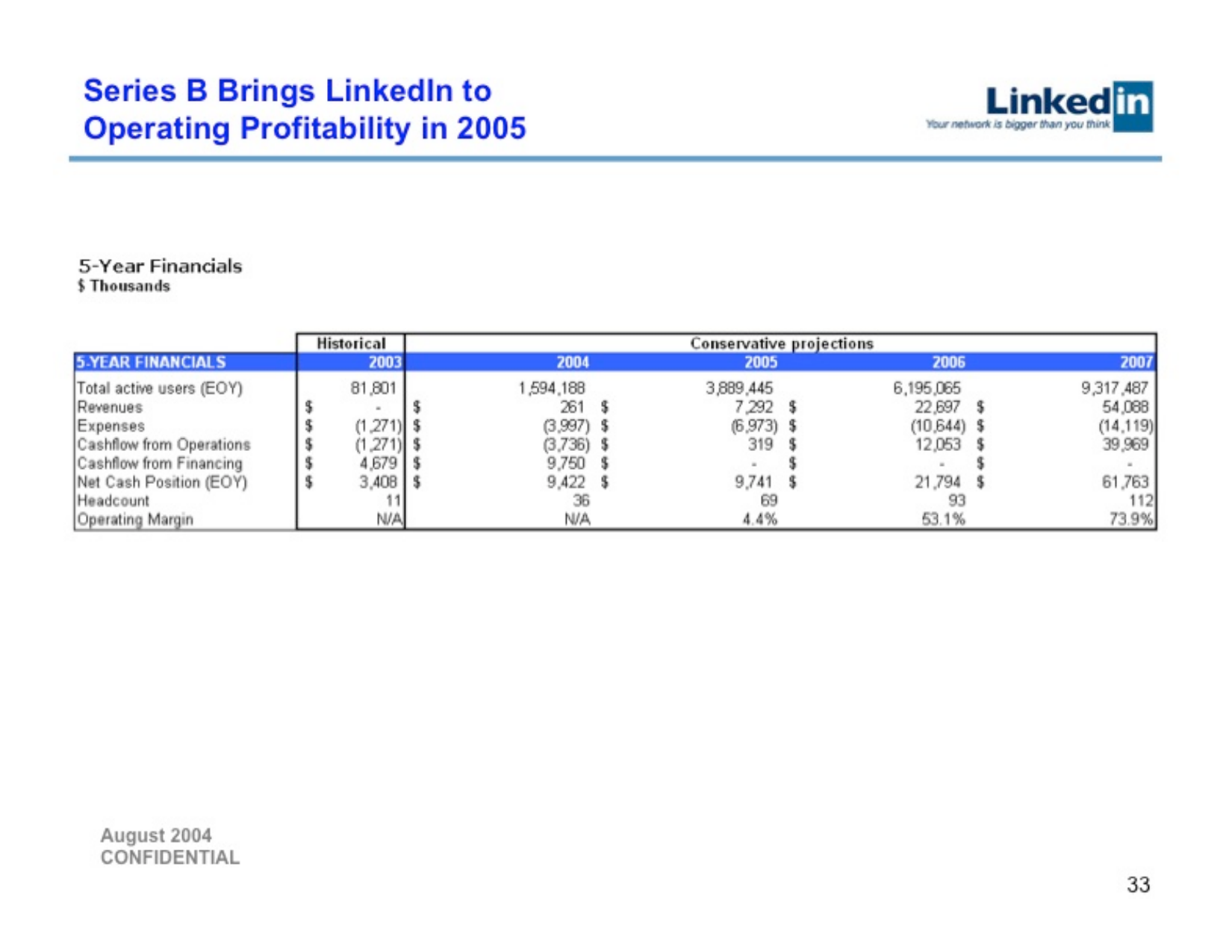
Five-year table: users grow to 9.3M by 2007; revenue from $261K (2004) to $54M (2007); operating cash flow positive in 2005 at 4.4% margin, 73.9% by 2007.
Why it works
LinkedIn hit operating profitability on roughly this path, rare for Series B projections. Hoffman redacted hyperbolic slides before publishing; even conservative numbers closed Greylock.
Team
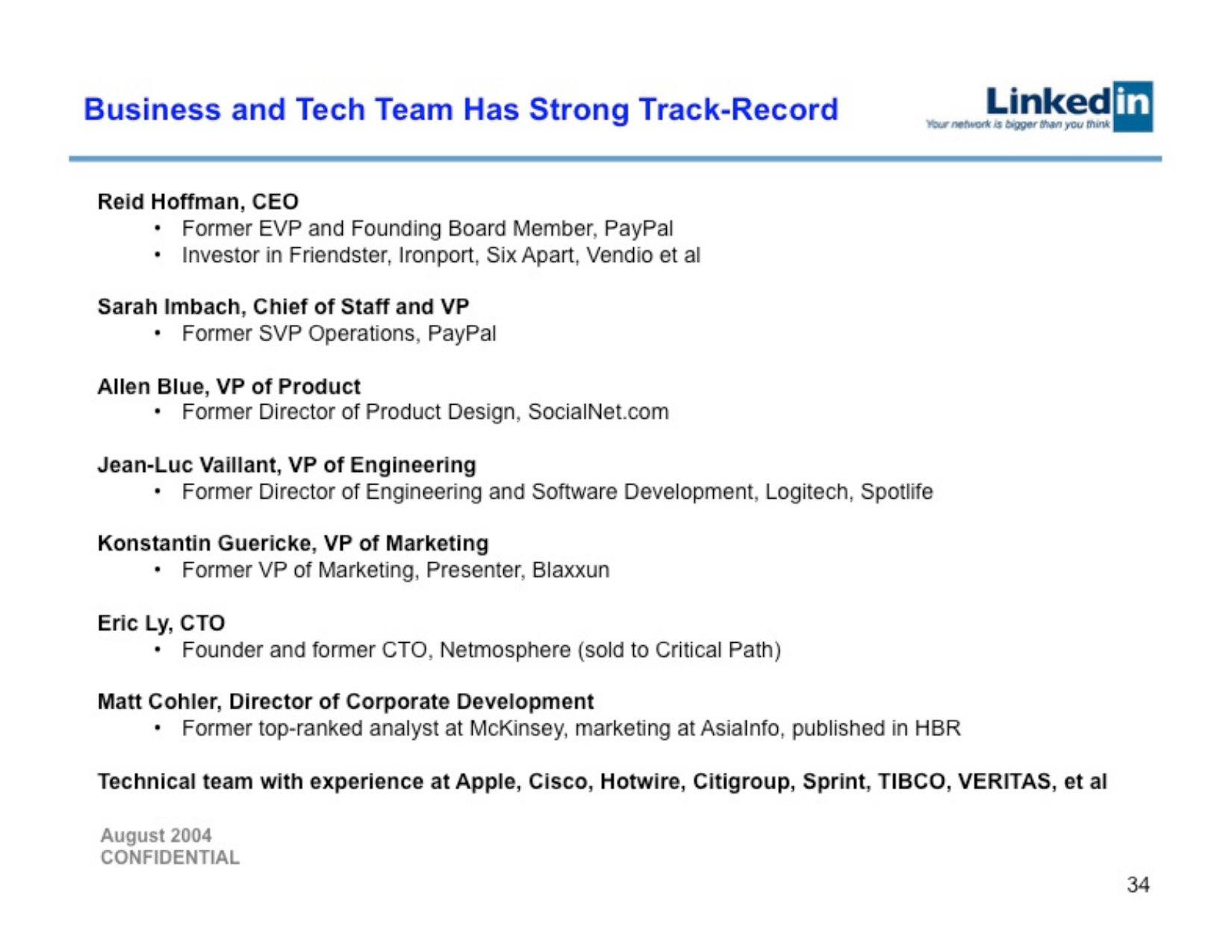
Reid Hoffman (PayPal), Sarah Imbach (PayPal ops), Allen Blue (SocialNet), Jean-Luc Vaillant (Logitech), Konstantin Guericke, Eric Ly (Netmosphere), Matt Cohler (McKinsey).
Why it works
Team slide late in the deck. Hoffman opens with thesis, not bios. PayPal alumni dominate; Matt Cohler co-built this deck and attended most pitches.
Investors
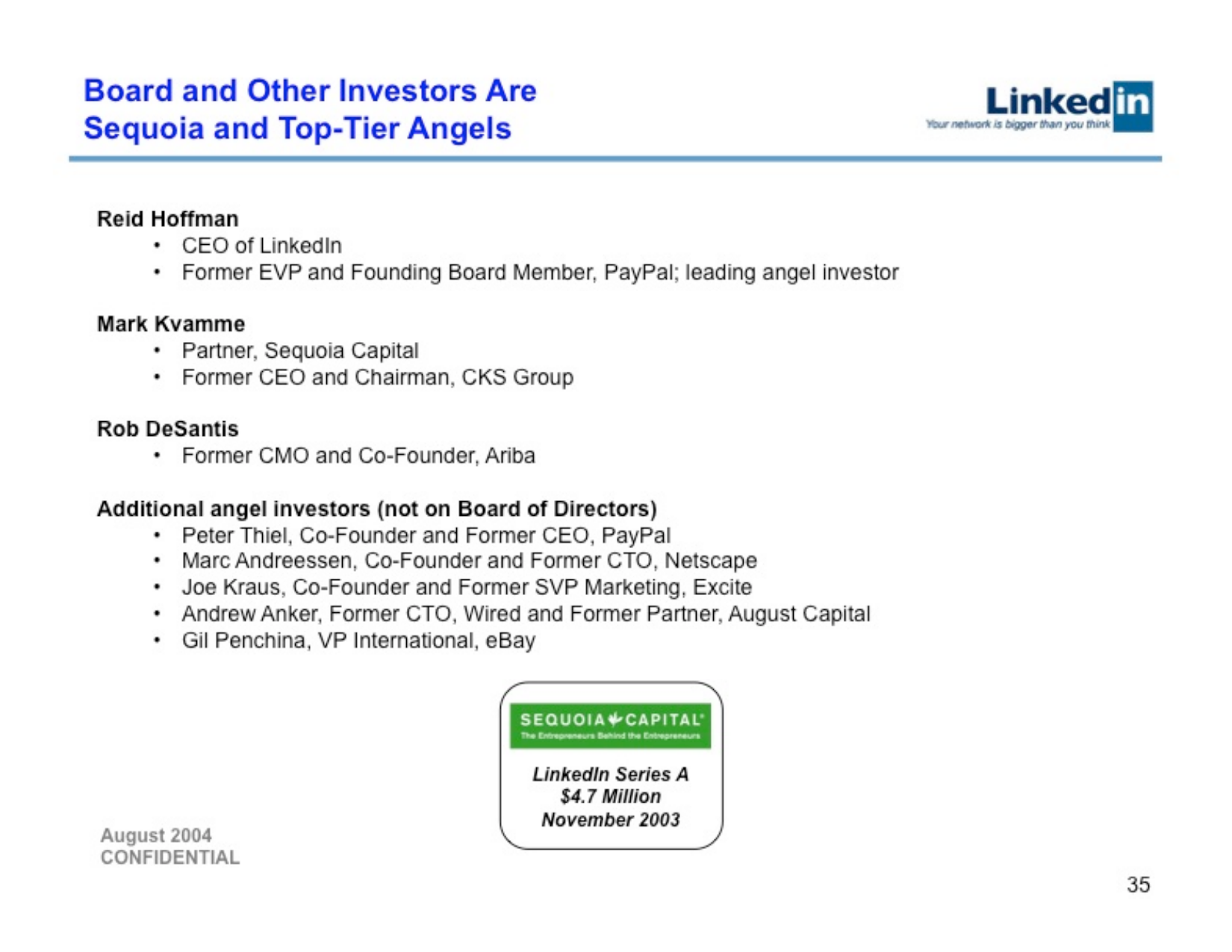
Board: Hoffman, Sequoia's Mark Kvamme, Ariba co-founder Rob DeSantis; angels include Peter Thiel, Marc Andreessen, and Joe Kraus. Series A was $4.7M from Sequoia.
Why it works
Sequoia logo placement borrows tier-one credibility for a Series B raise. Angel roster reads like a 2004 Silicon Valley hall of fame, social proof that smart money already chose LinkedIn.
Investment summary
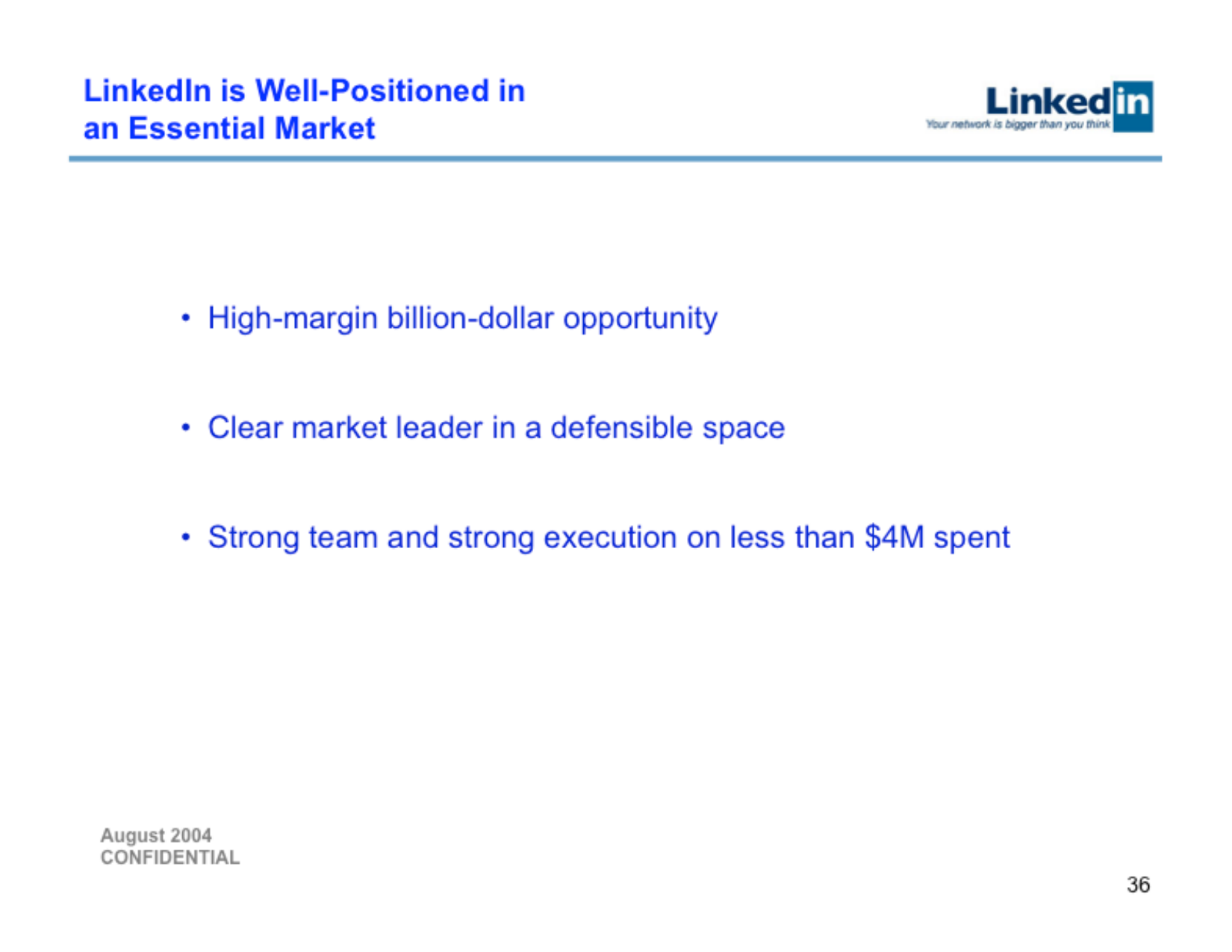
Three closing bullets: high-margin billion-dollar opportunity, clear market leader in a defensible space, strong team on less than $4M spent.
Why it works
Closing thesis before the callback slide. Three lines an associate can repeat to the partnership, margin, moat, execution, without re-reading 36 slides.
Investment thesis
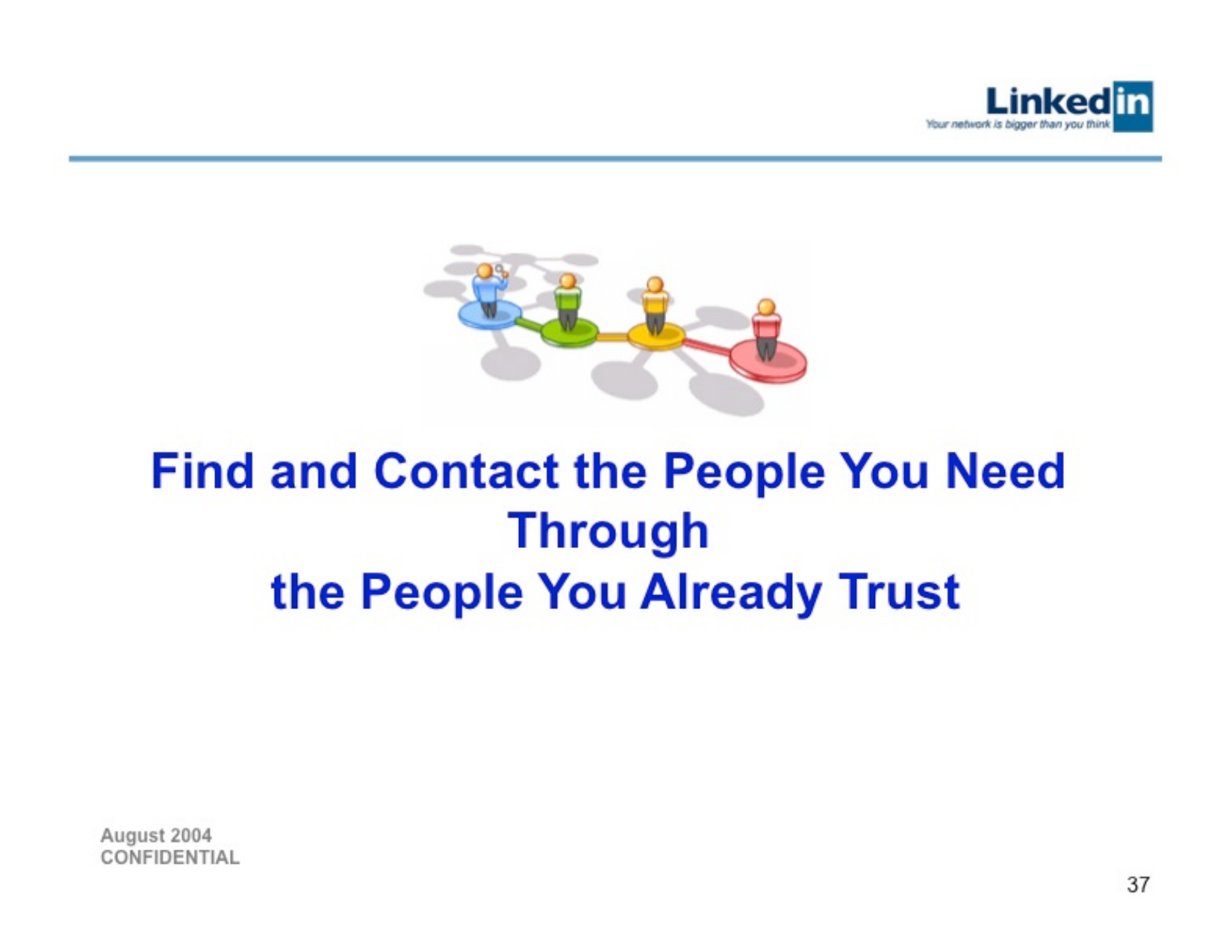
Find and contact the people you need through the people you already trust, network illustration with magnifying glass over connected profiles.
Why it works
Reused from the pitch's conceptual opening and left up during Q&A. Bookends the deck so investors end on the professional-graph vision, not "Appendix" or "Questions."
Compare similar investor decks
More series b and social / professional presentations in the library.



Your pitch deck, ready before the meeting
Start with your website or idea and see your slides in minutes. Pay only when you download.
Generate a deck