
LinkedIn Pitch Deck (2004)
Reid Hoffman published LinkedIn's Series B deck after raising $10 million from Greylock in August 2004, with zero revenue, ~900K users, and Friendster/MySpace dominating the social narrative. The 37-slide pitch frames LinkedIn as "professional people search 2.0," steers straight into monetization, and anchors the story with eBay, PayPal, and Google analogies before proving Series A execution.
Stage · Series BIndustry · Social / professional
- Industry
- Social / professional
- Business model
- Professional network with recruiting and ads
- Raised
- $10M Series B (Greylock, 2004)
- Location
- Sunnyvale, California
- Website
- linkedin.com
Build your own deck in this order
Paste your company URL. Pitches AI writes a new 12-slide draft. Free to build.
Slide-by-slide breakdown
Slide 1: Cover
LinkedIn Series B, August 2004, logo and tagline "Your network is bigger than you think."
Minimal cover: round, date, confidentiality stamp. No vision paragraph. Hoffman saves the investment thesis for slide 2 and repeats it on slide 37 for Q&A.
Slide 2: Professional People Search 2.0
Three premium services mapped to markets: targeted ads for service providers, job listings filtered through networks, and subscriptions extending professional reach.

Hoffman's boldest move, revenue before traction. In 2004's post-crash climate, consumer internet decks died on "how do you make money?" He answers it in the first two minutes.
Slide 3: Problem
Professional people search 1.0 uses flat directories, yellow pages, resume databases, and offline directories all fail to find and transact with professionals online.

Three named failure modes with underlined "fails." Each maps to adverse selection: sellers misrepresent quality, top talent opts out, and directories need critical mass. Sets up the network as the fix.
Slide 4: Solution
Internet 2.0 searches and transacts via networks, not flat directories, illustrated with a network graph and magnifying glass over a verified profile.
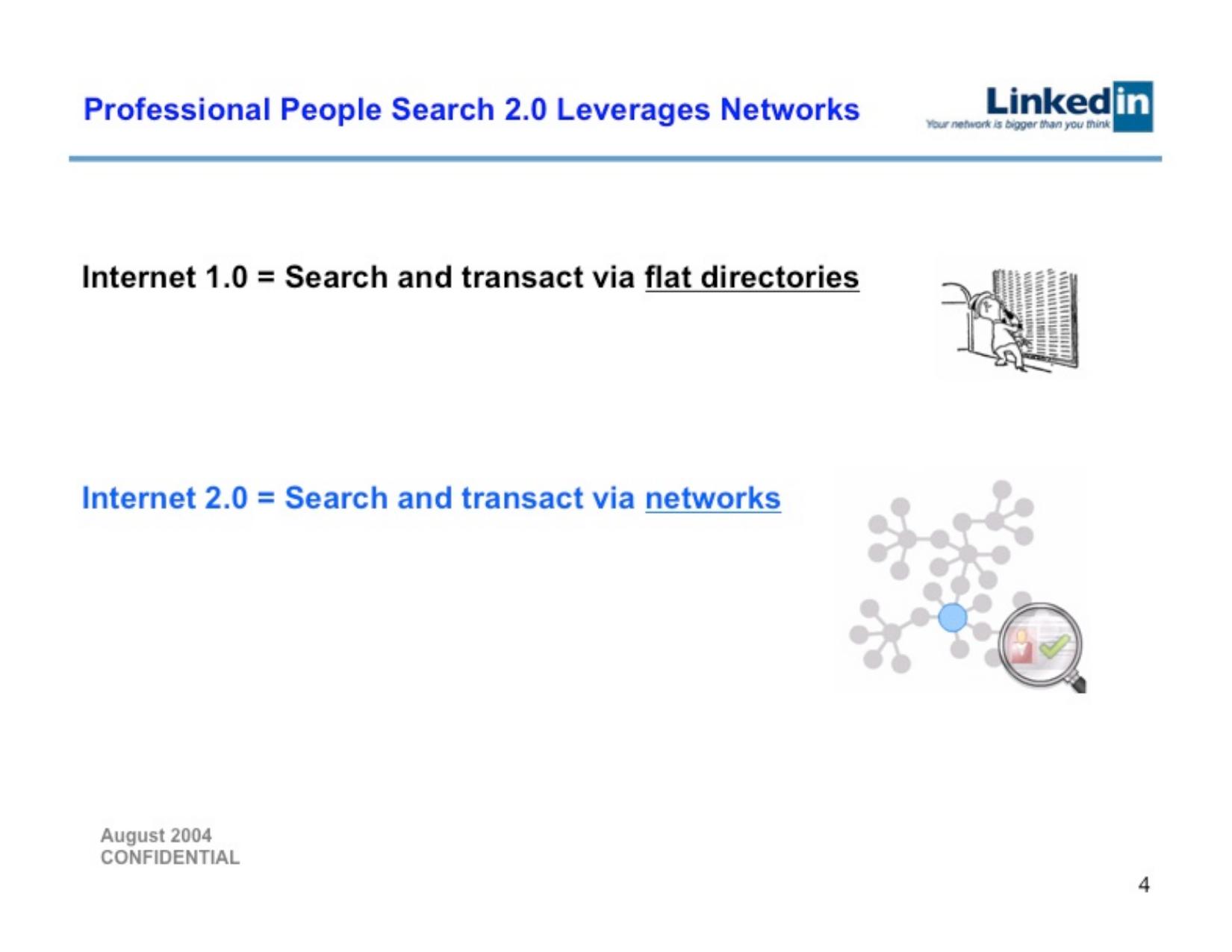
Coined "Internet 2.0" before O'Reilly popularized Web 2.0. One simple concept slide: the network is the platform for a new kind of people search that supports many businesses on top.
Slide 5: eBay analogy
Online classifieds assess sellers by individual claims; eBay assesses reputation through a network of transactions between users.

First of three analogy slides. Newspaper classifieds vs, eBay makes the 1.0→2.0 shift concrete, investors already understood eBay's trust layer was the product.
Slide 6: PayPal analogy
Citibank detects fraud by looking at each user in isolation; PayPal detects fraud through the network of transactions between users.

PayPal also reminds the room Hoffman co-founded it, show, don't tell. Network data beats isolated signals; the same logic applies to professional trust and reference checking.
Slide 7: Google analogy
AltaVista ranks pages in isolation; Google PageRank ranks search results using the network of links between pages.

Third analogy lands the pattern: networks amplify value in goods (eBay), payments (PayPal), and search (Google). LinkedIn is the professional-people variant investors can extrapolate from.
Slide 8: LinkedIn positioning
Monster and LexisNexis assess professionals by individual claims; LinkedIn assesses them through the network of relationships between users.

Applies the 2.0 template directly to the category. Monster and LexisNexis are named comparables with real revenue. Hoffman asks investors to apply the same network multiplier to LinkedIn.
Slide 9: Establishing the network
For eBay, PayPal, Google, and LinkedIn the network is the key; first mover is critical to revenue. PayPal waited until 4M users before monetizing to $400M+.

Defends spending Series A on growth with zero revenue. PayPal precedent tells Greylock: build the graph first, turn on money later. First-mover framing justifies the $10M ask.
Slide 10: Series A commitment
Network growth projection from the August 2003 Series A pitch, curve toward ~400K users by mid-2004.

Sets up the next slide's punchline. Hoffman deliberately under-promised in Series A so he could over-deliver here, founder credibility beats any forward projection.
Slide 11: Network growth success
Actual user growth far exceeds the Series A projection, approaching 1M users by July 2004, with Forbes calling LinkedIn the largest online business network.
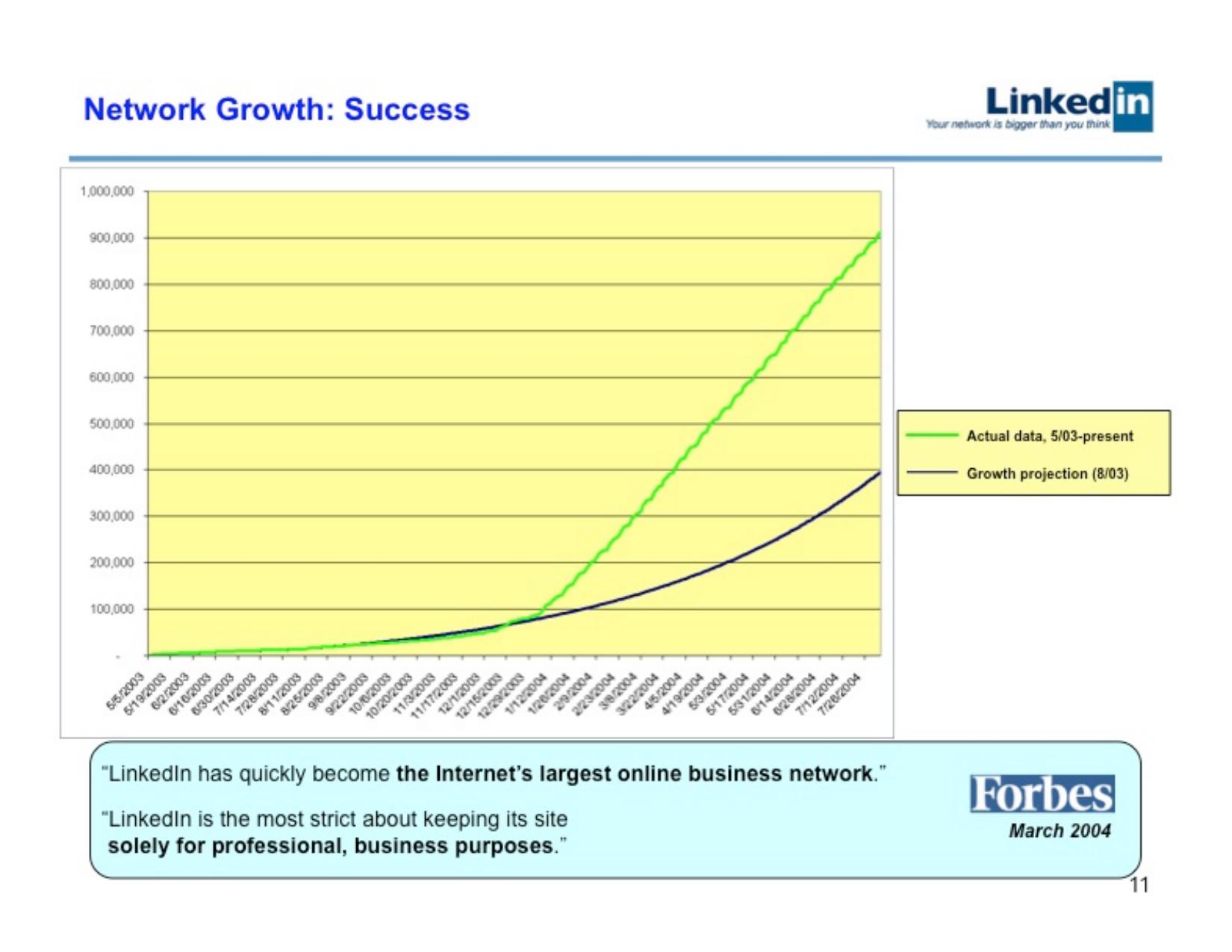
Green actual line vs, blue projection is the deck's trust anchor. Forbes quotes add third-party validation. Investors fund teams that keep promises, not teams that only promise.
Slide 12: Market leadership
February 2004 pie chart: LinkedIn holds 54% of registered users in online professional network tools (0.3M total market), ahead of Ryze, OpenBC, and Spoke.

Category creation slide, defines "online professional network tools" and shows LinkedIn already winning half. Small absolute numbers, but winner-take-most dynamics start here.
Slide 13: Growing the lead
August 2004: LinkedIn's share rises from 54% to 73% of 1.2M registered users; PC Magazine and Red Herring awards reinforce tipping-point momentum.

Six-month share gain in one chart. "Tipping point effects" language signals network effects before that term was startup cliché. Trend beats absolute scale when you're sub-Friendster.
Slide 14: Competition
2×2 matrix: social vs, professional focus, enterprise software vs, internet service. LinkedIn alone in professional-internet with 900K+ users, 29K weekly growth, and 23M email addresses.

Friendster and MySpace sit in social-internet; Spoke and BranchIT in enterprise-professional. LinkedIn owns the quadrant that matches its business model, the wedge is visual, not a feature list.
Slide 15: Groups and brand endorsement
MBA programs, conferences, and professional orgs (Fuqua, Red Herring, SDForum) use LinkedIn Groups. 50+ live, 15–20 new per month since April 2004.

Hoffman later calls this a mistake for consumer internet, enterprise customer logos rarely predict grassroots adoption. Included because Series B traction was thin and nerves were high.
Slide 16: Series A results
Six boxes on <$4M spent: 930K+ users, 50+ Groups, 22% CxO/senior execs, 1M+ searches/month, toolbar uploads, and inbound BD opportunities.
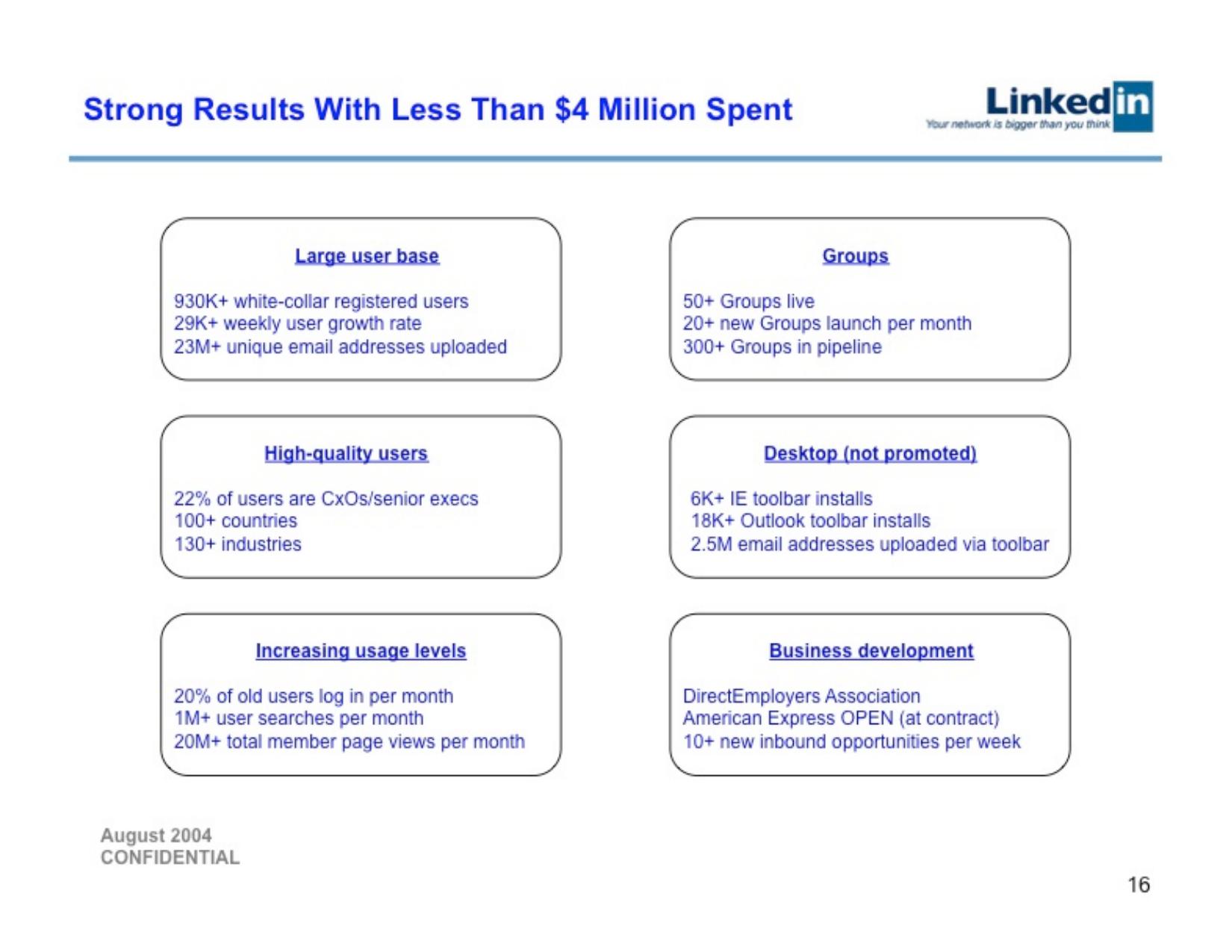
Execution proof after the concept pitch. Dense metrics grid shows capital efficiency, every Series A dollar bought users, engagement, and pipeline before revenue existed.
Slide 17: Business development
DirectEmployers two-year exclusive job search partnership and American Express OPEN co-brand exposing LinkedIn to 2M small-business cardholders.
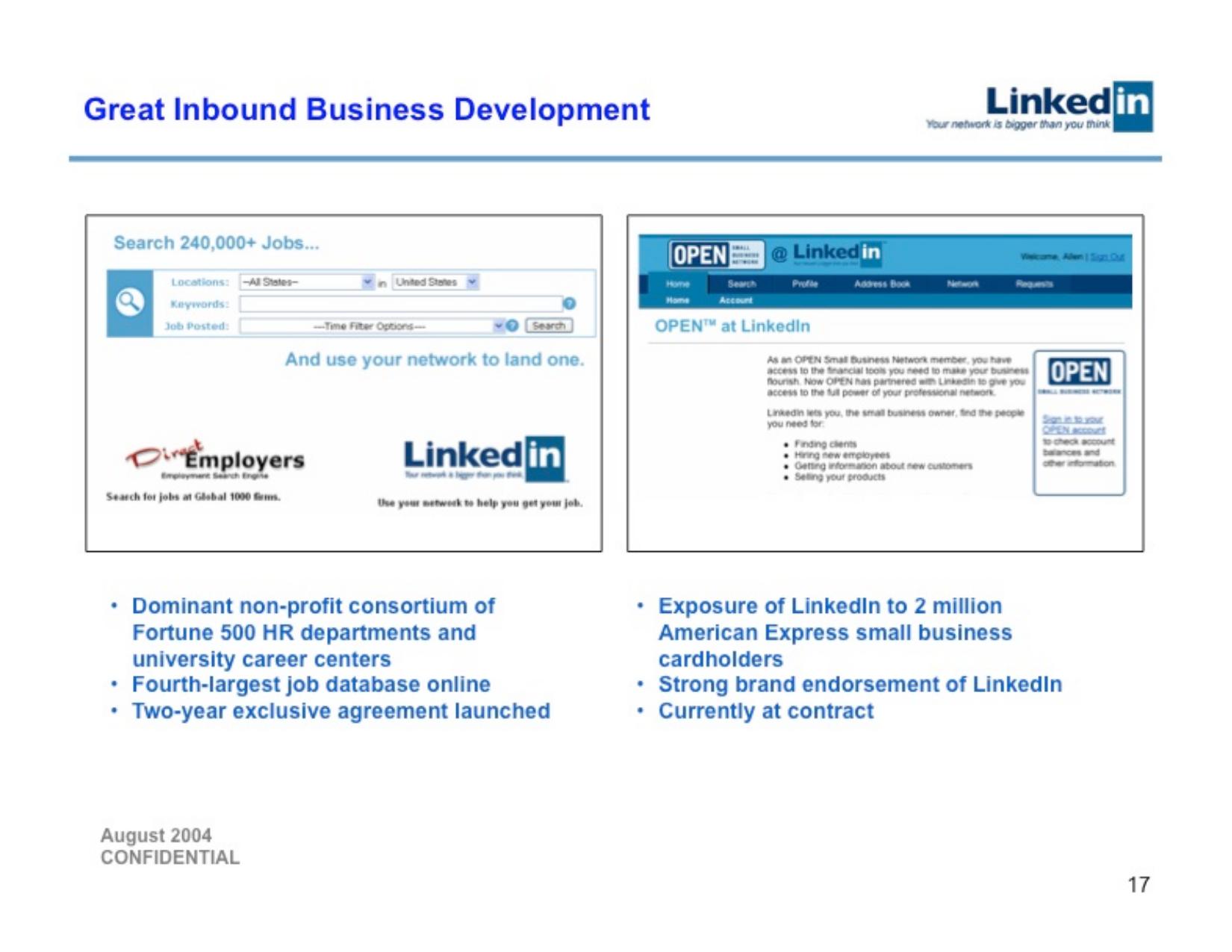
Partnership slide hedges organic-growth anxiety. Hoffman admits neither deal delivered lasting value, but in the room they signaled enterprise interest in the professional graph.
Slide 18: Barriers to entry
Viral product design with tipping points, reputation-driven network effects, and two patents in viral marketing and social networking (one granted, one pending).

Moat slide without buzzwords, virality, trust graph, and IP. Asserts network effects rather than proving viral mechanics (Hoffman saved that for the live pitch).
Slide 19: Network enables revenue
eBay, PayPal, and Google each monetize transactions and ads while keeping reputation, fraud detection, and PageRank free, network effects make the business valuable.

Bridges analogy section to LinkedIn monetization. Pattern: free network layer, paid applications on top. Investors who bought the eBay/PayPal/Google story can accept the same architecture here.
Slide 20: LinkedIn revenue model
LinkedIn's network trust enables three products: InLeads (contextual search ads), Opportunities (network-filtered job listings), and Network Plus (subscription), universal service stays free.

Maps the slide-2 revenue question to named SKUs. PC Magazine quotes on executive recruiting reinforce the recruiting wedge Greylock actually bet on.
Slide 21: Network then revenue
Stacked diagram: LinkedIn Universal Free Service forms the network base; InLeads, Opportunities, and Network Plus sit on top as the revenue layer.

Visual thesis in one frame, build graph first, stack businesses second. Hoffman reused this concept across three slides to reinforce a idea investors had never funded at scale.
Slide 22: Market opportunity
TAM comparables for three products: search ads and directories ($2.8B–$10B+), job sites ($0.8B), and personals/subscriptions ($0.6B).
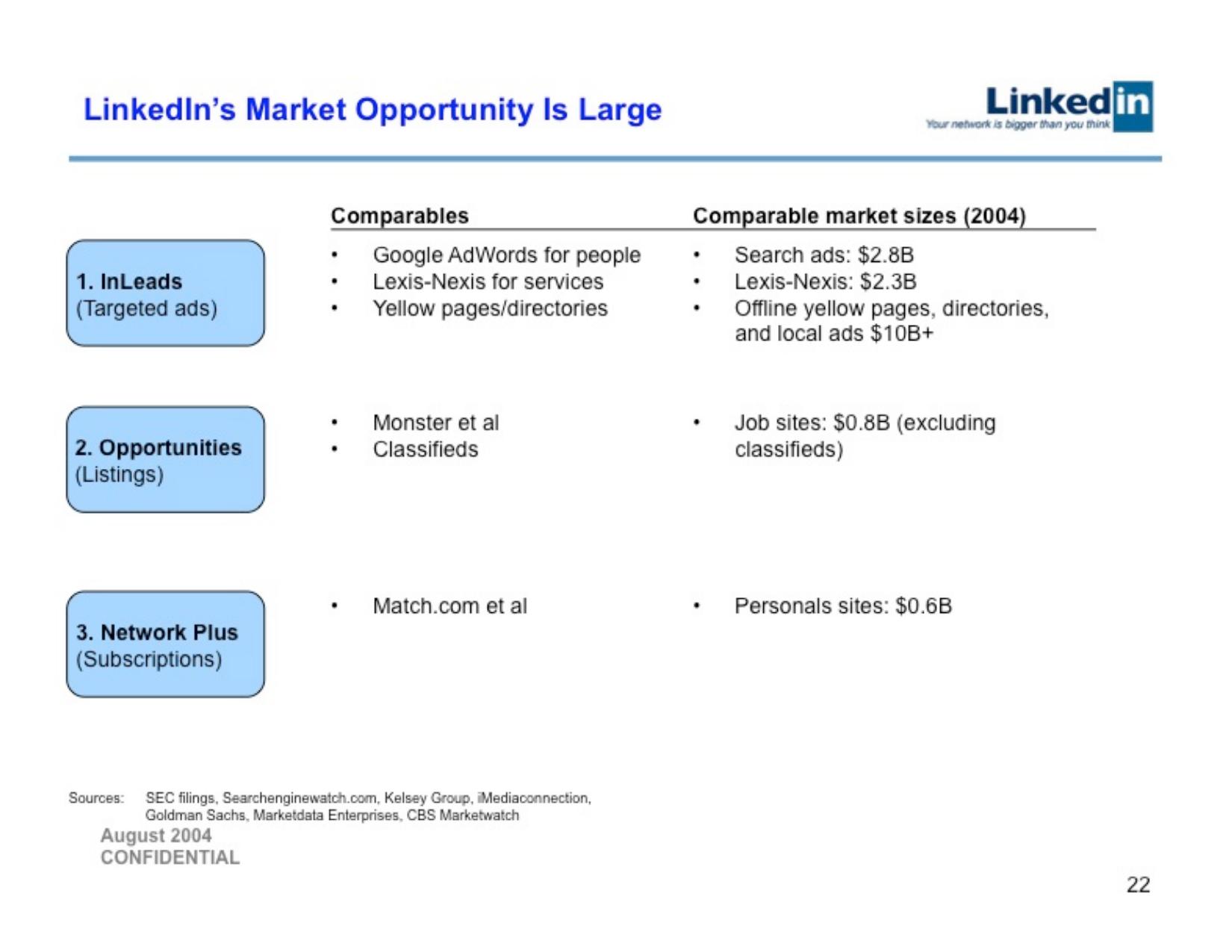
Anchors each revenue line to markets investors already sized. Job sites and personals are deliberately smaller, the deck spends more slides on recruiting than on ads.
Slide 23: InLeads product
Search UI mockup with sponsored profiles in results. 35K+ daily professional searches, 450K+ daily page views, plus a $100K+ closed-business testimonial.
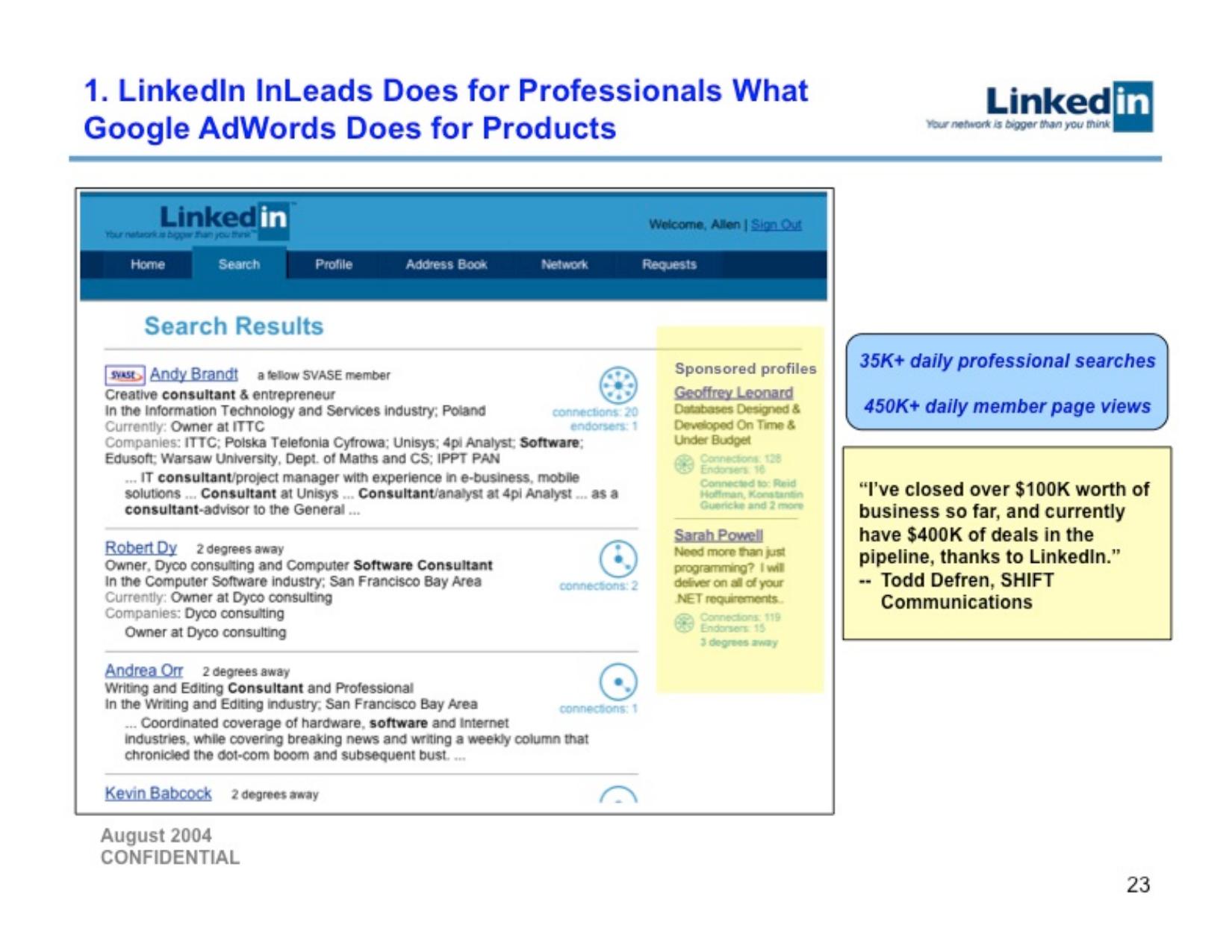
Mockup beats roadmap language. Led with AdWords analogy because every 2004 investor understood search ads; InLeads was never launched, recruiting became the real business.
Slide 24: InLeads market
Search advertising grows from $111M (2000) to $2.8B (2004E) in a stacked bar chart; LinkedIn targets white-collar CPCs of $2–$50 vs. $0.35 unfocused.
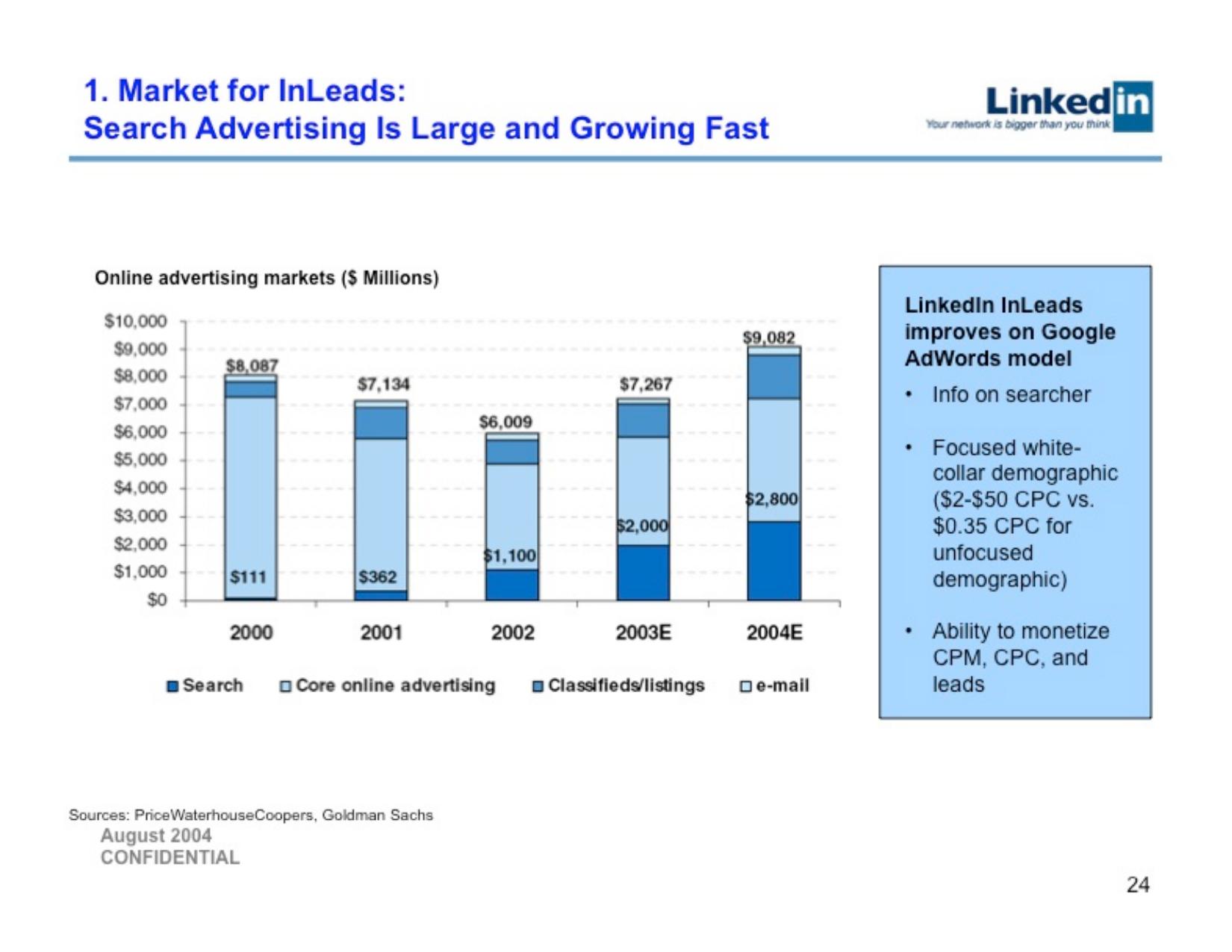
Trend chart makes a small current business feel inevitable. Demographic premium argument, professionals pay more per click, is the AdWords upside case in one sidebar.
Slide 25: Opportunities product
Mockups of network-filtered job postings (connections at the hiring company) and backdoor reference checking through shared employers.

Shows product-market fit for recruiting before revenue, jobs filtered through trusted paths beat Monster's resume warehouse. This is the slide Greylock's thesis rested on.
Slide 26: Recruiting testimonials
Three quotes on hiring via LinkedIn, saving $20K–$30K vs, headhunters, from a CEO, Netscape GM Jeremy Liew, and Akiba CEO Adam Honig.
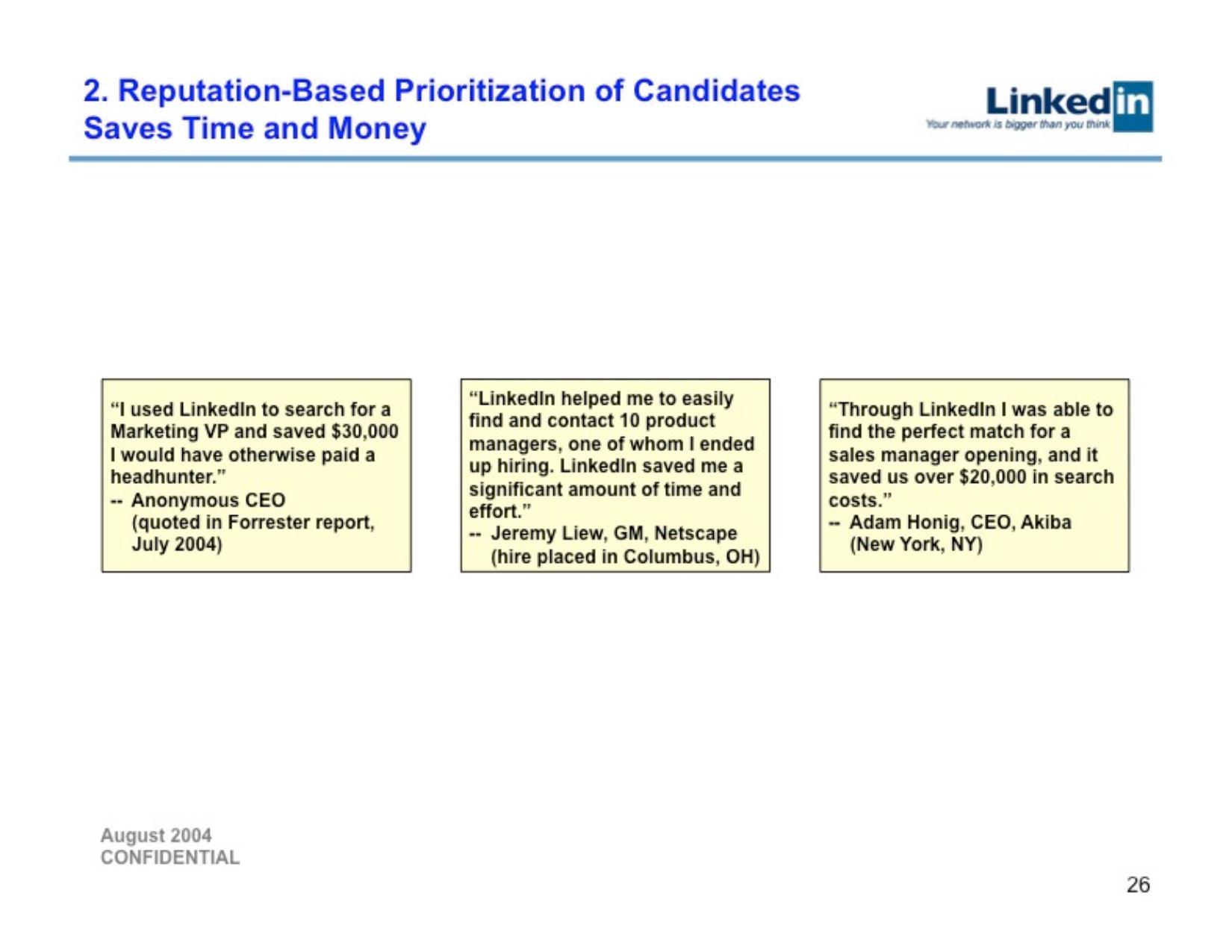
Hoffman calls this weak in hindsight, anecdotal quotes don't move skeptical investors. Works as social proof only if the buyer already believes network hiring saves money.
Slide 27: Job market size
Monster ($515M), CareerBuilder ($175M), and HotJobs ($94M) vs. LinkedIn at 0.3M monthly visitors, plus Forrester quote on passive candidate search.

Acknowledges LinkedIn is tiny on traffic but frames a lifetime relationship vs, transactional job boards. 20K+ contact requests/month shows intent even pre-monetization.
Slide 28: Network Plus product
Free users see three degrees; Network Plus extends visibility to four degrees, mockup plus testimonials from CNET, a consultant, and SoftTech VC's Jeff Clavier.
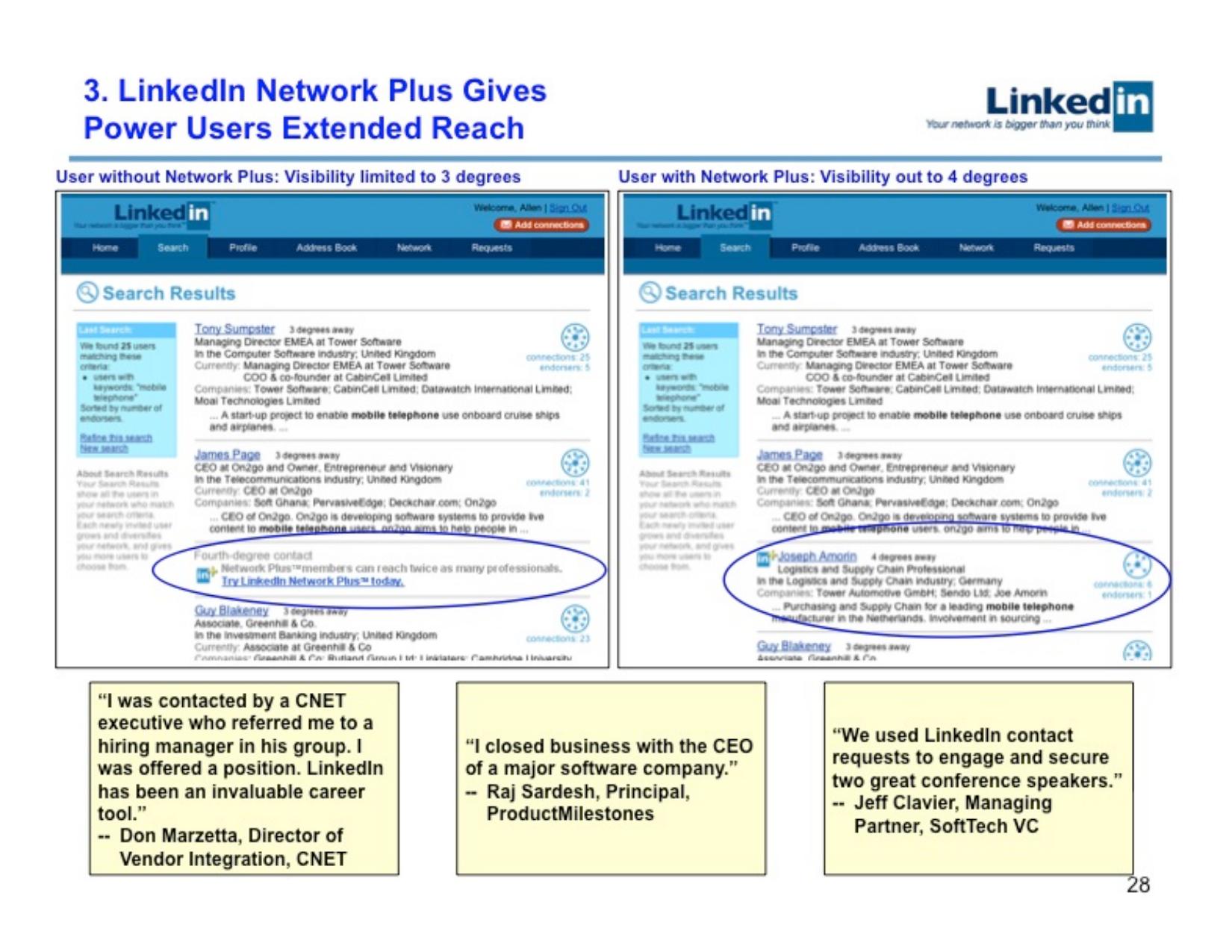
Freemium wedge explained visually. Underpromised four degrees publicly while planning broader paid access, classic under-promise, over-deliver for a trust-sensitive network.
Slide 29: Subscriptions market
Online personals revenue projected from $304M (2002) to $810M (2007E); 33K+ beta subscribers and U.S. News quote on referral-based job hunting.

Dating subscriptions proved consumers pay for connection online, unusual 2004 argument when most VCs saw ads as the only consumer internet model. LinkedIn helped change that assumption.
Slide 30: Revenue timeline
Pricing and launch dates: Opportunities listings at $79 in Nov 2004; InLeads CPC/CPM and Network Plus at $5.95/month launching Jan 2005; free tier stays live.
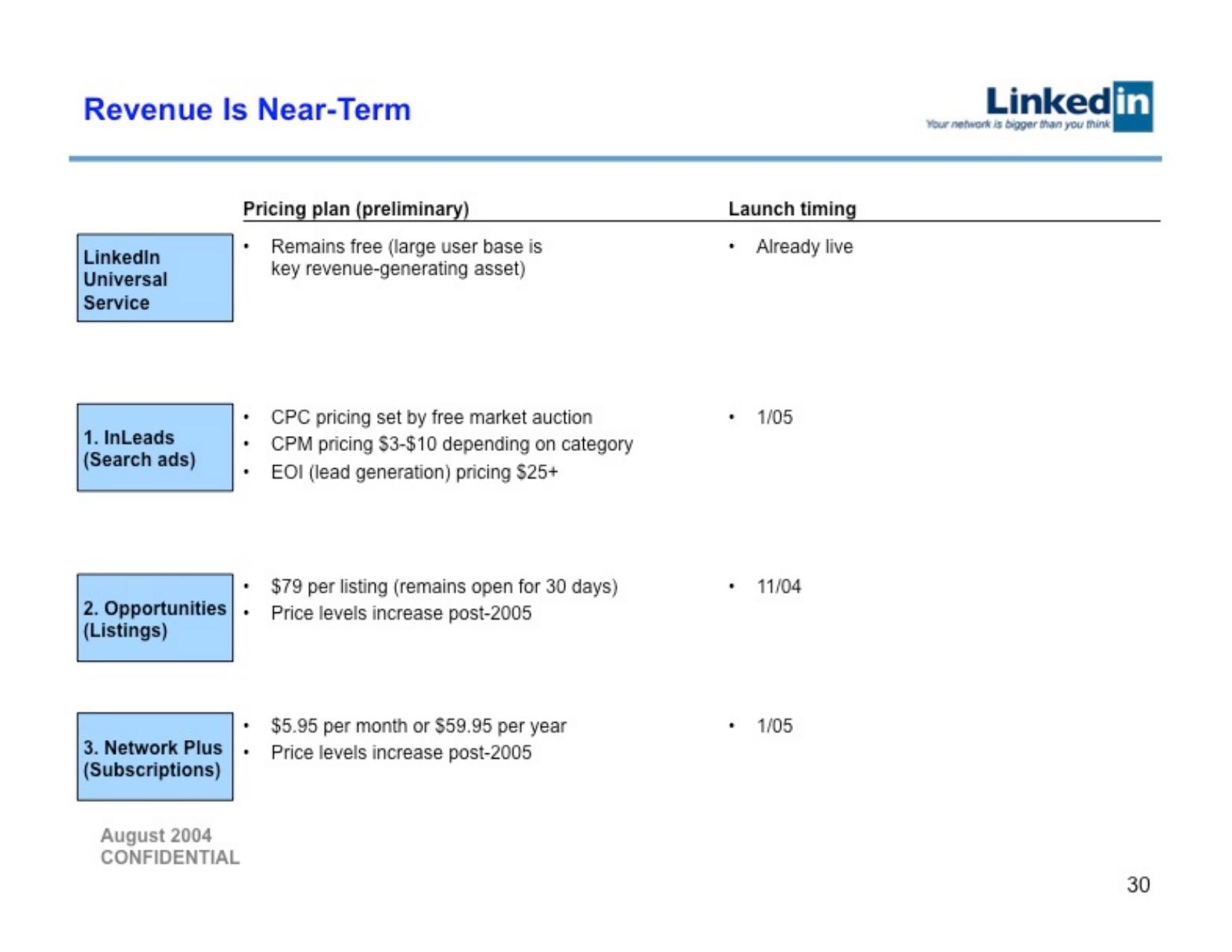
Decisive shipping calendar, specific dates signal execution discipline. Listings first because they show every member the network's hiring value before subscriptions scale.
Slide 31: Business model
Internet 2.0 model: high revenue potential across three products, very high margins on digital goods with free acquisition, execution gets easier as the network grows.

Margin story for a zero-revenue company, viral acquisition and zero marginal cost on transactions. "Very high" margins reveal Hoffman's revenue anxiety (he later wished he'd said "high").
Slide 32: Model assumptions
Conservative inputs: 3–13% monthly user growth, InLeads CPMs at $3–$5, $79 listings, 0.5–3.0% subscription conversion, all below current run-rate.

Assumptions slide investors skim but trust exists. Understated growth rates pass the blink test, founders who sandbag here earn room to beat plan in Series C.
Slide 33: Financials
Five-year table: users grow to 9.3M by 2007; revenue from $261K (2004) to $54M (2007); operating cash flow positive in 2005 at 4.4% margin, 73.9% by 2007.

LinkedIn hit operating profitability on roughly this path, rare for Series B projections. Hoffman redacted hyperbolic slides before publishing; even conservative numbers closed Greylock.
Slide 34: Team
Reid Hoffman (PayPal), Sarah Imbach (PayPal ops), Allen Blue (SocialNet), Jean-Luc Vaillant (Logitech), Konstantin Guericke, Eric Ly (Netmosphere), Matt Cohler (McKinsey).

Team slide late in the deck. Hoffman opens with thesis, not bios. PayPal alumni dominate; Matt Cohler co-built this deck and attended most pitches.
Slide 35: Investors
Board: Hoffman, Sequoia's Mark Kvamme, Ariba co-founder Rob DeSantis; angels include Peter Thiel, Marc Andreessen, and Joe Kraus. Series A was $4.7M from Sequoia.

Sequoia logo placement borrows tier-one credibility for a Series B raise. Angel roster reads like a 2004 Silicon Valley hall of fame, social proof that smart money already chose LinkedIn.
Slide 36: Investment summary
Three closing bullets: high-margin billion-dollar opportunity, clear market leader in a defensible space, strong team on less than $4M spent.

Closing thesis before the callback slide. Three lines an associate can repeat to the partnership, margin, moat, execution, without re-reading 36 slides.
Slide 37: Investment thesis
Find and contact the people you need through the people you already trust, network illustration with magnifying glass over connected profiles.

Reused from the pitch's conceptual opening and left up during Q&A. Bookends the deck so investors end on the professional-graph vision, not "Appendix" or "Questions."
What this deck teaches founders
- Steer into the investor's top objection first. Hoffman opened slide 2 with three revenue streams because post-crash VCs doubted consumer internet could make money.
- Pitch by analogy to companies investors already trust, eBay, PayPal, and Google each show how networks beat flat directories before LinkedIn claims the same pattern for careers.
- Show a promise kept from the last round. Series A growth projection vs, actual curve on slides 10–11 is worth more than any forward-looking hockey stick.
- Own a quadrant on the competition matrix, professional vs, social, internet service vs, enterprise software puts LinkedIn alone where the business model lives.
- Build the network first, monetize second, slides 9 and 19–21 argue reputation systems stay free while InLeads, Opportunities, and Network Plus sit on top.