
Airbnb
Airbnb Pitch Deck (2009)
Brian Chesky, Joe Gebbia, and Nathan Blecharczyk pitched Airbnb in 2008 and raised $600K after Y Combinator. Fourteen slides: problem, product, market, business model, team, and financials. No filler.
Stage · SeedIndustry · Hospitality
- Industry
- Hospitality
- Business model
- Online marketplace for lodging and travel experiences
- Raised
- $600K seed (2008 deck)
- Location
- San Francisco, California
- Website
- airbnb.com
Build your own deck in this order
Paste your company URL. Pitches AI writes a new 12-slide draft. Free to build.
Slide-by-slide breakdown
Slide 1: Cover
Book rooms with locals, rather than hotels.
The cover states the value prop in one line, no tagline soup.
Slide 2: Problem
Price anxiety, hotels disconnect you from culture, and no easy way to book with locals or become a host.

Three concrete pain points with bold keywords. Each problem is something travelers feel,
Slide 3: Solution
A web platform to rent space to travelers, save money traveling, make money hosting, connect with local culture.

Solution matches the three problems. Icons + short tiles keep it scannable before the product demo.
Slide 4: Market validation
Couchsurfing: 670,000 users. Craigslist: 17,000 temporary housing listings in SF and NYC in one week.

Validation uses real, named comparables, not vanity TAM. Shows demand existed before Airbnb scaled supply.
Slide 5: Market size
$2B+ trips booked worldwide → $560M budget/online segment → $84M serviceable share (15%).
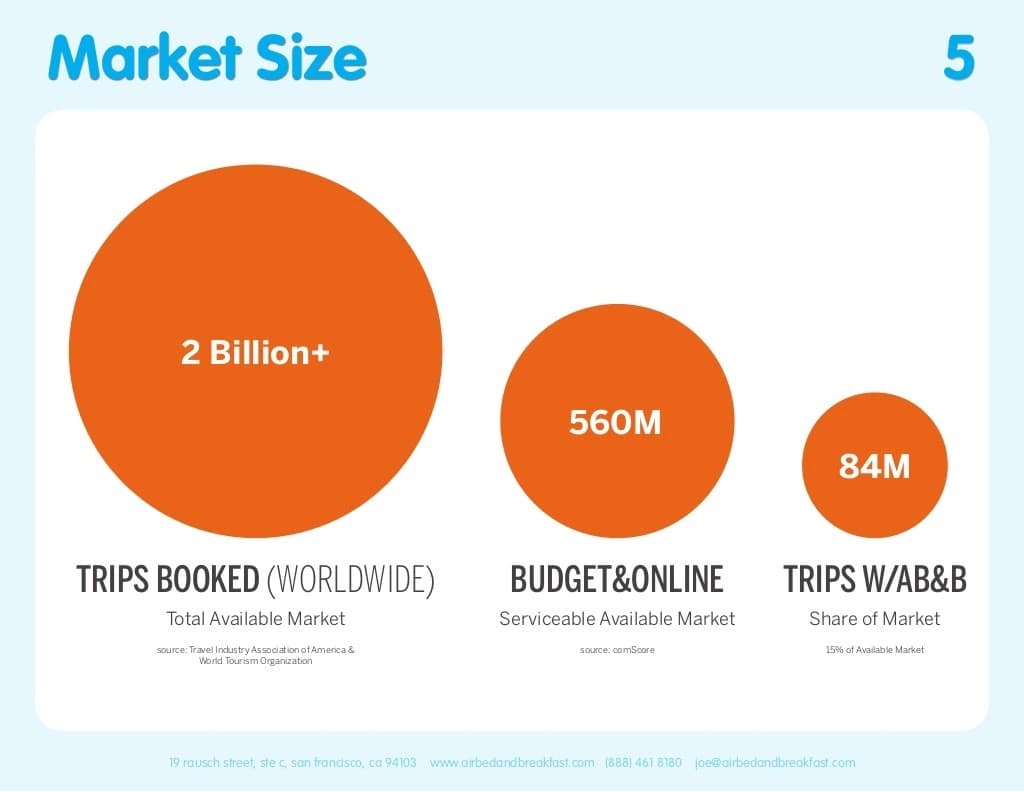
Classic TAM → SAM → SOM funnel with three numbers investors can repeat. Keeps ambition credible.
Slide 6: Product
Search-by-city interface with listings, map pins, and booking flow.

Product slide shows the actual UI, screenshots dominate. Shows the thing exists, not just the idea.
Slide 7: Business model
10% commission on completed bookings, host fee + guest fee on each transaction.

One killer metric slide: simple take rate, visual math to revenue. Investors remember this slide years later.
Slide 8: Market adoption
Events, partnerships, and classifieds as acquisition channels for hosts and guests.

GTM before competition, shows they thought about how to bootstrap liquidity on both sides of the marketplace.
Slide 9: Competition
2×2 matrix: temporary housing vs hotels, transactional vs non-transactional.

Positions Airbnb in an empty quadrant instead of a feature checklist. Makes the wedge obvious.
Slide 10: Competitive advantages
First transaction-based temp housing marketplace, host incentives, profiles, 3-click booking, search by price/location.

Six short advantages in a grid, defensibility without a moat essay. Each item is operational, not buzzwords.
Slide 11: Team
Brian Chesky, Joe Gebbia, Nathan Blecharczyk, design, business, and engineering from RISD/Harvard.

Real founders with specific credentials. YC-era decks win on team fit as much as market size.
Slide 12: Press
Early coverage from Mashable, Webware, Josh Spear, Springwise.

Social proof from era-appropriate tech press, shows traction beyond friends and family.
Slide 13: User testimonials
Quotes from early hosts and guests with photos and locations.

Human stories ground the metrics. Marketplace decks need both sides, supply and demand, saying yes.
Slide 14: Financial
Revenue projection path from early bookings to $200M, circles and arrows, not a dense spreadsheet.

Financial ask as a visual story, not a model dump. Shows ambition while staying on one slide.
What this deck teaches founders
- Name three problems travelers actually feel: price, disconnection from local culture, broken booking.
- Validate demand with real comparables (Couchsurfing users, Craigslist listings) before TAM slides.
- Classic arc: problem, solution, market, product, moat, team, ask.
- Business model slide: one take rate, simple math, one number investors repeat.